

London: Professor Nicolas Paz gives keynote address on nonviolence at Farm Street
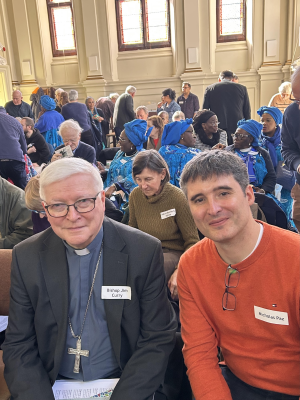
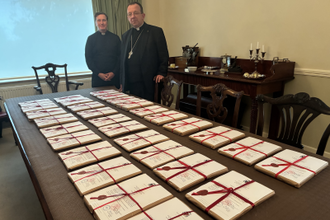
Bishop Jim Curry and Professor Nicolas Paz at the Farm Street event
Nonviolence is not weakness - it is action. Deliberate, organized, faithful, and rooted in the Gospel - that was the message from Professor Nicolas Paz, Director of the Catholic Nonviolence Initiative, and Associate Professor at the Pontifical University of Salamanca during his inspiring keynote address to a packed audience at an event at Farm Street Jesuit Centre last Saturday, organised by Pax Christi.
Nicolas pointed out that we live in a world that legitimises violence. With wars taking place in Gaza, Ukraine, Sudan, Myanmar DR Congo - now much of the Middle East is ablaze after the US and Israel attacked Iran, Lebanon and Syria.
"While it may seem counter-intuitive - growing evidence from empirical research shows that nonviolence strategies work - often better than armed responses. Neither passive nor impractical, there are numerous examples of this happening worldwide," he said.
"They say nonviolence in naive, but really war is naive."
But he pointed out, we can't deal with violence unless we recognise the violence in ourselves. Nonviolence must be a spirituality and way of life as well as a method for change.
Describing various non violent initiatives that have taken place around the world, Nicolas said: "We Catholics arrived late" but he added: "don't be afraid of arriving late!"
In the afternoon session, speakers focussed on non-violent responses to violence at a community level, and then at the more personal, family level.
Valerie Flessati, Vie president of Pax Christi England and Wales gave an account of how her parish, St Mellitus in Finsbury Park, north London, is responding to knife crime, through a number of initiatives to raise awareness about the danger of carrying knives. Whenever possible they hold a vigil in memory of those who have been killed nearby, as an expression of sympathy and solidarity with those who mourn. They have organised talks and peace walks, and in 2018 installed a weapons disposal bin with the help of the charity Word4Weapons. Within the first few months the bin collected more than 600 weapons. This initiative has been taken up by communities across the country. The parish is working with Caritas Westminster to share experience and plan further campaigning on this issue.
The next speaker was Nikki Dhillon Keane, from the National Board of Catholic Women. A psychotherapist, she founded the Safe in Faith network in November 2021, in response to the need for a faith-informed response to victims of domestic abuse - both physical and spiritual.
She told the story of a woman who turned to her parish priest after enduring over 25 years of dangerous abuse from her husband, only to be told to pray and thank God for her suffering. In desperation, she sought help from her local domestic abuse service, who advised her to give up her faith. As a result, she returned to her husband and endured five more years of abuse. "By the time she found informed help from within the Church, she was lucky to be alive."
Safe in Faith is building a network of counsellors, psychotherapists, pastoral workers, therapeutic practitioners, trainees and other helping professionals with an interest in working at the intersection of faith and domestic and sexual abuse. They are also building a directory of trained clergy and religious leaders (male and female) who can provide brief spiritual support and signposting for survivors of domestic abuse. (Anyone interested in joining these networks, or receiving training, should contact safeinfaith@rcdow.org.uk )
Bishop Jim Curry, lead Bishop for the Holy Land for the Bishops Conference, then spoke about his visit in January to the Holy Land by the Holy Land Co-Ordination group. Founded about 25 years ago, they visit Christian communities and projects in the Holy Land each year, to pray with them, visit holy sites, and encourage Christian pilgrims to visit - vitally important for local economy. Bishop Curry said they also advocate for the civil and human rights of all the Palestinian people, and a recognition of the Palestinian state - which has now come through. This was "a bittersweet moment" he said, because after the recognition of Palestine, the present government of Israel also allowed lots of illegal settlers to move into the West Bank building even more settlements - "compounding an already difficult situation."
"Our presence is our sign of solidarity." Bishop Curry said. "They are not forgotten. They are very much in our prayers, in our thoughts in our advocacy."
He pointed out that its is sad that there are many Christian communities around the world who still don't know about the Christians in Israel, Jordan, Palestine, Syria, Lebanon. "So many people think Christianity was an import. not an export," he said.
During their last visit in January, the bishops met Patriarch Sabah, now in his 90s, one of the contributors of the original Kairos document which called for the world to respond in a more robust way to the suffering of people in South Africa. He has now contributed to the second Kairos document which has been been signed off by many theologians. Bishop Curry said this is a "challenging document to any Christian from Europe or America because it uses terms like 'Apartheid' and 'Genocide' and calls for supporting of sanctions and boycott of Israeli goods. He said: "Patriarch Sabah sat with us for 45 minutes, reflecting on the situation of Christians in the Holy Land. When we asked about the document he said 'don't be put off by the way its written. This is the voice of indigenous people calling out to you to respond in some way.'"
Bishop Curry said: "There has been a change in tone. In the past Christian leaders would ask us not to say anything that would make their lives more difficult, but now they are desperate for us to do something."
The explosion of the current conflict has stopped pilgrims from visiting the Holy Land, he said. "Christians - not just Christians - anyone who is not part of the State of Israel who wants to see a future for their children are leaving."
Bishop Curry said in Israel there was very little dialogue between Israelis and Palestinians. Those who speak of peace are being ignored and shunned. He described how people on both sides are traumatised. Locked into silence.
Yet Caritas continues education and healthcare to Christian and Muslims throughout the West Bank, Gaza and Israel. Patriarch Saba said "We are grains of sand but we are effective."
Bishop Curry said the Bishops have asked the British government to come down heavily on the settlers; stop all the settlements. People afraid of being called anti-Semitic, he said, but he stressed that a criticism of the present government in Israel is not a criticism of the Jewish people of Jewish faith.
Bishop Curry asked: How do we be peacebuilders when "the forces of law have been replaced by the law of force.". ."What happens when international law is being disregarded? Just because the law is being disregarded we have to hang on to it. We still believe in the law. We need to keep pressuring our MPs, to advocate in pub conversations.
"And there is a need to reach out to the Jewish community in this country in friendship - and assure them that our criticism of Israel is not a criticism of them."
Commenting, Nicolas Paz said: "non violence is not always nice. Boycott is not nice. But is a matter of proportion. We are talking about trying to stop a genocide... I've been involved a lot trying to change anti-Semitic behaviour and ideology in Spain. That is nothing to do with what is going on in Gaza, so we really need to step up our actions, because the level of violence is so high we cannot do nice things. .... The flotilla really helped. Campaigning against the arms trade needs to scale up. we need to upgrade our non violence - the more we do that, the more lives we are saving."
At the end of the day Sr Katrina Alton, a Sister of St Joseph of Peace and Chaplain to Pax Christi led a prayer reflection, saying "We are called by Jesus to be living disciples, intentional, deliberate. We choose life.... We choose non-violence."
After his visit to London, Nicolas Paz went on to speak and lead workshops in Leeds and Liverpool.
LINKS
- In a world shaped by violence in words, systems, and wars, this short film which was shown at the conference reminds us that true strength lies in love, courage, and the commitment to build peace. Watch and share Why Nonviolence Now? - a call to live the Gospel of peace in our time. www.youtube.com/watch?v=P7SyEtOoJ9Q
- For more resources see: https://paxchristi.org.uk/resources/nonviolence-in-action/educational-resources-for-nonviolence/
- Professor Nicolás Paz - Why 'Nonviolence' Is More Effective, Even in a Violent World
www.pressenza.com/2025/05/why-nonviolence-is-more-effective-even-in-a-violent-world/
- Safe in Faith - https://caritaswestminster.org.uk/news/acc-fellowship-for-founder-of-safe-in-faith/
 Facebook
 Twitter
 LinkedIn
 Print
Print Email
Email







 Facebook
 Twitter
 YouTube
 LinkedIn
 Pinterest