

Viewpoint: Nonviolence - a way of being, a test of faith
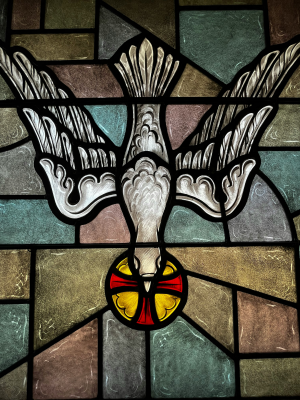
Photo by David Bumgardner on Unsplash
In Brian Friel's play 'The Enemy Within' the dramatized character Columba (the Irish Abbot of the Monastery at Iona) is pressured by his brother and nephew to return to Ireland to lead upto fifty armed-clansmen 'straining for bloodshed' in order to rescue his Christian grand-nephew and niece-in-law held captive by 'heathen Picts' in Antrim.
The raid would also confirm the clan's power and dominance, and enable the seizure of land and 'booty', as Antrim is 'rich'.
The pressure inflicted on Columba is harrowing and causes him great distress. He is told that without his holy presence and leadership there will be unbridled 'killing, torture and death', that 'men will die in their sins and be damned forever' that this is 'God's cause'.
Columba refuses. He'd yielded to pressure to fight before. He pleads with them that he must finally listen to his soul, that 'whispers' - and he shows them his arms 'scarred by the wounds of battle', saying that he is an old man now, that his final years must be devoted entirely to Christ.
He proceeds to encourage talks with the Picts, and offers to personally conduct negotiations with their leader - but they do not hear this. Unable to pressure Columba, they condemn him, curse him, and call him a 'coward' and a 'traitor' before leaving Iona for the final time.
They are men wedded to the cycle of violence, conquest, murder and looting - for them it 'is a way of being'.
For Columba it was the greatest test of faith.
For Pope Benedict XVI however, it is nonviolence that 'is a way of being' - and for us the greatest test of faith.
During an Angelus in February 2007, he said that 'one understands that for Christians, nonviolence is not merely tactical behaviour but a person's way of being - the attitude of one who is so convinced of God's love and power that he is not afraid to tackle evil with the weapons of love and truth alone'.
I recently read with concern and interest an article titled 'What realistic nonviolence looks like in an age of war' by John Noble (an American Catholic peace activist) in the June edition of US Catholic magazine.
In the piece Mr Noble conducts interviews with several 'Christian nonviolence advocates' and finds amongst them a diverse 'interpretation' of Christian teaching on the subject.
I must assert that there is only one possible 'interpretation' of nonviolence, and this is revelation itself. Nonviolence is 'a way of being' as it is rooted in the person of Jesus, His teaching and practice - the one definitive and eternal word given to humanity.
During the interviews, one voice took the view that there are instances in which 'violent or armed self-defence can be necessary, and aligned with Christian morality'.
Another determined that there was 'a tendency, often from a place of privilege, to declare violent resistance categorically and universally immoral, regardless of context'.
The Catholic priest Camilo Torres was also invoked during interview. Fr Torres had taken up arms in Columbia when state repression made nonviolent resistance 'untenable'.
So, we have a problem. God's will can be cast aside, becomes subject to negotiation, to context. It is Man firmly in control, deciding himself if God's will is 'tenable' or 'realistic'. Humanity of course is on familiar ground here - it's preferred ground in fact - as the serpent coils its way around Man's neck.
"Thou shalt not kill. Love one another as I have loved you".
Christ demands the seemingly impossible. This is especially so when violence, injustice and oppression crush us, dehumanize us - and our hearts ache to overthrow evil.
As Fr Daniel Berrigan once observed, it is at moments such as these that we may be tempted to 'paint a gun into the open hands of Christ, to disappear into bloody secular history'. To extend Fr Berrigan's point, we try to handle both gun and gospel, but cannot - and drop the gospel.
We can see how fatally easy it is for phrases such as; 'legitimate violence', 'limited retaliation', 'just war' and 'God's cause' to rationalize our violence, to make sense of it all, to satisfy us of the right to exact our own justice.
Yet, at the point of greatest temptation, the way to demonstrate the greatest faith lies open to us. To say, Lord "I have done everything you ask of me, everything humanly possible to love, to not yield to this unbearable temptation. I entrust this bloodshed to your hands - to divine justice".
To those who retain the view that our refusal to take up bombs or guns, aimed at the flesh of brothers and sisters is utopian or naive, I offer the following words from Pope Francis in Fratelli Tutti.
"Every war leaves our world worse than it was before. War is a failure of politics and of humanity, a shameful capitulation, a stinging defeat before the forces of evil.
Let us not remain mired in theoretical discussions but touch the wounded flesh of the victims.
Let us ask the victims themselves. Let us think of the refugees and displaced, those who suffered the effects of atomic radiation or chemical attacks, the mothers who lost their children, and the boys and girls maimed or deprived of their childhood.
Let us hear the true stories of these victims of violence, look at reality through their eyes, and listen with an open heart to the stories they tell. In this way, we will be able to grasp the abyss of evil at the heart of war.
Nor will it trouble us to be deemed naive for choosing peace".
Craig RA Hesketh is a member of Pax Christi UK, and a former trade union official.
 Facebook
 Twitter
 LinkedIn
 Print
Print Email
Email













 Facebook
 Twitter
 YouTube
 LinkedIn
 Pinterest