


Gospel in Art: So when the plants came up
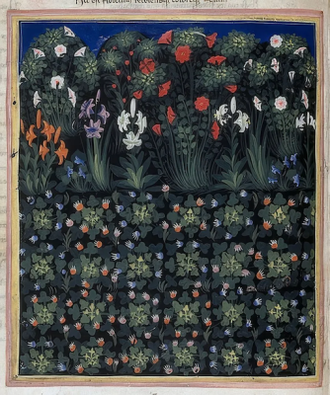
Garden (From Regia Carmina di Convenevole da Prato), by Pacino di Buonaguida, 1340 © British Library
Source: Christian Art
Gospel of 19 July 2026
Matthew 13:24-30
At that time: Jesus put another parable before the crowd, saying, 'The kingdom of heaven may be compared to a man who sowed good seed in his field, but while his men were sleeping, his enemy came and sowed weeds among the wheat and went away. So when the plants came up and bore grain, then the weeds appeared also. And the servants of the master of the house came and said to him, "Master, did you not sow good seed in your field? How then does it have weeds?" He said to them, "An enemy has done this." So the servants said to him, "Then do you want us to go and gather them?" But he said, "No, lest in gathering the weeds you root up the wheat along with them. Let both grow together until the harvest, and at harvest time I will tell the reapers, 'Gather the weeds first and bind them in bundles to be burned, but gather the wheat into my barn.' " '
Reflection on the Illuminated Manuscript Page
In today's Gospel, there is a striking difference between the landowner and his servants. When the weeds begin to appear among the wheat, the servants want to pull them out immediately. Their instinct is to create a perfectly pure field without delay. The landowner, however, responds with patience. He allows the wheat and the weeds to grow together, trusting that, at the time of harvest, the separation will happen naturally and the good grain will remain.
Jesus uses this image to teach us something about the Kingdom of God and about the Church. Until the end of time, the Church will always contain both holiness and human weakness. Likewise, each one of us carries within us both grace and frailty. We strive to become ever more like Christ, yet we recognise that our journey of conversion is lifelong and that perfection belongs to eternity rather than to this present life.
The Lord deals with us in the same way as the patient landowner. He does not abandon us because of our shortcomings, nor does he expect instant transformation. Instead, he continues to nurture the good within us, allowing it to mature and bear fruit. We, too, are called to show that same patience: towards ourselves and towards others. This is not an excuse for complacency, but a humble acknowledgement that every disciple is still being shaped by God's grace. We are all, in the truest sense, works in progress.
Our medieval illuminated miniature, painted by Pacino di Buonaguida, presents us with a garden in perfect harmony. Executed in tempera and gold leaf on parchment, every plant seems carefully ordered, every flower in its proper place, and not a single weed appears to disturb the beauty of the scene. Pacino was one of the great Florentine artists of the early fourteenth century. His garden is less a portrait of the world as it is, and more a glimpse of the world as God intends it to be.
We long for gardens without weeds, for lives without struggle, and for communities without faults. Yet the Gospel reminds us that such perfection belongs not to the present age but to the final harvest. The Church on earth is not yet the finished garden either; neither are we. For now, the Divine Gardener patiently tends his creation, nurturing the wheat even as it grows alongside the weeds, until the day when all things will finally blossom in the fullness of his Kingdom.
LINKS
Christian Art: www.christian.art
Today's image: https://christian.art/daily-gospel-reading/matthew-13-24-30-2026/
 Facebook
 Twitter
 LinkedIn
 Print
Print Email
Email

















 Facebook
 Twitter
 YouTube
 LinkedIn
 Pinterest