

Sunday Reflection with Canon Robin Gibbons: July 19, 2026
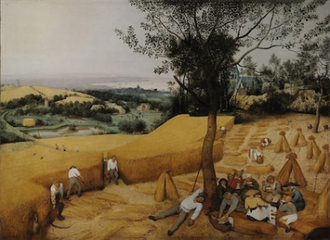
Pieter Bruegel the Elder- The Harvesters. Metropolitan Museum of Art New York
Sixteenth Sunday in Ordinary Time
1.Romans 8: 26-27
The work of the Spirit
"Brothers and sisters:
The Spirit comes to the aid of our weakness;
for we do not know how to pray as we ought,
but the Spirit himself intercedes with inexpressible groanings.
And the one who searches hearts
knows what is the intention of the Spirit,
because he intercedes for the holy ones
according to God's will".
This short passage from the letter to the Romans ought to become one of those passages from Scripture that anyone involved in pastoral care should keep in their memories and heart . I find it expressly comforting and meaningful from the experience of somebody who has just been a postoperative resident in St Luke's Hospital Oxford. I found that my prayer at this time of recovery and in this type of situation has not been easy, because pain and the attendant difficulties of dealing with physiotherapy and rehabilitation takes all the energy out of one. So, for me this passage, and particularly the focus on that phrase about the inexpressible groanings of the Spirit, can be directly linked to my own and others inner and outer groaning from the pain of our different medical situations.
It is consoling in a setting where different kinds of illness, disability and also confusion after strokes, is present and makes the individual patient vulnerable and helpless. Here is certainly a sacred space where the `Spirit is interceding through and in those who suffer, a true spirituality of sharing in the kenosis of Christ, becoming humbler yet! A holy place where we simply have to let go, because there is no other way, and trust that God in the Spirit may enter into the rawness of our condition.
2. The merciful harvest
But what a contrast this passage from Romans is with Jesus' parable of the weeds sown amongst the wheat which is part of the gospel today. It is one of the many sayings about the Kingdom that form this section of Matthew's gospel, all of which demand from us quiet reflection on how good and evil co-exist, but how the leniency of God in this parable allows a different kind of reckoning to what many of us who are religious people would prefer, instead of a tangible, acknowledged form of punishment for wrongdoing Jesus points out that the Lord of the Harvest waits until harvest time itself to sort out the weeds, but we need to be alert for this harvest time is not at all what we might expect.
Matthew tells us why through the words of Jesus: "The harvest is the end of the age,* and the harvesters are angels. Just as weeds are collected and burned [up] with fire, so will it be at the end of the age. The Son of Man will send his angels, and they will collect out of his kingdom* all who cause others to sin and all evildoers".(Mt 13:39b-41)
This is a God whose patience is more than ours, whose openness to those seeking forgiveness is endless, whose leniency stretches to encompass all of our wrongdoings, yes ours as well , this is exactly as our first reading tells us:
"But as you are righteous, you govern all things righteously;
you regard it as unworthy of your power
to punish one who has incurred no blame.
For your might is the source of righteousness;
your mastery over all things makes you lenient to all.
(Wis 12: 15,16)
3. The gift of the Spirit our advocate
This story of the harvest at the end of the ages brings us back to an abiding gift that we have been given. We might be part of the weeds of life at times, we hope we are wheat, a good harvest, but in our difficult times, when we feel bewildered, lost or in need of forgiveness, there is that gift of the Spirit deep within our being that is always with and in us to speak for us, to articulate the confused 'groanings' of our muddle and distress. When you are down, try to remind yourself that one of the titles of the Holy Spirit is paraclete. This is a wonderful name for the Spirit's role with us in human life : it comes from the Koine Greek word paráklētos, meaning "one called alongside to help". In our Christian tradition, it is a title used for the Holy Spirit and which we translate as our advocate, helper, or comforter. Whatever we may think, the work of the Spirit continues in all places, with all people and at all times.
It is good to awaken in our own lives a devotion to the third person of the Triune God, and to obtain the Paraclete's help all we need to do is pray; "Come Holy Spirit". This action of the Spirit as our comforter and helper was understood and written into a poem by the 17th century Anglican priest and poet Robert Herrick, the opening lines take us to the heart of what we wish and trust that the Comforter will be and do for us:
" In the hour of my distress,
When temptations me oppress,
And when I my sins confess,
Sweet Spirit, comfort me!"
May we become part of the good harvest for the Kingdom and in times of difficulty and need may the comfort of the Sweet Holy Spirit remain with us always. Amen
Lectio Divina
Prayer to the Holy Spirit from the Eastern Liturgies
"O Heavenly King, the Comforter, the Spirit of Truth, who art in all places and fillest all things, Treasury of blessings and giver of life: come and dwell in us, cleanse us from every stain, and save our souls, O gracious Lord."
Pope Francis
General Audience August 24th 2022
When Jesus speaks of the Kingdom of God, he describes it as a wedding feast; as a party with friends; as the work that makes the house perfect. It is the surprise that makes the harvest richer than the sowing. Taking seriously the Gospel words about the Kingdom enables our sensitivities to enjoy God's working and creative love, and puts us in tune with the unprecedented destination of the life we sow. In our old age, my dear contemporaries - and I speak to the old men and old women - in our old age, the importance of the many 'details' of which life is made - a caress, a smile, a gesture, an appreciated effort, an unexpected surprise, a hospitable cheerfulness, a faithful bond - becomes more acute. The essentials of life, which we hold most dear as we approach our farewell, become definitively clear to us. See: this wisdom of old age is the place of our gestation, which illuminates the lives of children, of young people, of adults, of the entire community. We, the elderly should be this for others: light for others. Our whole life appears like a seed that will have to be buried so that its flower and its fruit can be born. It will be born, along with everything else in the world. Not without labour pains, not without pain, but it will be born (cf. Jn 16:21-23). And the life of the risen body will be a hundred and a thousand times more alive than we have tasted it on this earth (cf. Mk 10:28-31).
ROBERT HERRICK
Litany to the Holy Spirit
In the hour of my distress,
When temptations me oppress,
And when I my sins confess,
Sweet Spirit, comfort me!
When I lie within my bed,
Sick in heart and sick in head,
And with doubts discomforted,
Sweet Spirit, comfort me!
When the house doth sigh and weep,
And the world is drown'd in sleep,
Yet mine eyes the watch do keep,
Sweet Spirit, comfort me!
When the passing bell doth toll,
And the Furies in a shoal
Come to fright a parting soul,
Sweet Spirit, comfort me!
When the tapers now burn blue,
And the comforters are few,
And that number more than true,
Sweet Spirit, comfort me!
When the priest his last hath pray'd,
And I nod to what is said,
'Cause my speech is now decay'd,
Sweet Spirit, comfort me!
When, God knows, I'm toss'd about
Either with despair or doubt;
Yet before the glass be out,
Sweet Spirit, comfort me!
When the tempter me pursu'th
With the sins of all my youth,
And half damns me with untruth,
Sweet Spirit, comfort me!
When the flames and hellish cries
Fright mine ears and fright mine eyes,
And all terrors me surprise,
Sweet Spirit, comfort me!
When the Judgment is reveal'd,
And that open'd which was seal'd,
When to Thee I have appeal'd,
Sweet Spirit, comfort me!
 Facebook
 Twitter
 LinkedIn
 Print
Print Email
Email











 Facebook
 Twitter
 YouTube
 LinkedIn
 Pinterest