


Reflection on Methodist conference on Palestinian Christians
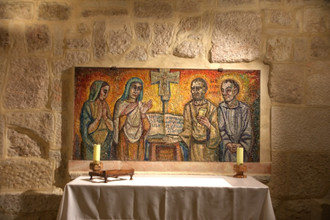
Altar in the Church of the Nativity, Bethlehem. Photo by Dawn McDonald on Unsplash
On the eve of the Anglican Synod Debate on Palestine currently taking place, (July 10-14) - Ann Farr reflects on the Prayers and Bible Study used at the recent Methodist Church Conference, that she attended as an Observer and where the Palestinian Christian cry, in 'Kairos Palestine 11 - A Moment of Truth: Faith in a Time of Genocide' was presented and overwhelmingly accepted.
Ann writes: The theme of Conference was 'Sorrow, Joy' and on the day when the voice of Palestinian Christians was to be heard, the opening prayers were led by Rev David Hardman, Methodist Liaison Officer in Jerusalem and Fr Fadi Diab, the Rector of St Andrew's Episcopal Church in Ramallah, who would later speak on behalf of Palestinian Christians.
We were invited to 'Hear what God the Lord will speak'. The Gospel Reading was of Jairus and his daughter and the healing of the woman with a haemorrhage (Luke 8:40-56).
In his reflection on this, Rev David said: "this story of Jesus confronts us with a truth we would rather ignore: sorrow and suffering, and therefore joy, are woven into the human condition. They do not belong to one people more than another. They are not the possession of the powerful, nor the burden only of the weak. They belong to all of us.
And yet, how quickly we forget.
When we speak of sorrow in Palestine and Israel, we are tempted to weigh suffering and sorrow, to measure it, to trade it, to use it against each other. We weaponise grief to win arguments, to secure votes on conference resolutions, and even to justify silence. But suffering is not a currency to be spent. Every time we treat it as such, we diminish the humanity of another and our own.
Croatian theologian Miroslav Volf warns, in his work Exclusion and Embrace, that after suffering there comes a dangerous temptation: to make your own sorrow and pain the measure of all sorrow and pain. To declare your pain incomparable. To insist that what has happened to you stands above all others suffering. This is the moment when the heart hardens, there is no embrace, division deepens, and the other is no longer seen as human but as a threat, as an enemy, as less - there is exclusion - and the Wall is built.
The sorrow of the Holy Land cries out - from Palestinian and Israeli, from Muslim, Jew, Christian and all who call the land home. It is heard in refugee camps, from below the rubble, in cities, and across the world. Sorrow and joy are not simple opposites; they are entangled, complex, and often unequally borne. One person's sorrow may stand as a direct result of another's joy.
And let us be clear: sorrow here is not abstract - it has names - and graves. 72 thousand killed in Gaza and counting, homes reduced to dust and futures erased. West Bank communities and land lost through violent Israeli settler action, annexation and confiscation. And, too, the deep and devastating loss of Israeli lives, mourned in Israel and in Jewish communities worldwide.
These are not competing truths. They stand together and they accuse us when we acknowledge only one.
The Gospel places before us an image we cannot evade. Two figures approach Jesus.
Jairus, a man of status (the narrative names him), a leader. He walks openly through the crowd. He is seen. He is recognised. The way is made for him. He speaks, and he is heard.
And then, the woman. Twelve years of bleeding. Twelve years of exclusion. 2000 years unnamed. She does not walk openly; she hides. She presses through unnoticed. She reaches out, not to be seen, but to seek healing and a secure future. A future free of exclusion and sorrow, a future of healing and embrace.
Two encounters. Two sorrows.
One public, one hidden.
One carried with authority, one buried in silence.
And yet Jesus refuses the hierarchy we so easily create. He does not measure their sorrow. He does not rank their worth. He heals both.
But more than that - he stops.
He stops for the one the crowd does not see.
He calls her forward. He brings her from the margins into the crowd's focus. He restores not only her body but her dignity. He names her faith before all who would have ignored her.
This is the pattern of the Kingdom of God.
Now hear this clearly: there are those today who come like Jairus - visible, powerful, able to command attention. And there are those who come like the woman - unseen, unnamed, pressing forward from the edges of the world, hoping that even an anonymous touch might bring healing.
Among many in the world, Palestinian Christians, and Palestinians more broadly, speak from that place of marginalisation - of displacement, of occupation, of daily vulnerability. Their cry is not abstract. It rises from lived experience.
To acknowledge this is not to deny Israeli suffering. It is not to erase Jewish grief or fear. But it is to refuse the lie that recognising one pain cancels another. Truth does not demand silence; it demands courage.
The lived experience of Palestinians is on the painful margins, in the shadows of suffering & sorrow - yet a cry emerges from this place and from a faith that refuses to be ignored. Somewill hear it as protest. Some will resist it. But it is, at its heart, a call not to hatred and exclusion, but to embrace justice, dignity, and shared humanity. It is reaching out to touch the hem of the worldwide church in the faithful hope that not just Christians may be healed, not just Palestinians may be healed but that the Holy Land and all its people WILL be healed.
This cry is the Kairos II document and it declares:
'From the heart of pain, genocide and displacement, we raise this cry - a prophetic cry of steadfastness. We declare our commitment to work for the good of this land and of all humanity on the basis of our shared humanity until the day we live free in our land together with all the inhabitants of the land in true peace and reconciliation founded on justice and equality for all God's creation, where mercy and truth meet and righteousness and peace kiss each other'. (Psalm 85:10) (Kairos II 4.5)
This is not the language of exclusion. It is the language of embrace - hope forged in suffering and sorrow.
The woman reached out, unseen, to Jesus for healing. Jesus healed her body - and today, Palestinian Christians, often unseen, reach out, not only for their own healing, but for the healing of the land, for the healing of all its people.
And so the question is not only about them. It is about us.
Do we only see and hear the approach of the powerful and take account of their suffering?
If we do hear the cry of the marginalised, do we judge their sorrow differently?
Will we, like Jesus, amplify the cry of the oppressed and marginalised for all to see their faith?
Or will we turn away, protecting our comfort, preserving our tired narratives, and leaving the unnamed unseen?
The promise of God's Kingdom stands before us still: embrace not exclusion, a world remade, where enemies are reconciled, where justice and peace are no longer distant hopes but living realities. As Isaiah 11 states; 'The wolf shall live with the lamb, the leopard shall lie down with the kid… they will not hurt or destroy on all my holy mountain' - on Zion.
The call is urgent.
To recognise the humanity of all.
To honour the suffering of all.
To stand with Christ healing both the powerful and the marginalised.
Yet, it must be more than this - God calls us…
To notice the reach of the oppressed for healing and justice.
To allow their voice at the margins to refocus ours and the world's attention.
To make room for restoration, not only for their body, but for their dignity too.
To honour their faith before all who would ignore them.
Tomorrow, on Sunday evening, those at the Church of England General Synod will also hear Fr Fadi present the cry of Palestinian Christians and the Carlisle Motion will be heard.
Rev Richard Sewell, Dean of St George's College, Jerusalem, writes in an Open Letter to Synod:
"I am aware that pressure has been exerted on General Synod from various quarters both within the Church of England and from some Jewish sources too. This appears to seek to delegitimise the value and truth of these statements and predicts all kinds of harm that may result even from discussing the Carlisle Motion. I implore you not to heed such advice. Lobbying tactics must not silence the raw truth of the Kairos Palestine call."
Let us hope that Richard's plea is heard and heeded and let us join in prayer that in this Kairos moment, Synod Members will have the courage to stand where Christ stands, to speak truth with love, to lift up the wounded and work for a peace that is rooted in justice for all who call the Holy Land Home.
Fr Fadi's Address to Methodist Conference, Recording, 28 mins in: www.methodist.org.uk/about/structure-and-governance/the-methodist-conference/conference-2026/watch-again/
Methodist Conference Bible Study Recording, 17 mins in: www.methodist.org.uk/about/structure-and-governance/the-methodist-conference/conference-2026/watch-again/
Richard Sewell's letter in full:
Church Times: "British have a historic obligation to end occupation of the West Bank, says Palestinian priest."
 Facebook
 Twitter
 LinkedIn
 Print
Print Email
Email













 Facebook
 Twitter
 YouTube
 LinkedIn
 Pinterest