


Sunday Reflection with Canon Robin Gibbons: July 12th 2026
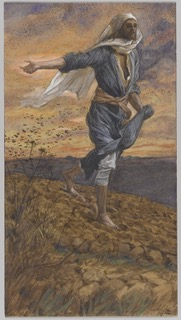
The Sower, James Tissot, Brooklyn Museum
15th Sunday in Ordinary Time
1. Becoming open to the healing Word
I continue to write from St Luke's Hospital in Headington, where my recuperation and rehabilitation after my knee replacement continues. So I share my thoughts particularly with any of you who are house bound, undergoing some form of recuperation after illness, or face changed circumstances, particularly that of losing independence even for a while.
There is a long and good tradition of those who are sick being understood in an expressly overt way, as a particular presence of the Christ amongst us. I believe it comes from the mixture of our human frailty, dependency on others, suffering of one kind or another that mixed together brings the patient very close to the suffering and humility of Christ, so that the embrace of the Cross becomes very much part of their inner struggle and outer adjustment, even if they do not know or understand it as such.
The Abbot Benedict, whose feast we celebrated yesterday, understood this powerful charism of the sick, for in chapter 36 of his Rule he makes this powerful statement: "Before all things and above all things care must be taken of the sick, so that they may be served in very deed as Christ himself." This of course is not just his own insight, he takes his cue from the Christ the Word: shown when Benedict then adds these inclusive words, "for he said: I was sick and you visited me; and, whatever you did to one of these least ones you did it unto me".
Here set out before us in those words about the sick, I can also find the context of this Sunday's parable of the sower as discerned in the situation of illness, seen through the lens of semi-helplessness. Through the monastic tradition and practice of Lectio Divina I find that Benedict, as a true listener of the Word, having heard, ruminated and understood the teaching of the Scriptures, then applies its message to life. Suddenly the explanation of Jesus to his disciples about the different approaches to receiving the Word in the parable expands to become not only different attitudes to reception of the Word, but when we open ourselves a little more to the teaching inherent if the parable we can focus on them as sequences, stages we ourselves have to go through in meditating on scripture but particularly on the role of the Sower as healer of our lives through the Word.
2. The parable of the Sower as a call to engagement with Christ
We are all familiar with this parable, it has been a primary method of understanding how the parables of Jesus work and its opening is one that immediately captures our attention: "A sower went out to sow".
(Mt 13:3) It is what happens to the grain being sowed that forms the heart of this teaching, made more immediate by Jesus' application of the various images to explore how various people receive the scriptures in different ways. Yet by reading the parable in the context of illness where one has hardly got the energy to be joyful or attentive, the story points to something essential that we all need to learn, and that is to listen attentively and just let the Holy Scriptures reach into our inner selves and perhaps more poignantly, let the Sower reach out to us. 'A sower went out to sow' conjours up for me vitality, movement, the intimate relationship humans have had ( and perhaps need to be recovered) with the fruits of the earth, the cycle of the seasons and the rhythm of each and every life. In this case the sower can either be our good Lord Jesus himself, or perhaps the Holy Spirit working with him, but whichever way we look at the Sower, it is evident that he (or she) is the one we need to engage with in order to be made whole and reach our fullest potential, for each of us that means a close encounter with Jesus the Christ.
3. The sower sows in each one of us
Jesus says directly to us; "Hear then the parable of the sower" (Mt 13:18). He then proceeds to illustrate how the Word is received in four situations, the path, rocky ground, amongst thorns and in rich soil. Each acts in the story as a stand alone encounter: seed sown on the path is lost and here the word received is not understood. The word sown on the rocky ground is weak and under trial falls away. The metaphor of strangling and choking by the thorns manages to evoke the alternative lure of wealth, power, and riches but also the type of anxiety that follows us whenever we make these desires our main aim. That the seed sown in rich soil makes absolute sense for growth, as Jesus tells us this soil represents 'the one who hears the word and understands it'.(Mt 13: 23)
But let us not leave it just like that. The Spirit calls us to build on the Word who is Jesus the Christ. We can, with a little thought, change the story to create for ourselves a way of growth that moves beyond the apparent failure of the seed to grow, or a person to accept the Word of God. The Sower sows, but his co-workers also help alongside at each stage of the seed's growth. One thing recuperation after this operation is teaching me is that an apparent failure or problem one day can be shifted or changed in the next week or so, for healing like growth is a long process with its own rhythm and stages. Perhaps this might help us construct a small spiritual way of working alongside the Sower
4. The four steps, a short way of the Sower for us
We put our trust in the healing touch and words of the Sower who can guide us away from those areas of confusion and sterility, making each encounter not an end in death or disruption but a point of healing and a stage that becomes recuperation. Maybe we can understand them like this, steps along the way or rungs on the ladder of salvation.
The first step is simply to learn how to listen to the Word of God, learn with the help of others how to let it take root on our new path, and a desire to understand the Scriptures and make them part of our lives.
The second step is to turn the rocky places of our spiritual journey into compassionate spaces for the sower to sow the seed, perhaps asking the help of St Peter the rock for the Spirit's gift of perseverance in difficulty, but forgiveness like Peter if we fail at times and then picking ourselves up to go on further!
The third step is finding a balance in our lives, seeking help to sort out our anxieties and learning to prioritise things according to the teaching of the Beatitudes, examining our consciences each day to make sure Christ is very much our centre and that what we do is in some way blessed by the Triune God.
If these three steps are a continual part of our faith life, not in any burdensome way, but in that good 'childlike' trust in Christ then the growth of step four will be present always. And then these words will apply to us :' …the one who hears the word and understands it, who indeed bears fruit and yields a hundred or sixty or thirtyfold".(Mt 1:23)
Lord Jesus, Sower of the Word in us, harvest with us your gifts grown and given for the building of your Kingdom. Amen
Lectio
Responsorial Psalm Psalm 65:10, 11, 12-13, 14
R. (Lk 8:8) The seed that falls on good ground will yield a fruitful harvest.
You have visited the land and watered it;
greatly have you enriched it.
God's watercourses are filled;
you have prepared the grain.
R. The seed that falls on good ground will yield a fruitful harvest.
Thus have you prepared the land: drenching its furrows,
breaking up its clods,
Softening it with showers,
blessing its yield.
R. The seed that falls on good ground will yield a fruitful harvest.
You have crowned the year with your bounty,
and your paths overflow with a rich harvest;
The untilled meadows overflow with it,
and rejoicing clothes the hills.
R. The seed that falls on good ground will yield a fruitful harvest.
The fields are garmented with flocks
and the valleys blanketed with grain.
They shout and sing for joy.
R. The seed that falls on good ground will yield a fruitful harvest.
From : Chapter 36 Rule of Saint Benedict
Before all things and above all things care must be taken of the sick, so that they may be served in very deed as Christ himself; for he said: I was sick and ye visited me;1 and, what ye did to one of these least ones ye did unto me.2
But let the sick on their part consider that they are being served for the honour of God, and not provoke their brethren who are serving them by their unreasonable demands. Yet they should be patiently borne with, because from such as these is gained a more abundant reward.
Therefore let the abbot take the greatest care that they suffer no neglect. For these sick brethren let there be assigned a special room and an attendant who is God-fearing, diligent and careful. Let the use of baths be afforded to the sick as often as may be expedient; but to the healthy, and especially to the young, let them be granted seldom. Moreover, let the use of flesh meat be granted to the sick who are very weak, for the restoration of their strength; but, as soon as they are better, let all abstain from flesh meat as usual.
Let the abbot take the greatest care that the sick not be neglected by the cellarers and attendants; for he must answer for all the misdeeds of his disciples.
 Facebook
 Twitter
 LinkedIn
 Print
Print Email
Email















 Facebook
 Twitter
 YouTube
 LinkedIn
 Pinterest