


Gospel in Art: A leper came to him and knelt before him
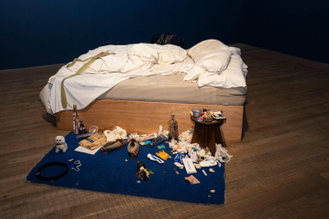
My Bed Installation by Tracey Emin, born 1963. Created 1998. Mixed media © Tracey Emin, all rights reserved / Wikimedia
Source: Christian Art
Gospel of 26 June 2026
Matthew 8:1-4
When Jesus came down from the mountain, great crowds followed him. And behold, a leper came to him and knelt before him, saying, 'Lord, if you will, you can make me clean.' And Jesus stretched out his hand and touched him, saying, 'I will. Be clean.' And immediately his leprosy was cleansed. And Jesus said to him, 'See that you say nothing to anyone, but go, show yourself to the priest and offer the gift that Moses commanded, for a proof to them.'
Reflection on the Contemporary Art Installation
In the time of Jesus, leprosy was one of the most feared diseases. Those afflicted were forced to live apart from society, in ghettos outside the city and village walls, and were expected to keep their distance from others. Yet in today's Gospel, a leper does something extraordinary: he approaches Jesus. Somehow he senses that Jesus is 'different'. He does not keep his distance, nor does he hide in shame. Instead, he comes forward and places himself before the Lord, trusting that he will be received. The leper's only uncertainty is not whether Jesus can heal him, but whether He wants to: "If you want to, you can cure me." Jesus immediately removes all doubt. He reaches out, touches the man, and heals him. In that moment, Jesus not only heals a disease; He breaks through the loneliness and isolation that had defined the man's life.
We may not encounter lepers in our society today here in the West, and so it is tempting to think that this Gospel has little to do with us. Yet every age has its outcasts: those who are homeless, struggling with addiction, suffering from mental illness, living in extreme poverty, or simply carrying burdens that make others uncomfortable. If some of them were to approach us, we might instinctively step back and feel uncomfortable. Jesus does the opposite. He draws near. The Gospel reminds us that no one is beyond the reach of God's love. The challenge is not whether the Lord is willing to heal us, but whether we are willing to approach Him.
That is why the artwork we are looking at today makes us feel very uncomfortable. In 1998, Tracey Emin exhibited her famous work My Bed: her own unmade bed, surrounded by discarded objects, empty bottles, stained sheets, cigarette packets and the debris of a life that had become chaotic. Emin created the work following a period of deep personal crisis, depression and addiction. I remember seeing it in London in the 1998 when it first went on show, and feeling profoundly uncomfortable. Like many people, I found myself asking: "Is this really art?" It lays bare human brokenness, vulnerability and suffering, so openly that we feel queasy in front of it. I am sure even some of your readers will share that same feeling and maybe feel this isn't an appropriate artwork to use on this website.
Yet, it brings us back to today's Gospel. Most people would probably have preferred not to look too closely at a leper. Most people now would not want to look much at addicts in the street, let alone be approached by them. But Jesus teaches us to look directly at the person before Him. He teaches us to look beyond what we may find physically difficult to cope with. He sees beyond the disease, beyond the stigma, beyond addiction or the brokenness. Where others saw someone to avoid, Jesus saw someone to love. The Gospel challenges us in exactly the same way. When confronted with human frailty, do we turn simply away in discomfort, or do we learn to see beyond with the compassionate eyes of Christ?
LINKS
Christian Art: https://christian.art/
Today's reading: https://christian.art/daily-gospel-reading/matthew-8-1-4-2026/
Video: How art called me to the priesthood: www.indcatholicnews.com/news/55096
 Facebook
 Twitter
 LinkedIn
 Print
Print Email
Email
















 Facebook
 Twitter
 YouTube
 LinkedIn
 Pinterest