


Gospel in Art: Beware of practising your righteousness before other people
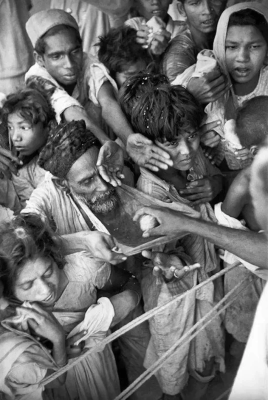
Beggars in India, Gujarat, Baroda (Vadodara), by Henri Cartier-Bresson, 1948 © Henri Cartier-Bresson/Magnum Photos
Source: Christian Art
Gospel of 17 June 2026
Matthew 6:1-6, 16-18
At that time: Jesus said to his disciples: 'Beware of practising your righteousness before other people in order to be seen by them, for then you will have no reward from your Father who is in heaven.
'Thus, when you give to the needy, sound no trumpet before you, as the hypocrites do in the synagogues and in the streets, that they may be praised by others. Truly, I say to you, they have received their reward. But when you give to the needy, do not let your left hand know what your right hand is doing, so that your giving may be in secret. And your Father who sees in secret will reward you.
'And when you pray, you must not be like the hypocrites. For they love to stand and pray in the synagogues and at the street corners, that they may be seen by others. Truly, I say to you, they have received their reward. But when you pray, go into your room and shut the door and pray to your Father who is in secret. And your Father who sees in secret will reward you.
'And when you fast, do not look gloomy like the hypocrites, for they disfigure their faces that their fasting may be seen by others. Truly, I say to you, they have received their reward. But when you fast, anoint your head and wash your face, that your fasting may not be seen by others but by your Father who is in secret. And your Father who sees in secret will reward you.'
Reflection on the photograph
Photography has its roots in the early nineteenth century and has since grown into one of the major branches of contemporary art, standing alongside painting, sculpture, and printmaking. It is perhaps the most immediate of all art forms. A photograph can capture an ordinary moment with a truthfulness and directness that few other media can equal. This image, taken just five seconds earlier or later, would have been entirely different. Photography has the power to preserve a fleeting instant that otherwise would have vanished forever.
This photograph was taken in 1948, at a time when cameras were still relatively rare and precious objects. Today, almost everyone carries a camera in their pocket through their mobile phone, and in that sense photography has become democratised. Yet in 1948, taking a photograph still required patience, technical skill, attentiveness, and often considerable expense. It is important therefore to view this image within its own historical moment.
Henri Cartier-Bresson was a French camera artist. I use that term deliberately, rather than simply "photographer", because many practitioners in the 1940s described themselves in this way. It reflects the seriousness and artistry of their craft. Cartier-Bresson is widely regarded as the father of modern photojournalism, one of the most compelling forms of fine art photography. Through his street photography across the world, he produced images that are visually balanced and aesthetically beautiful, yet at the same time deeply human and often profoundly moving. More than anyone else, he mastered what he famously called "the decisive moment": that brief instant when all the moving elements within a scene suddenly fall into perfect harmony.
Today's Gospel tells us: "Beware of practising your righteousness before other people." In this photograph, we see someone distributing food or alms, yet his face is absent from the frame. We do not know who he is. The photographer thus does not focus on the benefactor, but entirely on those receiving the charitable gesture. The attention is not on the one giving, but on the dignity and humanity of those in need.
Pope Francis once told a group of Franciscans: "When you do some activity for the 'little ones', the excluded and the least, never do it from a pedestal of superiority. Think rather that all that you do for them is a way of returning what you have received for free." How true that is. Perhaps that is why this photograph remains so powerful. True charity does not draw attention to itself. It does not seek applause or recognition. It simply serves quietly, and then steps out of the frame.
LINKS
Christian Art: https://christian.art/
Today's reading: https://christian.art/daily-gospel-reading/matthew-6-1-6-16-18-2026-2/
Video: How art called me to the priesthood: www.indcatholicnews.com/news/55096
 Facebook
 Twitter
 LinkedIn
 Print
Print Email
Email









 Facebook
 Twitter
 YouTube
 LinkedIn
 Pinterest