

Gospel in Art: An eye for an eye
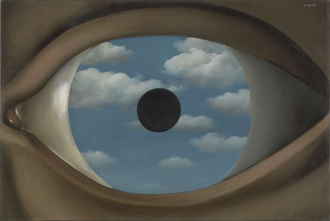
The False Mirror, by René Magritte, 1929, Oil on canvas © Museum of Modern Art, New York
Source: Christian Art
Gospel of 15 June 2026
Matthew 5:38-42
At that time: Jesus said to his disciples, 'You have heard that it was said, "An eye for an eye and a tooth for a tooth." But I say to you: Do not resist the one who is evil. But if anyone slaps you on the right cheek, turn to him the other also. And if anyone would sue you and take your tunic, let him have your cloak as well. And if anyone forces you to go one mile, go with him two miles. Give to the one who begs from you, and do not refuse the one who would borrow from you.'
Reflection on the painting
We do not need to look far to be reminded that there is real evil in the world. Watching the evening news is enough. A gunman walks into an ordinary place, a market, a school, a place of worship, where people are going about their ordinary lives, and in a moment everything is shattered. Lives ended. Others impacted beyond recognition. Or look at all the wars raging in the world, based on greed and pride. Jesus knew this darkness intimately. In today's Gospel he names it plainly: the violent man, the greedy man who drags his neighbour to court over a coat. But his concern is not simply to acknowledge that evil exists. His concern is how we respond to evil when we are confronted by it.
And his answer, as Saint Paul distils it so perfectly, is this: do not overcome evil by doing evil, but overcome evil with good. Jesus does not ask us to be passive or naive. He asks us to be radically different! He asks us to meet injustice not with retaliation but with a generosity that the world finds incomprehensible. If a Roman soldier commands you to carry his pack for one mile, carry it for two miles. It makes no worldly sense. It was never meant to. It is simply the way of Christ: a way that runs entirely against the grain of the secular world, which is precisely why we cannot walk it alone. We need the Holy Spirit.
The phrase Jesus is pushing back against in today's Gospel is one of the oldest legal principles in human history: an eye for an eye, a tooth for a tooth. It appears first in the Code of Hammurabi, the Babylonian law code of the eighteenth century before Christ, and is also found in the books of Exodus, Leviticus, and Deuteronomy. In its original context it was not a licence for cruelty; it was actually a restraint on vengeance, a way of ensuring that punishment matched the offence and went no further. But Jesus looks at it and says: not enough. Not nearly enough. The logic of equal retaliation, however carefully calibrated, still keeps us trapped in the same cycle.
And so today we find ourselves looking simply at an eye. René Magritte painted The False Mirror in 1929. It is a large, close-up human eye, but where the iris should be, Magritte has placed a vast open sky: blue, luminous, scattered with soft white clouds. Is the eye looking outward at the world, or is the world somehow contained within it? Magritte offers no answer. He called it a false mirror, because an eye, unlike a mirror, does not simply reflect what is in front of it. It perceives. It interprets. It chooses what to see. That is precisely Magritte's unsettling point, and it is the Gospel's point too. Two people can look at the same act of injustice and see entirely different things. One sees an offence that demands retaliation. The other, the one formed by Christ, sees a human being in need of something more than they deserve. The eye that has been touched by grace sees differently. It sees the way God sees. And that changes everything.
https://christian.art/daily-gospel-reading/matthew-5-38-42-2026/
 Facebook
 Twitter
 LinkedIn
 Print
Print Email
Email







 Facebook
 Twitter
 YouTube
 LinkedIn
 Pinterest