

Gospel in Art: The harvest is plentiful, but the labourers are few
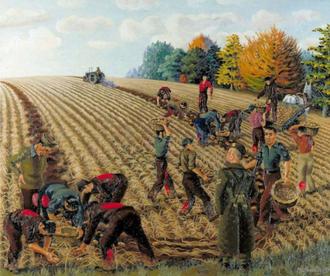
Italian Prisoners of War Working on the Land by Michael Ford 1942 © Imperial War Museum
Source: Christian Art
Gospel of 14 June 2026
Matthew 9:36-10:8
At that time: When Jesus saw the crowds, he had compassion for them, because they were harassed and helpless, like sheep without a shepherd.
Then he said to his disciples, 'The harvest is plentiful, but the labourers are few; therefore pray earnestly to the Lord of the harvest to send out labourers into his harvest.'
And he called to him his twelve disciples and gave them authority over unclean spirits, to cast them out, and to heal every disease and every affliction.
The names of the twelve Apostles are these: first, Simon, who is called Peter, and Andrew his brother; James the son of Zebedee, and John his brother; Philip and Bartholomew; Thomas and Matthew the tax collector; James the son of Alphaeus, and Thaddaeus; Simon the Zealot, and Judas Iscariot, who betrayed him.
These twelve Jesus sent out, instructing them, 'Go nowhere among the Gentiles and enter no town of the Samaritans, but go rather to the lost sheep of the house of Israel. And proclaim as you go, saying, "The kingdom of heaven is at hand." Heal the sick, raise the dead, cleanse lepers, cast out demons. You received without paying; give without pay.'
Reflection on the painting
In today's Gospel, Jesus sends his disciples out to the lost sheep of Israel. He does not send them empty-handed. He gives them authority, power, and a mission. But notice what he asks of them first: pray. He asks them to pray to the Lord of the harvest to send labourers. It is a striking request. Jesus himself is at work, yet he tells his disciples that the harvest is too vast for him alone, that he needs co-workers, and that they must ask God to send more. That call has often been interpreted too narrowly, as a prayer for priests and religious. But the Gospel is wider than that. Every baptised person is needed! Every one of us has a part to play. Every one of us has a spade to pick up, a field to tend, a corner of the harvest that only we can reach. The grain will not gather itself. And if we leave our row unworked, it goes unworked, because no one else is standing exactly where we are.
And yet, Jesus knew from the beginning how fragile his co-workers could be. From the wider group of disciples he chose twelve, a number rich with meaning, symbolically linked to the twelve tribes of Israel. He formed the apostles carefully, travelled with them, taught them, let them witness miracle after miracle. And still, when the cross came into view, they scattered. Every one of them. Peter denied him. Judas betrayed him. The rest fled into the night. This is not a detail the Gospel glosses over. It sits at the very heart of the story. Jesus calls, he teaches, he forms,... but, ... He does not force. He never has. The same is true today. He calls each of us by name, but the response is always ours to give.
Our painting shows us exactly what God does not do. He does not force us. He does not march us into his fields under guard. No, He simply invites, and leaves the response entirely to us. A yes, a no, or even a tentative let me try and see. The choice is always ours. The men bending over the onion rows in this quiet Hampshire field had no such choice. Michael Ford painted them in 1942, in the middle of the war, in a field near his home village of Overton. They are Italian prisoners of war, most of them captured during the North Africa campaign, where Mussolini's army had faced the British Army across the desert. Many had been transferred to Britain, in the Hampshire countryside, billeted at camps in nearby Whitchurch and Popham. You can identify them by their uniforms: the distinctive brown with large orange patches, sewn on precisely so they could not disappear unnoticed into the English landscape.
Ford, who studied at Goldsmiths and went on to do war artist work held by the Imperial War Museum, records the scene with a quiet, documentary tenderness. There is no drama here, no war propaganda. Just men, working a field, far from home. Britain in 1942 faced an acute labour shortage; with its own men at the front, it needed hands for the harvest, and the prisoners had to help. And that is precisely the contrast the Gospel invites us to feel. These men laboured because they were compelled to. But God asks us to labour because we are loved. God's harvest is just as urgent, just as real, but he will not force a single one of us into his fields.
LINKS
Christian Art: https://christian.art/
Today's reading: https://christian.art/daily-gospel-reading/matthew-9-36-10-8-2026/
Video: How art called me to the priesthood: www.indcatholicnews.com/news/55096
 Facebook
 Twitter
 LinkedIn
 Print
Print Email
Email










 Facebook
 Twitter
 YouTube
 LinkedIn
 Pinterest