


Gospel in Art: Saint Anthony of Padua, Priest, Doctor
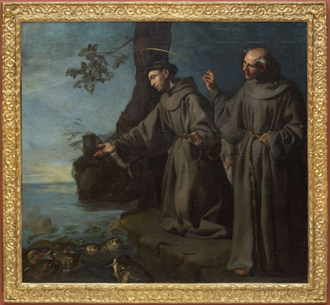
St Anthony Preaching to the Fishes by Francisco de Herrera the Elder © Detroit Institute of Arts
Source: Christian Art
Gospel of 13 June 2026
Luke 10:1-9
At that time: The Lord appointed seventy-two others and sent them on ahead of him, two by two, into every town and place where he himself was about to go.
And he said to them, 'The harvest is plentiful, but the labourers are few. Therefore pray earnestly to the Lord of the harvest to send out labourers into his harvest. Go your way; behold, I am sending you out as lambs in the midst of wolves. Carry no money bag, no knapsack, no sandals, and greet no one on the road.
'Whatever house you enter, first say, "Peace be to this house!" And if a son of peace is there, your peace will rest upon him. But if not, it will return to you. And remain in the same house, eating and drinking what they provide, for the labourer deserves his wages. Do not go from house to house. Whenever you enter a town and they receive you, eat what is set before you. Heal the sick in it and say to them, "The kingdom of God has come near to you." '
Reflection on the painting
Fernando Martins de Bulhões was born in Lisbon in 1195, the son of a knight, educated by the Augustinian canons, and formed from his earliest years in a life of prayer and Scripture. We know him today as Saint Anthony of Padua. In 1220, something changed in him. He heard of five Franciscan friars who had been martyred in Morocco (their heads severed for preaching the Gospel) and their witness set his heart on fire. He left the Augustinians, joined the Franciscans, and immediately sought permission to sail to North Africa to preach to the Saracens, ready, if necessary, to die for the faith.
God had other plans. He fell gravely ill on the journey and was forced to turn back. His ship was blown off course and landed in Sicily. Too weak to travel, too sick to preach, he must have wondered what God was doing with him. He was sent by his superiors to teach theology, first at Bologna, then at Montpellier, Toulouse, and across southern France. Francis of Assisi himself wrote to him: "I wish you to teach the friars sacred theology." He became one of the greatest preachers of his age, drawing crowds of thousands wherever he went. When he died near Padua in 1231, he was just thirty-five years old. He was canonised less than a year later, one of the fastest canonisations in history. In 1946, Pope Pius XII proclaimed him a Doctor of the Church.
But it is one story, more than any other, that has made Anthony beloved across the centuries. He was preaching in Rimini. The townspeople would not listen. They turned their backs, walked away, shut their doors. And so Anthony walked down to the shore, stood at the water's edge, and began to preach to the fish. And the fish came. A great multitude of them, gathering at the surface, lifting their heads above the water as if straining to hear every word. Anthony spoke to them of God's goodness, of the gift of creation, of the obedience written into every living creature, the obedience that the people of Rimini had refused to offer. The townspeople, watching from a distance, were undone. They came back. Many converted. The fish, it seemed, had more sense than the crowd.
Our painting was made for the Convent of San Antonio de Padua in Seville. Long attributed to Francisco Herrera the Elder, new scholarship now suggests it may be the work of Alonso Cano, a painter who trained alongside the young Diego Velázquez in Seville. Anthony kneels at the water's edge, arms open wide, his whole body an act of offering. Beside him, a fellow Franciscan gestures in astonishment at what he is witnessing. And there, in the water below, the fish raise their heads, attentive, patient, still.
LINKS
Christian Art: https://christian.art/
Today's reading: https://christian.art/daily-gospel-reading/luke-10-1-9-2026-4/
Video: How art called me to the priesthood: www.indcatholicnews.com/news/55096
 Facebook
 Twitter
 LinkedIn
 Print
Print Email
Email










 Facebook
 Twitter
 YouTube
 LinkedIn
 Pinterest