


Gospel in Art: Pray for those who persecute you
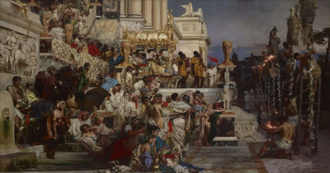
Nero's Torches, by Henryk Hektor Siemiradzki, 1878 © National Museum, Krakow
Source: Christian Art
Gospel of 16 June 2026
Matthew 5:43-48
At that time: Jesus said to his disciples: 'You have heard that it was said, "You shall love your neighbour and hate your enemy." But I say to you: Love your enemies and pray for those who persecute you, so that you may be sons of your Father who is in heaven. For he makes his sun rise on the evil and on the good, and sends rain on the just and on the unjust. For if you love those who love you, what reward do you have? Do not even the tax collectors do the same? And if you greet only your brothers and sisters, what more are you doing than others? Do not even the Gentiles do the same? You therefore must be perfect, as your heavenly Father is perfect.'
Reflection on the painting
The call of the Gospel can be very challenging. Today's reading is arguably one of the most demanding passages in all of the gospels. Jesus calls on his disciples not only to love our neighbour, a command that is found in the Old Testament, but he also calls on them, and on us, to love our enemy, which goes beyond anything found in the Old Testament.
Many of us might struggle to think of someone we would describe as our 'enemy'. Yet, we might be able to recall people who we don't particularly like or people who have hurt us or caused us harm in some way. We are unlikely to have warm feelings toward such individuals. But when Jesus calls his disciples to love their enemies, he is not speaking primarily about emotions or feelings. He is speaking about an act of the will. Christian love is not sentimental. It means choosing not to hate, refusing to seek revenge, resisting bitterness, and continuing to recognise the dignity of the other person, even when relationships are wounded. To love an enemy does not mean approving of what they have done; it means refusing to allow darkness to have the final word in our own hearts.
"Nero's Torches," also known as "Candlesticks of Christianity," is a painting created by the Polish artist Henryk Hektor Siemiradzki in 1876. It is a monumental dramatically depicting the horrors of the early Christian persecutions during the reign of Emperor Nero (AD 54-68). After the Great Fire of Rome in AD 64, Nero blamed the Christians for the disaster. He subjected them to horrific punishments, including being used as human torches to light his gardens. The painting captures in meticulous detail the chilling moment when Christians are tied to stakes and set on fire to illuminate a decadent garden party for Nero and his guests. The scene is set in an opulent garden, emphasising the stark contrast between the cruelty of the act and the grandeur of the surroundings.
The painting elicits a strong emotional response, highlighting the innocence and suffering of the martyrs while condemning the barbarity of their persecutors. The juxtaposition of human cruelty against a backdrop of opulence and beauty makes for a very engaging painting. The painting serves as a poignant reminder of the early Christian martyrs' sacrifices... all Christians who put the call of today's Gospel reading into practise.
LINKS
Christian Art: https://christian.art/
Today's reading: https://christian.art/daily-gospel-reading/matthew-5-43-48-2026-2/
Video: How art called me to the priesthood: www.indcatholicnews.com/news/55096
 Facebook
 Twitter
 LinkedIn
 Print
Print Email
Email












 Facebook
 Twitter
 YouTube
 LinkedIn
 Pinterest