


Gospel in Art: Blessed are...
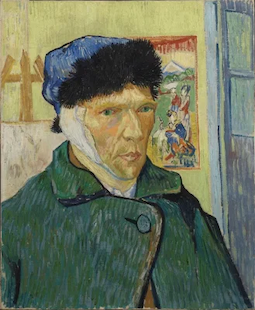
Self-Portrait with Bandaged Ear, by Vincent van Gogh, (1853-1890) painted in 1889 © Courtauld Institute, London
Source: Christian Art
Gospel of 8 June 2026
Matthew 5:1-12
At that time: Seeing the crowds, Jesus went up on the mountain, and when he sat down, his disciples came to him. And he opened his mouth and taught them, saying: 'Blessed are the poor in spirit, for theirs is the kingdom of heaven. Blessed are those who mourn, for they shall be comforted. Blessed are the meek, for they shall inherit the earth. Blessed are those who hunger and thirst for righteousness, for they shall be satisfied. Blessed are the merciful, for they shall receive mercy. Blessed are the pure in heart, for they shall see God. Blessed are the peacemakers, for they shall be called sons of God. Blessed are those who are persecuted for righteousness' sake, for theirs is the kingdom of heaven. Blessed are you when others revile you and persecute you and utter all kinds of evil against you falsely on my account. Rejoice and be glad, for your reward is great in heaven, for so they persecuted the prophets who were before you.'
Reflection on the painting
Portrait painting is a remarkable and highly demanding art form. Great portrait artists do far more than capture a person's outward appearance; they try to reveal something of the soul, the character, even the hidden life within the sitter. I love visiting National Portrait Gallery near Trafalgar Square. Walking through its rooms is like walking through history itself: kings and queens, writers, saints, politicians, artists, and ordinary faces from centuries past all gaze back at us. And even today, in places such as Piazza Navona in Rome, one still sees artists sketching and painting portraits for passers-by seated in the open air, sometimes even adding playful humour through exaggerated caricatures that gently tease and entertain... We like portraits as it tells us something about us and our history.
I often think of the Beatitudes as a kind of spiritual auto-portrait painted by Christ Himself. When Jesus spoke those words, He was revealing His own heart. He is poor in spirit, utterly dependent on the Father. He is gentle and humble of heart. He mourns over the brokenness of the world and longs for God's will to be done on earth as it is in heaven. He hungers and thirsts for righteousness and is willing to suffer so that truth and justice may prevail. He is merciful toward sinners and the wounded. His heart is pure, seeking only the will of the Father, etc... In describing the Beatitudes, Jesus is therefore painting a portrait of Himself.
Yet at the same time, He is also painting a portrait of who we are called to become. The Beatitudes are not simply beautiful ideals to admire from a distance; they are an invitation to transformation. Christ places this portrait before us and gently asks whether we are willing to let our lives be shaped into His likeness. We cannot do this by our own strength alone. Just as an artist slowly shapes a portrait with patience and care, so too the Holy Spirit works within us, gradually forming us into the image of Christ. Day by day, prayer by prayer, act by act, God continues His work upon the canvas of our souls.
Not too far from the National Portrait Gallery stands The Courtauld Institute of Art, where one of the most unforgettable self-portraits in the history of art hangs: Self-Portrait with Bandaged Ear by Vincent van Gogh. Van Gogh painted this work in January 1889, only days after leaving hospital following the terrible incident in which he mutilated his own ear after a breakdown and a fierce argument with fellow artist Paul Gauguin. Because Van Gogh painted himself using a mirror, the bandage appears on the right side, even though it was his left ear that had been injured.
What makes this painting so extraordinary is its complete honesty. Van Gogh does not paint himself as heroic, elegant, or triumphant. Instead, he presents himself wounded, fragile and exhausted. Wrapped in a thick green coat and fur hat against the winter cold, he stares quietly outward with eyes that seem full of pain, but also of endurance. This is why the painting is so powerful: it is far more than a likeness of a face. It becomes a portrait of suffering itself. Yet it is also a portrait of survival. The painting reminds us that brokenness and beauty can exist side by side. Christ's auto-portrait in the Beatitudes however opens a true path toward healing and transformation. In showing us His own face through the Beatitudes, Jesus also reveals the face we are called to grow into.
LINKS
Christian Art: https://christian.art/
Today's reading: https://christian.art/daily-gospel-reading/matthew-5-1-12-2026-2/
Video: How art called me to the priesthood: www.indcatholicnews.com/news/55096
 Facebook
 Twitter
 LinkedIn
 Print
Print Email
Email








 Facebook
 Twitter
 YouTube
 LinkedIn
 Pinterest