

Bristol Quakers apologise for role in slavery
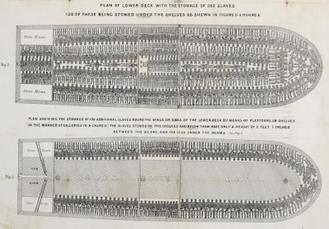
British slave ship Brookes 1788 had shelves 2'7" high for holding 292 'Women, Boys and Men'.
lBristol Quakers have apologised for their role in trafficking enslaved African people. More than half a million people were forcibly carried across the Atlantic in Bristol ships.
The impact of the economy of trafficking and enslaving African people is still felt in Bristol today, Quakers say, in the trauma and inequality suffered by descendants of enslaved people and in the city's wealth.
Bristol was Britain's leading slave port in the 1730s and 1740s and was responsible for over 20 per cent of British trafficking between 1698 and 1807.
More than 2,000 slave voyages set out from Bristol and Quakers were involved at every stage in some of those voyages.
The profits from their involvement in enslavement are still visible across the city, from Blaise Castle to Goldney House and Royal York Crescent.
Following lengthy research and discussions, Bristol Area Quaker Meeting has issued a formal apology, acknowledging that Quaker families in the city profited directly from the trafficking and enslavement of Africans as well as indirectly from related trade, manufacturing and financial services.
"Bristol Quakers today are deeply shocked to discover the harms which Bristol Quakers inflicted upon thousands of African people," the apology says.
"We apologise to all those who were harmed and to their descendants, in sorrow and humility and with the knowledge that these harms have not yet ended."
Julia Bush, from Redland Meeting, has led much of the Quaker research.
"This is not just ancient history," she said. "We continue to see the consequences in the present day - the impact of racism, systemic inequality and an ongoing trauma from enslavement which is felt by a lot of people in this city."
She emphasised that the harms went beyond economics. "It's not only about money. We've been reminded throughout that reparation means repair and healing. This will require a transformation of attitudes."
Bristol Quakers have already given £5,000 towards a memorial for Fanny Coker, an African woman enslaved by the Pinney family who worked for most of her life in Bristol.
Bush said further decisions on funding would be needed and must not be top-down.
"It is not up to us to decide how any future reparation funding should be spent," she said. "That would just be replicating the sins of the past."
Research by Bristol Quakers shows that at least four Bristol Quaker families owned plantations abroad. No Bristol Quaker was ever expelled from their Meeting for involvement in enslavement.
In March 2021, Bristol City Council became the first city outside London to pass a motion supporting "Atonement and Reparations" for the city's role in trafficking enslaved African people. Bristol Quakers say their apology aligns with that commitment.
The Quaker apology will be shared with local, black-led organisations, including the Bristol Legacy Foundation and Black South West Network, and displayed in Bristol's meeting houses.
Bristol's apology follows a similar one from Lancashire Quakers in 2025 and comes as a national Quaker working group reports on reparation to the Yearly Meeting of Quakers in Britain.
Bristol Quakers involvement with enslavement includes:
- Members of Quaker families involved in enslavement helped to fund Bristol landmarks including Clifton Court, Goldney Hall, Royal York Crescent and Blaise Castle mansion.
- Several members of the Harford family, owners of Blaise Castle from 1789, were directly involved in slave trafficking through part-ownership of slave ships in addition to their extensive links through trade, manufacturing and banking.
- Quaker-run copper works at Crews Hole and Warmley, and brass mills along the Avon Valley, supplied manillas and kettles traded for enslaved people on the West African coast.
- By the mid-18th century more than half of Bristol's sugar came from Jamaican plantations. Quaker industries such as the Fry family's chocolate manufacturing depended on enslaved labour for most of their cocoa and sugar supplies.
- A 1768 Jamaican plantation list names 120 enslaved people held by the Quaker Dickinson family, including a woman called Yellow Mary and a boy, Neptune. Enslaved children brought to Bristol from Jamaica by the Dickinsons included a young boy named as 'Champayne'.
- Towards the end of the 18th century an increasing number of Bristol Quakers became actively involved in the slavery abolition movement.
Read the full apology here: www.quaker.org.uk/documents/bristol-quakers-apology-for-complicity-in-enslavement
More information on Bristol Quakers and enslavement available here:
https://bristolquakers.org.uk/wp-content/uploads/2025/03/Reparations-leaflet-for-online-reading.pdf and
https://bristolquakers.org.uk/wp-content/uploads/2024/11/Bristol-Quakers-and-African-enslavement.pdf
Slaveship Brookes: https://lsa.umich.edu/social-solutions/news-events/news/digests/a-look-back/a-look-back--the-first-slave-ship-in-the-u-s-.html
 Facebook
 Twitter
 LinkedIn
 Print
Print Email
Email





 Facebook
 Twitter
 YouTube
 LinkedIn
 Pinterest