


Viewpoint: Serious flaws in Christian campaign 'Europe be faithful to our common home'
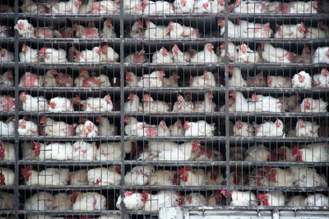
Battery chickens - Photo by mahmut on Unsplash
Virginia Bell writes: The Campaign which calls on Europe to be faithful to its founding values for Our Common Home, reported in ICN 22 May 2026: (140+ faith organisations urge EU to tax massive fossil fuel profits and lead global transition) sounds admirable. But reading through it, I think the Statement is seriously flawed, as it talks only of fossil fuels to be tackled, and only of one of the several environmental emergencies, climate change, to be addressed, and only of the suffering of one of the 8 million or so species of animals on the planet - humans.
Out of the nine general planetary boundaries, six are compromised, not just climate change.
The Planetary Health check report of 2025 puts loss of biodiversity as the most urgent of the environmental crises, with climate change being the fourth worst, yet people only talk of climate change.
As Pope Francis, Jonathon Porritt, Chris Packham and many others have said, these things are interconnected. So why mention only one emergency?
And why mention only one cause of planetary degradation - fossil fuels?
Animal agriculture produces carbon dioxide. A groundbreaking Stanford University study published in 2022 revealed that phasing out animal agriculture could reduce atmospheric CO2 levels by 68%. This research, led by Michael Eisen and Patrick Brown, represents one of the most comprehensive analyses of animal agriculture's climate impact to date, highlighting the urgent need to understand and address this critical environmental challenge.
But animal agriculture also produces other far more potent greenhouse gasses - methane and nitrous oxide. Methane is up to 80 times more potent a greenhouse gas than CO2, and nitrous oxide is up to 300 times more potent, plus nitrous oxide degrades the ozone layer.
But greenhouse gasses are not the only threat to the planet. And some of those other threats are driven mainly by meat. Such as deforestation, loss of biodiversity, water pollution and water shortages.
According to the Pacific Institute and National Geographic, to produce one egg, around 53 gallons of water is needed. For one pound of chicken meat, it's about 468 gallons, and one pound of beef requires 1,800 gallons.
Deforestation especially is a problem. It is a double problem because it releases the greenhouse gases which the trees had captured, and it disables the planet's ability to collect more greenhouse gases (the trees which would do this having been cut down).
The main cause of loss of biodiversity, at the moment considered our most urgent problem, is deforestation.
The main cause of deforestation is animal farming.
Animal agriculture uses 80% of agricultural land to supply just 18% of global calories.
It is an extremely wasteful way of producing food, using a very large amount of land, water, and energy to produce a very small amount of food.
It takes, on average, 39 Kilograms of plant feed to produce one Kilogram of animal biomass for human consumption.
Calculation of the percentage of greenhouse gasses emitted by animal agriculture varies between 14.5% (FAO, which partners with meat and dairy farmers, 2013), 53% (Gerard Wedderburn-Bisshop 2025), 87% (Sailesh Rao 2021).
Taking the lowest percentage - 14.5% - makes it equal to transportation - all planes, trains and cars combined.
We could feed the world right now if we fed people directly with the food we give to livestock. So, to eat meat means to starve people.
And if humanity shifted to veganic arable farming, an area larger than North America and South America combined would be freed up. We could feed the world sustainably AND have lots of land to give back to Nature.
Am I being cynical in thinking that the reason we concentrate on sustainable or renewable energy is because it gives the promise of continued electricity use and continued economic growth, so that we can continue with our consumeristic lifestyles?
Of course we need green energy, but equally we need to reduce our exploitation of the planet's resources, and our commitment to economic growth.
The suffering of animals is also overlooked in the Statement. In fact, it's overlooked practically everywhere, by Christians and environmentalists as much as by atheists and polluters, as if animal lives and animal suffering didn't matter.
They are among the poorest of the poor, as they are innocent but suffer because of our selfish actions.
A link to the People for the Ethical Treatment of Animals website would educate people about the horrendous suffering that farm animals endure.
Don't forget fish! Fishing is a cause of climate change and loss of biodiversity, because it damages the ocean's ability to control climate change and to promote biodiversity. Seabed habitats are destroyed by trawlers.
One third of all fish taken from the ocean go to waste. And many thousands of non-target marine animals are killed each year through fishing activities: whales, dolphins, porpoises, seals, terrapins. This is a significant threat to marine species.
Recent research finds that fish suffer prolonged agony when caught.
Fish Farms are no better. They cause high emissions, use fossil fuels, destroy ecosystems, pollute surrounding waters, spread diseases to wild fish, promote waste (wild fish are fed to the captive fish) and keep fish in cruel conditions.
Veganism is usually promoted because of how healthy it is, but even ignoring the unhealthy effects of meat, dairy and fish, the classic research by Poore & Nemecek at the University of Oxford 2018 concludes "A vegan diet is probably the single biggest way to reduce your impact on planet Earth, not just greenhouse gases, but global acidification, eutrophication, land use and water use".
 Facebook
 Twitter
 LinkedIn
 Print
Print Email
Email

















 Facebook
 Twitter
 YouTube
 LinkedIn
 Pinterest