


South African Reflection: Fuel, Fear and Faith
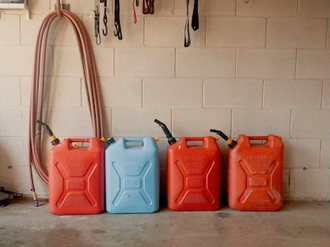
Photo by Chad Stembridge on Unsplash
Source: Jesuit Institute South Africa
This week, the news warned of the sharpest fuel price increase ever experienced in South Africa, driven by soaring international oil prices due to the war in the Middle East.
The warning landed in my body, not only in my head. After a long day of meetings and Holy Week commitments, I found my tank running low and decided to risk the petrol station. Two stations were dry. The third had a long queue. After forty-five minutes of inching forward, I finally reached the pumps and watched a man darting between what were clearly his three bakkies, each fitted with two 1000-litre tanks, filling them while the line behind us lengthened. I do not know his story. Perhaps he had a legitimate need. Still, the scene felt painfully familiar. It called to mind the hoarding during the early days of the COVID lockdown, when fear turned aisles into battlegrounds and toilet paper into treasure.
Hoarding is rarely about greed alone. It is often a spiritual response to anxiety. When the future feels unstable, we try to make ourselves stable by stockpiling. We grasp for control through accumulation. But Scripture is honest about what this does to the human heart. In the wilderness, the Israelites were told to gather manna, but not to store it overnight. Those who kept extra found it rotting by morning (Exodus 16:19-20). The lesson was not that planning is sinful, but that hoarding is a kind of distrust. It assumes that God will not be faithful tomorrow, so I must secure myself today at someone else's expense.
Jesus names the same danger in the parable of the rich fool. A man has such an abundant harvest that he runs out of storage. His solution is to build bigger barns and tell himself, "Relax, eat, drink, be merry." But God calls him a fool, not because he produced wealth, but because he mistook stored goods for stored life (Luke 12:16-21). "One's life does not consist in the abundance of possessions" (Luke 12:15). Hoarding shrinks the imagination. It makes our world small, with "mine" at the centre.
In moments of scarcity, the Christian calling is not naïve optimism, but courageous trust expressed through solidarity. We can plan responsibly, yes. But we must also ask hard questions: Is my "just in case" becoming someone else's "not enough"? Am I protecting my comfort while deepening another person's insecurity?
Holy Week leads us to the One who did not hoard, but gave sacrificially. Jesus resisted the temptation to secure life through power, possession, or self-protection. In a culture trained to stockpile, the church and Christians have an opportunity to follow Jesus' example and become a living sign of another economy: the grace of enough, the dignity of shared provision, and the freedom that comes when fear no longer dictates our choices.
Follow The Jesuit Institute on Twitter @JesuitInstitute
 Facebook
 Twitter
 LinkedIn
 Print
Print Email
Email












 Facebook
 Twitter
 YouTube
 LinkedIn
 Pinterest