

Palm Sunday Reflection with Canon Robin Gibbons
March 29th 2026
On our journey through Great Lent we have discovered the essence of Jesus' love for us all and found the practical experience of it through his teaching. Now we reach Palm Sunday, the gateway into the liturgies of Holy Week and the solemn celebration of his passion, death and resurrection in those three days of the Paschal Triduum, making up as they do the feast of feasts, the pinnacle of the Church's year, a solemn unified whole culminating in that great Vigil of Easter. So in reflecting on Palm Sunday my own thoughts reach into the beauty of Matthew's gospel that opens the liturgical procession we ourselves make with palms echoing Jesus' entry into Jerusalem.
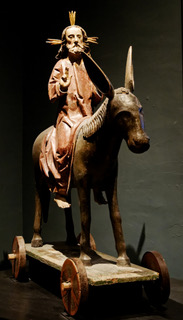
If we enter into the meaning of this gospel there is put before us the Lord's call to be his witnesses proclaiming the good news in humbleness, with our hearts contrite and open. This gospel is not about the powerful, nor great religious figures, it hands us over to the little ones, the crowd outside the city who acknowledge him as Messiah, it also reminds us by the gift of the ass and colt that even the beasts of creation know their Lord and are blessed by him, and as such are also worthy of our care, for here at the centre of the story of salvation this prophecy is fulfilled:' "Say to daughter Zion,
'Behold, your king comes to you,
meek and riding on an ass,
and on a colt, the foal of a beast of burden.'"
The disciples went and did as Jesus had ordered them.* They brought the ass and the colt and laid their cloaks over them, and he sat upon them'.(Mt 21:5-7)
Yet we need to remind ourselves that all this belongs to Christianity as a whole even in our fragmented state of division! The ecumenism of Holy Week is ours for the taking if we can but let go of any preconceptions and prejudices we might still have and acknowledge Christ's salvation is for all.
Last week saw the installation of Dame Sarah Mullally, the first woman Archbishop of Canterbury. An event whose historical importance will reveal itself in future times. I can claim a tenuous link with her as she took one of our classes in Liturgy when I taught with the late, and much loved Fr Kevin Donovan SJ ( may he rest in peace) and Fr Andrew Cameron Mowatt SJ at the then Heythrop College. She mentioned this when I later met her on a visitation to St Barnabas Pimlico, an Anglican parish in the Diocese of London, whose church our Melkite community shares for worship. With so many others my own prayers and best wishes go with her as she begins this ministry, but it is also a reminder that the call to unity begins in sharing what we can and praying and working together whenever possible.
In one important sense the archbishops installation at this point in the liturgical year is a gift, for it reveals the potential for a wider ecumenism. Palm Sunday which begins our Holy Week, affords us all the opportunity of witnessing to the Lord, and uniting with other sisters and brothers of different denominations. This may take the form of shared services, like the united Palm Sunday procession in my own village, or of that eloquent witness of those Good Friday marches following the cross alongside other Christians, that we can find in some of our big cities and towns.
As I have often written, whilst I am firmly rooted in the Catholicism of West and East, a wider ecumenism has always been part of my 'second' vocation as a theologian and priest. I find that some of the ungracious comments expressed about the new archbishop (expressions of a regretful antipathy to ecumenical endeavour) lack the charity and friendship we are bound to show to other Christians let alone any other neighbour. Our good Lord's own commandment is to love one another,is a theme that is driven home by the scriptures , chants and music of this week! Like the crowd welcoming Jesus we are also called to the solidarity of common witness through our baptismal vocation.
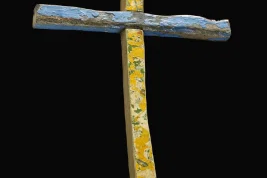
As Jesus taught us, we are commanded to love one another no matter who we might be, and in that image of the ass and colt we are yet again brought to the virtue of humility, the humble and contrite heart so beloved of God. So with our hearts quickened by the Lords love, let us journey with him united in the faith we profess with our sisters and brothers. Amen.
Holy Week Lectio
The Prayer of the Colt
"Lord, I am just a humble colt, the foal of a donkey, never ridden before.
Yet you chose me to carry you, the King of Kings, into the city.
I do not understand the crowds, the shouting, or the green branches they lay before me,
But I feel your peace, and I hear your calm voice.
I walk carefully, knowing I carry the hope of the world.
Help me to bring you safely to your destination.
May I be a vessel for your humility and your peace.
Hosanna in the highest! Amen."
My Song is Love Unknown
One of the most loved hymns sung in Holy Week is 'My Song is Love Unknown'. It is not a 'Catholic' hymn in origin as it was originally written as a poem by a puritan minister Samuel Crossman in 1664, after he had been ejected from the Church of England for refusing to take the Oath for the Act of Uniformity in 1662. Interestingly enough the great ejection of two thousand or so clergy paved the way for the growth of non-conformity in English religious life, a fact that those of us who are Catholics should be aware of, as Catholicism itself at this point was categorised as a form of non-conformity. While distinct from Protestant Dissenters, Catholics were often grouped with them under penalized non-conformity, particularly after 1662, though they faced harsher penalties for suspected disloyalty to the state. This is not just history it is a reminder that our own faith has undergone many experiences many of them painful, and yet similar to others from a different denomination.
This hymn is a gift from the Protestant tradition.
My song is love unknown,
my Saviour's love to me;
love to the loveless shown,
That they might lovely be.
O who am I,
that for my sake
my Lord should take
frail flesh and die?
He came from his blest throne
salvation to bestow;
but men made strange, and none
the longed-for Christ would know.
But O, my Friend,
my Friend indeed,
who at my need
his life did spend!
Sometimes they strew His way,
and His sweet praises sing;
resounding all the day
hosannas to their King.
Then 'Crucify!'
is all their breath,
and for His death
they thirst and cry.
Why, what hath my Lord done?
What makes this rage and spite?
He made the lame to run,
he gave the blind their sight.
Sweet injuries!
yet they at these
themselves displease,
and 'gainst him rise.
They rise, and needs will have
my dear Lord made away;
a murderer they save,
the Prince of Life they slay.
Yet cheerful He
to suffering goes,
that He His foes
from thence might free.
In life no house, no home
my Lord on earth might have;
in death no friendly tomb
but what a stranger gave.
What may I say?
Heav'n was his home;
but mine the tomb
wherein he lay.
Here might I stay and sing:
no story so divine;
never was love, dear King,
never was grief like Thine!
This is my Friend,
in Whose sweet praise
I all my days
could gladly spend.
-Samuel Crossman, Common Praise 112
 Facebook
 Twitter
 LinkedIn
 Print
Print Email
Email















 Facebook
 Twitter
 YouTube
 LinkedIn
 Pinterest