

Sunday Reflection with Canon Robin Gibbons - 15 March 2026
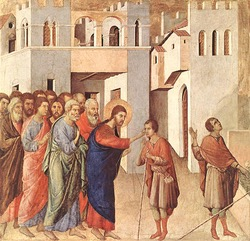
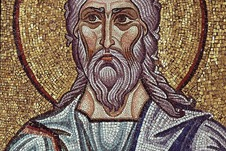
Duccio di Buoninsegna: Healing of the Blind Man. Wiki image
Fourth Sunday of Lent
For far too long disability was understood by many religious people as somehow connected to heavenly disfavour, in some cases a direct consequence of sinfulness, and so it at first seems with the story of the man born blind, we note the unfavourable comment of the disciples who ask Jesus;'"Rabbi, who sinned, this man or his parents, that he was born blind?" Jesus' answer is unequivocal in its directness and leads beyond his immediate response, though he does not engage in the theological complexities of their query, to a declaration of his own divine mission as the one who will bring the victory over darkness, sin and death! :'"Neither he nor his parents sinned; it is so that the works of God might be made visible through him. We have to do the works of the one who sent me while it is day. Night is coming when no one can work. While I am in the world, I am the light of the world."(Jn 9:1,3-5)
It is to our shame that these healing words, a statement about the compassion and power of God, have been unheeded in the past, and it has taken the 'insight' of continual medical research, developments in theological and psychological understanding of illness and disability, to move them (and our own prejudices) out of the 'ruffled' arena of sin into something more humanly compassionate, the need to understand, confront any misconceptions about illness and disability of any kind in the positive way of Christ, in order to awaken our own consciences, renew our sense of solidarity with those others, so that we may with a changed perception, support, help, and minister to those in need, just as the Christ asks of us.
I discovered a lovely phrase about Jesus, which I find helps me understand the meaning of Jesus work in this story, 'reviled but not ruffled!' It may be a miracle of healing, the giving of something new to the man born blind, whose life after Jesus had met him is going to be transformed and changed, not necessarily into something wondrous, but more perhaps as a life of new expectations and challenges. It isn't fanciful to imagine in this event our own forms of blindness particularly that connected with bereavement and loss, where the one we once loved is no more seen amongst us. Yet if we follow the unfolding teaching of our good Lord he suggests something greater is happening than simply a gift of new sight. It is more, so much more, for Jesus turns upside down our miserable and mean concepts of sin, particularly with regard to other people, shaking the foundations of religious self-complacency and pompous self-righteousness to make us stand in the enveloping light of God, that light which sees into the heart of each and reveals the truth of things, in order to make good what is wrong, forgive what is sinful, heal the hurts of each one of us. In all the nastiness of religious debate, and the attacks on Jesus himself, the man born blind takes us to the crux of the matter, in fact the point all of us must get to, where we finding the Lord and not fully understanding who he is, nevertheless in an encounter of a love are asked to trust and believe in him.
The Credo of the Man born blind is like our own baptismal credo. At our baptism or whenever we renew our baptismal vows, we are asked 'do you believe?' and we reply 'I believe or I do '. The man born blind speaks for us in an unfolding miracle of another form of sight, the believer's gaze into a light that allows us to begin to see the face of God in so many things about us. To the man born blind Jesus responds by saying: "I came into this world for judgment, so that those who do not see might see, and those who do see might become blind." (Jn 9:39)
Perhaps we might take some consolation from reflecting on these words of Jesus, for though there is judgement, in Christ we have already been judged and because of his incarnation, passion, death and resurrection been given the gift of salvation.
As children of the Light we now have to perceive things differently, and perhaps also become 'blind' to the choices of evil we might otherwise make, blind in that sense of avoiding the pitfalls. I haven't a clear answer to the question of those in life who are blind to goodness, nor do I fully understand the immensity of divine mercy, but I have trust and hope that from this gospel we can take heart that our Good Lord will bring us to this understanding and knowledge of himself as the light of the world, that he will also guide us in the right ways. We can also hold before us the words of the Lord to Samuel in our first reading:'God does not see as a mortal, who sees the appearance. The LORD looks into the heart' (I Sam 16:7b)
Lenten Lectio
Psalm 23(22) Dominus regit me
The Lord is my shepherd;
there is nothing I shall want.
Fresh and green are the pastures
where he gives me repose.
Near restful waters he leads me,
to revive my drooping spirit.
He guides me along the right path;
he is true to his name.
If I should walk in the valley of darkness
no evil would I fear.
You are there with your crook and your staff;
with these you give me comfort.
You have prepared a banquet for me
in the sight of my foes.
My head you have anointed with oil;
my cup is overflowing.
Surely goodness and kindness shall follow me
all the days of my life.
In the Lord's own house shall I dwell
for ever and ever.
Benedict XVI - Angelus, St Peter's Square, Fourth Sunday of Lent, 2 March 2008
Jesus reveals to the blind man whom he had healed that he had come into the world for judgement, to separate the blind who can be healed from those who do not allow themselves to be healed because they consider themselves healthy. Indeed, the temptation to build himself an ideological security system is strong in man: even religion can become an element of this system, as can atheism or secularism, but in letting this happen one is blinded by one's own selfishness.
Dear brothers and sisters, let us allow ourselves to be healed by Jesus, who can and wants to give us God's light! Let us confess our blindness, our shortsightedness, and especially what the Bible calls the "great transgression" (cf. Ps 19[18]: 13): pride. May Mary Most Holy, who by conceiving Christ in the flesh gave the world the true light, help us to do this.
 Facebook
 Twitter
 LinkedIn
 Print
Print Email
Email















 Facebook
 Twitter
 YouTube
 LinkedIn
 Pinterest