

Holy See Statement at 70th Commission on Status of Women
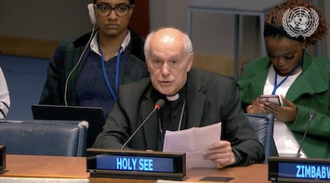
Source: Holy See Mission to UN
On 17 March 2026, in New York, HE Archbishop Gabriele Caccia, Permanent Observer Mission of the Holy See to the United Nations, delivered a Statement at the 70th Commission on the Status of Women.
In his remarks, he underscored the urgent need to strengthen access to justice for all women and girls. Archbishop Caccia emphasized that true access to justice requires more than legal frameworks; it demands addressing the root causes that place women and girls at risk, including poverty, lack of education, discrimination, and violence. He highlighted that many women-particularly those who are poor, rural, or vulnerable-face significant barriers to legal representation and awareness of their rights. Ensuring equal opportunities within families and communities, he noted, is essential to building a just society.
The Permanent Observer also drew attention to the heightened vulnerability of women and girls to exploitation, including human trafficking, forced marriage, surrogacy, and criminal activity. He called for stronger systems of accountability, improved prevention and prosecution efforts. Concluding his statement, he stressed that ensuring access to justice requires a holistic approach-one that combats poverty, strengthens institutions, eliminates discriminatory practices, and promotes education. The Holy See reaffirmed its commitment, alongside numerous Catholic institutions, to supporting these efforts worldwide.
The full text of the statement follows.
Statement by H.E. Archbishop Gabriele Caccia
Permanent Observer of the Holy See to the United Nations
70th Commission on the Status of Women
New York, 9-19 March 2026
Ensuring and strengthening access to justice for all women and girls, including by promoting inclusive and equitable legal systems, eliminating discriminatory laws, policies, and practices, and addressing structural barriers
Madam Chair,
Ensuring access to justice for women and girls requires more than just formal legal protections. It also involves addressing the root causes that put them at risk, prevent them from seeking justice and ultimately undermine their God-given human dignity.
Poverty and its consequences pose significant barriers to accessing justice. Poor women and girls often lack the resources to secure legal representation, and many legal aid organizations are inadequately resourced and overwhelmed. Moreover, those in rural areas are further impeded by a lack of transport and reliable communication networks. In addition, women and girls who have not received a quality education or who do not speak the majority language may be unaware of their rights and how to seek help and navigate the justice system. Equal access to justice also requires daughters to receive the same resources and opportunities as sons, and for families to be healthy and peaceful environment for all.
As Pope Leo XIV has observed, justice "cannot be reduced to the mere application of the law or the work of judges, nor is it limited to its procedural aspects."[1] For this reason, it is important to recognize and dismantle the barriers that women and girls face, such as violence and discrimination. To this end, effective systems of accountability and a culture of responsibility are necessary to prevent abuse and ensure redress for violations.
Failure to tackle these issues also puts women and girls at risk of revictimization and exploitation, including human trafficking. Women and girls constitute a majority of trafficking victims,[2] often for sexual exploitation such as prostitution, but also for forced marriage, surrogacy and criminality.[3] Strengthening efforts to prevent, detect and prosecute those who traffic women and girls is vital.
At the same time, women and girls accused of crimes must enjoy fair trial guarantees, adequate legal representation and safe, hygienic, single-sex detention facilities. The particular health and nutritional needs of pregnant women and mothers of infants must be considered during their detention. In line with international law, girls must receive special care and accommodation in age-appropriate custodial settings.
Madam Chair,
Ensuring access to justice is vital for achieving a just society. This requires a holistic approach involving the eradication of poverty, the combatting of discrimination and violence, the strengthening of institutions, and education. The Holy See and numerous Catholic institutions will continue to support these efforts.
Thank you.
[1] Pope Leo XIV, Address for the Jubilee of Justice, 20 September 2025.
[2] United Nations Office of Drugs & Crime, Global Report on Trafficking in Persons 2024, p. 45 (2024).
[3] Ibid. at p. 47; Reem Alsalem, Report of the Special Rapporteur on violence against women and girls, its causes and consequences: The different manifestations of violence against women and girls in the context of surrogacy, A/80/158, 39.
 Facebook
 Twitter
 LinkedIn
 Print
Print Email
Email








 Facebook
 Twitter
 YouTube
 LinkedIn
 Pinterest