


Rockets over Bethlehem
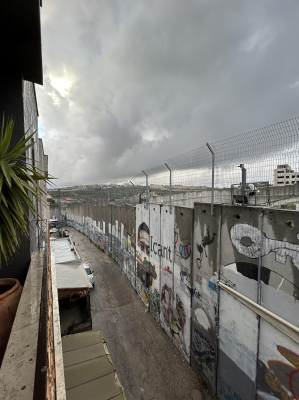
Separation Wall. Image ICN/JS
This morning there was the loudest boom so far. At first it was unclear whether the rocket had struck just north of Bethlehem, near the settlements of Gilo or Har Homa, or farther away. On social media it looked as though there had been an impact opposite the Jaffa Gate in Jerusalem. Mary contacted an acquaintance who lives there to ask how he was doing. Thank God, everything was fine, he replied. It brought back memories of the time of the Second Intifada, more than twenty years ago, when calling to check on the well-being of friends and acquaintances was also a familiar ritual. Mary also contacted Palestinian acquaintances in Haifa.
Yesterday she showed me a photo of fragments from interceptors, components of the defense systems designed to take rockets out of the air. The Palestinian Civil Defence-an agency you hear about more and more in recent years-has handled 96 reports of fallen interceptor fragments since the start of the war, according to Haaretz. On Saturday, thirteen interceptor fragments fell at various locations across the West Bank. A member of Mary's extended family saw such fragments a few hundred meters from her home in Birzeit, not far from Ramallah.
You tell yourself that in West Bank cities such as Beit Jala (next to Bethlehem), where we live, there is little danger. That is different for Palestinian villages located close to Israeli settlements. The Palestinian Civil Defence warns residents not to go onto rooftops during sirens (which can be heard from nearby settlements), not to gather in open areas, and not to touch missile fragments.
In the West Bank, as in many Palestinian towns inside Israel, there are no bomb shelters. An Israeli app regularly sounds an alarm inside the house, but sometimes we hear only a distant boom, without any warning. The question is how long the Israeli defence system can keep this up, and to what extent there is sufficient ammunition in reserve.
Iran appears to be aiming for a war of attrition, with attacks on Gulf states and the global economy. The United States and Israel are caught in a trap: the world economy pushes them to end the war, but there is no clear scenario for doing so without suffering humiliation at the hands of the Iranian regime. What people here fear most is that Israel will continue to climb the so-called escalation ladder and increasingly bomb civilian targets in Iran and Lebanon to force an end to the war.
People are still going to work locally. Within our town, traffic is for now normal. The prices of some vegetables have risen sharply, but supplies still seem adequate for the moment. It is also still possible to exchange money. All of this stands in stark contrast to Gaza, where there are major problems with transport and with access to medicines, cash, water, and food.
Schools and universities are functioning largely online. Only the final graduating class still meets in person at schools. Mobility between West Bank cities has declined sharply, although intercity taxis appear to be running for now. When an alarm sounds in an area, the Israeli army temporarily halts traffic there. Many checkpoints are closed or open only a few hours a day, with all the frustrations that entails. Naturally, the price of fuel is also rising.
At the same time, provocations by settlers are increasing. Is the war once again a "window of opportunity" for the so-called hilltop youth, now that the world's attention is focused elsewhere? In many cases it is not safe to drive past settlements. According to the same Haaretz report, 64 incidents of harassment and violence by settlers were recorded in the first eight days of the war. In fact, the army and the settlers are more dangerous here than the rockets.
On Saturday, three Palestinians were shot dead by settlers; they join the two brothers from the village of Qaryut near Nablus who were killed last Monday by a settler reservist.
Palestinian sources cited in the Haaretz article report that 331 people were arrested in the first six days of March, compared with 866 arrests during the 28 days of February. Another striking fact: based on a preliminary count by B'Tselem and Palestinian media, at least 57 Palestinian apartment buildings had been converted into military bases by Saturday.
Toine van Teeffelen, an MA graduate in social anthropology and a PhD holder in discourse analysis from the University of Amsterdam, moved from the Netherlands to the occupied West Bank in 1994. Alongside working as a guide, he conducted workshops for universities, schools, and educational NGOs, and served as the development director at the Arab Educational Institute, a Pax Christi Partner in Bethlehem. His contributions on discourse analysis and Palestine have appeared in local publications and international journals.
 Facebook
 Twitter
 LinkedIn
 Print
Print Email
Email

















 Facebook
 Twitter
 YouTube
 LinkedIn
 Pinterest