

Bethlehem Update: A Journey into the Way of the Icon
Usama Nicola writes in Bethlehem Updates:
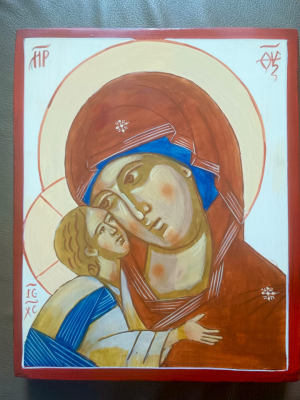
Today marked the final session of the icon-writing course that began in January. While the city was busy with the noise and tension of local council elections, I stepped away into a different kind of space, one of silence, prayer, and attention. I spent five hours completing my icon, and we ended with prayers and blessings, for the icon and for each of us who had taken part in its creation.
This course was not simply about learning an artistic skill. It became a spiritual journey, a path of prayer, fasting, love, and encounter with God. When any journey begins, we stand in one place. When it ends, we are no longer the same. Something in us has shifted. For me, this experience was a movement from darkness toward light, from uncertainty toward reverence, from seeing only with my eyes to learning to see with my heart. As our teacher gently reminded us, we leave the course carrying two icons, one in our hands, and one formed quietly within us.
Iconography is not "religious art" in the usual sense. An icon is not created for self-expression or decoration. It is written, not painted, and it belongs to the prayerful life of the Church. It is part of a sacred tradition that teaches us not only how to look at Christ, but how to encounter Him.
At the beginning, I struggled with a question many people ask, how can Christianity allow images when Scripture says, "You shall not make for yourself a carved image"? Through the course, I came to understand the deeper wisdom of the Church. This commandment speaks against idolatry, the worship of false gods, not against holy images themselves. In fact, Scripture shows that God permitted sacred images, like the cherubim on the Ark of the Covenant. What is forbidden is treating an image as a god, not honouring it as a window that points beyond itself.
At the heart of iconography lies the mystery of the Incarnation. "The Word became flesh" (John 1:14). God, who was once unseen, chose to become visible. As Saint John of Damascus wrote, in the past God could not be depicted, but now, having taken flesh, He can be shown. If Christ truly became human, then His human face can be depicted. To deny this is, in a way, to deny the fullness of the Incarnation.
This truth is echoed in the words of the apostle John, who insists on what was "heard," "seen," and even "touched." God did not remain distant. He entered human history in a tangible way. Icons flow from this reality, they are rooted in the fact that God made Himself visible.
The Church later affirmed this understanding at the Second Council of Nicaea in 787. It clarified an important distinction; we do not worship icons. Worship belongs to God alone. Icons are venerated, meaning they are honored, and that honor passes to the one they represent, Christ, the Virgin Mary, or the saints. The icon is never an end in itself. It is always a doorway.
Before we began writing our icons, we prepared ourselves through fasting and prayer. One ancient prayer especially stayed with me. It reminded me that this work does not belong to me alone, it is guided by the Holy Spirit. For this reason, the iconographer does not sign the icon. It is not about personal recognition, but about obedience, humility, and faith.
This tradition reaches back to the very beginnings of Christianity. In a sense, we live in the land of icons. The first "icon" was the face of Christ Himself, seen by the shepherds in Bethlehem. From that moment, the invisible God entered human history in a visible way.
As I worked, I began to understand why icons look the way they do. They are intentionally simple. They do not try to imitate natural light or earthly beauty. Instead, they point to a transformed world, the Kingdom of God, where light does not fade. As the Book of Revelation says, "They will see His face… and the Lord God will give them light."
Writing an icon taught me to slow down. To pray with my hands. To listen in silence. It reminded me that faith is not only something we think about, it is something we practice, something we enter into. This journey became a quiet movement, from darkness to light, from seeing to believing, and from belief to communion.
I began this journey in one place. I finished it changed.
At the end of the process comes another important step, the blessing and consecration of the icon. In the traditions of the Church, this is not a formality, but a meaningful act. Through prayers, anoints it with blessed oil, and holy water, the icon is dedicated to God. It is no longer simply a crafted object, it becomes a sacred sign, a witness to the presence of God and His saints.
In some traditions, the icon is even placed on the altar for a period of time before being used. This emphasises that the icon belongs to the life of the Church. While the image of a saint is already considered holy by what it represents, the formal blessing gives the icon its full place within the spiritual life of the community.
After this, the icon becomes what many describe as an "open book", a silent teacher, a window through which believers are invited to encounter the divine.
Postscript:
Through his Patreon page, Usama Nicola offers regular reflections, updates from Bethlehem, and spiritual insights, creating a worldwide community of solidarity and shared understanding. His hope is to touch hearts, gently challenge complacency, and remind people everywhere that even in places marked by sorrow, life continues to grow.
You can support Usama's writing ministry by subscribing to Bethlehem Updates as a generous supporter.
Bethlehem Updates: www.patreon.com/bethlehemupdates
 Facebook
 Twitter
 LinkedIn
 Print
Print Email
Email







 Facebook
 Twitter
 YouTube
 LinkedIn
 Pinterest