


Gospel in Art: All in the synagogue were filled with wrath
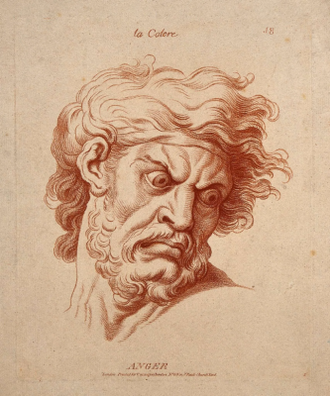
The face of a bearded man expressing Anger (la Colère), Print of a drawing after Charles le Brun, Original drawing circa 1670 © Wellcome Collection, London
Source: Christian Art
Gospel of 9 March 2026
Luke 4:24-30
When Jesus came to Nazareth, he said to the people in the synagogue: 'Truly, I say to you, no prophet is acceptable in his home town. But in truth, I tell you, there were many widows in Israel in the days of Elijah, when the heavens were shut up three years and six months, and a great famine came over all the land, and Elijah was sent to none of them but only to Zarephath, in the land of Sidon, to a woman who was a widow. And there were many lepers in Israel in the time of the prophet Elisha, and none of them was cleansed, but only Naaman the Syrian.' When they heard these things, all in the synagogue were filled with wrath. And they rose up, and drove him out of the town, and brought him to the brow of the hill on which their town was built, so that they could throw him down the cliff. But passing through their midst, he went away.
Reflection on the Old Master Print
We all know the experience of anger. It is something we encounter regularly in our lives. At times, our own anger reveals what is happening within us. We may react sharply, only to realise later that it comes from stress, fatigue, frustration or inner tension. At other moments, anger is stirred by something outside us such as a word spoken, an action taken, a situation that feels unjust, our children that don't behave... Often, it is a mixture of both: what is within us and what comes from beyond us meeting in one strong reaction: anger.
In today's Gospel, we hear that the people in the synagogue at Nazareth were filled with anger toward Jesus. Their reaction seems to arise both from what he said and from what was already present inside their hearts. Jesus points to two prophets who brought God's help not to Israelites, but to outsiders: a widow from Sidon and a man from Syria, lands traditionally seen as hostile to Israel. This challenges their expectations and unsettles them. Their understanding of God was limited, while Jesus reveals a God whose love reaches far beyond the Jewish boundaries and divisions. As the Son, he knows the Father fully, and shows that God's care extends to all. This wider vision of God's love is both liberating and, for some, deeply uncomfortable, even provoking anger.
Our striking print, made in the 18th century after a drawing by Charles Le Brun, focuses entirely on the expressive power of the human face. Le Brun, a leading French Baroque artist and court painter to Louis XIV, was deeply interested in how emotions could be visually represented. He studied facial expressions almost scientifically. Here, anger is rendered with intensity: the man's eyes are wide open, almost bulging, the nostrils flared, and the mouth tightly drawn downward, as if struggling to contain a surge of emotion. His beard and hair seem to echo the agitation within, adding to the sense of inner turbulence. Artists like Le Brun understood that anger is not just seen in one feature, but in the whole face, in the tension of the muscles, the sharpness of the gaze, the tightening of the lips. The result is a powerful drawing: we immediately recognise the emotion of anger, almost feeling it ourselves.
LINKS
Christian Art: https://christian.art/
Today's reading: https://christian.art/daily-gospel-reading/luke-4-24-30-2026/
 Facebook
 Twitter
 LinkedIn
 Print
Print Email
Email












 Facebook
 Twitter
 YouTube
 LinkedIn
 Pinterest