


Peace Sunday: 'War is over if you want it'
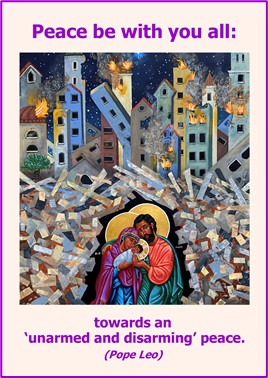
'And so this is Christmas' remains a festive favourite, 55 years after the song was written by John Lennon and Yoko Ono. One day last week I heard it on the car radio three times! Its impactful words and catchy melody remind that whilst we are able to comfortably celebrate Christmas and the New Year, others aren't so lucky. The refrain, 'War is over if you want it,' prompts reflection, especially with 1 January, World Peace Day, being marked tomorrow.
The songs suggests that we are all responsible for conflict and can choose to end it. As long as people imagine they have no control over violence, then they have no control. However, we have a choice to remove the fear of war that hangs over us, just as it more immediately hangs over communities from Gaza to Sudan to Myanmar.
The Catholic Head of the United Nations, António Guterres said in his New Year Message: "Let's resolve to get our priorities straight in 2026. Let's invest more in fighting poverty and less in fighting wars. Let's heal the planet and secure a future of peace and justice."
A key question to ask is: Does everybody want to end war? Many consider war a necessary evil and some want to fuel wars for profit - which is the stance of those involved in arms trading. Remember that the UK is one of the world's largest arms traders.
Another issue is that modern audiences are no strangers to violence in the media and perhaps we have become desensitised to it. Seeing people get punched, maimed, blown up, or killed on screen is common, to the extent that we barely cringe when we see it anymore. And perhaps in the real world we have too much tolerance for actual conflicts and wars going on - and there are far too many of them. We do get pangs of conscience when we see mothers and children struggle to survive each day amidst the flooded and freezing ruins of Gaza, or young families on tiny boats in the Mediterranean fleeing conflict in Africa, but whilst charity may be forthcoming, isn't it also important to join campaigns to abolish war or reduce military expenditure? How many of us believe that we can build a world without militarism and injustice? Remember Proverbs 29: Without a vision the people perish!
Well, the Church is responding.
Pope Leo's theme for World Peace Day is: 'Peace be with you all - Towards an 'unarmed and disarming peace.' And Catholics in England and Wales celebrate a special Sunday for Peace on 18 January. We are reminded that Christians are people of peace, living by the Catholic Social Teaching imperative to be peacemakers. Pope Leo places Gospel nonviolence at the heart of the Church's response to a world increasingly marked by conflict, fear, and fragmentation.
Pax Christi, the international Catholic movement for peace, promotes this message, produces excellent resources, and is permitted a special collection in parishes on Peace Sunday. In return, it provides peace education expertise to parishes, schools, and youth networks. It campaigns for disarmament, and the abolition of nuclear weapons. The August anniversaries of the bombings of Hiroshima and Nagasaki are commemorated annually, and arms fairs are opposed in different towns and cities. Pax Christi promotes a just peace for Palestine and Israel by working in solidarity with peacemakers from all sides - Israeli, Palestinian, Christian, Jewish and Muslim. It upholds the rights of conscientious objectors in different countries, marking International Conscientious Objectors' Day on 15 May. Discussion sessions in person and on zoom to advance understanding of active nonviolence are organised throughout the year. Members are kept well-informed throughout the year.
In preparing for the 2026 World Peace Day, Pax Christi's UK President, Bishop John Arnold of Salford, writes: "I encourage you to celebrate Peace Sunday in your parish, underlining that it is the task of all of us to be peacemakers."
Earlier this year, the UK government increased defence spending, including substantial funds to military projects such as nuclear submarines and warheads, while reducing overseas aid spending. The Church has been critical of this. It considers that security needs to be seen in much broader terms that are not dominated by military and arms company interests. A wider security policy would allocate resources according to actual threats and benefits, including addressing major causes of insecurity such as inequality and climate change.
Pope Leo XlV is a prophetic leader, challenging the waging of war and war planning. "Peace be with you" was his first greeting after his May election. Let us join him in celebrating World Peace Day and Peace Sunday.
Resources at: https://paxchristi.org.uk/peace-sunday-2026/
 Facebook
 Twitter
 LinkedIn
 Print
Print Email
Email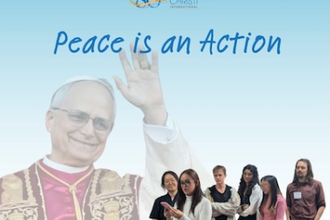






 Facebook
 Twitter
 YouTube
 LinkedIn
 Pinterest