


Gospel in Art: Saint John Damascene, Priest, Doctor
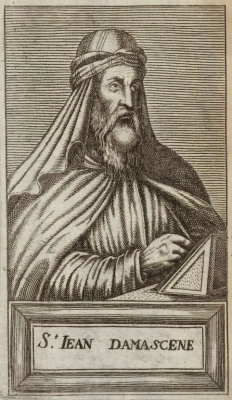
Saint John of Damascus, Engraving by André Thevet (1504-1590), Issued circa 1590 © Christian Art
Source: Christian Art
Gospel of 4 December 2025
Matthew 7:21, 24-27
At that time: Jesus said to his disciples: 'Not everyone who says to me, "Lord, Lord", will enter the kingdom of heaven, but the one who does the will of my Father who is in heaven.
'Everyone then who hears these words of mine and does them will be like a wise man who built his house on the rock. And the rain fell, and the floods came, and the winds blew and beat on that house, but it did not fall, because it had been founded on the rock. And everyone who hears these words of mine and does not do them will be like a foolish man who built his house on the sand. And the rain fell, and the floods came, and the winds blew and beat against that house, and it fell, and great was the fall of it.'
Reflection on the engraving
Saint John of Damascus (c. 676-749), priest, monk, and Doctor of the Church, stands as one of the earliest and most courageous defenders of sacred images - a towering figure in the history of Christian art. It is no surprise that he is among my favourite saints.
Also known as John Damascene, he was a distinguished theologian whose principal contribution to Christian thought was his passionate defence of the veneration of sacred images. This defence is most famously articulated in his seminal work, On the Divine Images (or Apologia Against Those Who Decry Holy Images), written during the height of the iconoclastic controversies in the Byzantine Empire. In this treatise, Saint John argued eloquently against the destruction of religious images, asserting their role as tools to facilitate contemplation and devotion, rather than being objects of worship in themselves. His theological reasoning was rooted in the incarnation: since God became visible in the person of Jesus Christ, it is both permissible and beneficial to depict Christ and other sacred figures in visual form. As God created us in his image,... God himself used images,... and therefore we can do the same,... thus participating in God's joyful creative spirit when we create images.
Saint John's writings laid the intellectual foundation for the Church's affirmation of sacred art at the Second Council of Nicaea in 787, where the veneration of icons was formally upheld. His defence of sacred imagery not only preserved a tradition of visual devotion but also paved the way for the flourishing of Christian art in subsequent centuries. It is not an overstatement to say that without Saint John of Damascus, we might never have seen the grandeur of Gothic cathedrals, the masterpieces of Michelangelo, or the countless works of sacred art that have inspired generations.
Our engraving is by André Thevet (1504-1590), a French priest, explorer, cosmographer, and engraver best known for his work in documenting the peoples and places of the New World and other regions through travel accounts and illustrations. While primarily recognised as a travel writer, Thevet's engravings are closely based on the places he visited. For our engraving he probably used the face of a real person wearing traditional that he may have encountered whilst visiting Syria. For this particular image, he likely sketched the face of an actual person, complete with traditional headdress, whom he encountered during his travels in Syria.
LINKS
Gospel in Art: https://christian.art/
Today's Reflection: https://christian.art/daily-gospel-reading/matthew-7-21-24-27-2025/
 Facebook
 Twitter
 LinkedIn
 Print
Print Email
Email










 Facebook
 Twitter
 YouTube
 LinkedIn
 Pinterest