


Gospel in Art: Feast of Saint Matthew, Apostle & Evangelist
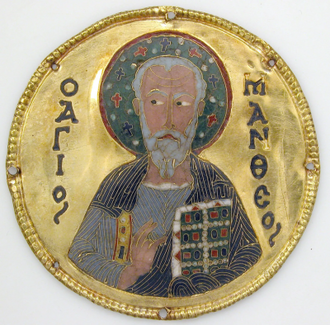
Byzantine Medallion. St Matthew, 1100 Constantinople. Cloisonné gold, silver, enamel. © The Metropolitan Museum, New York.
Source: Christian Art
Gospel of 21 September 2023
Matthew 9:9-13
As Jesus was walking on, he saw a man named Matthew sitting by the customs house, and he said to him, 'Follow me.' And he got up and followed him.
While he was at dinner in the house it happened that a number of tax collectors and sinners came to sit at the table with Jesus and his disciples. When the Pharisees saw this, they said to his disciples, 'Why does your master eat with tax collectors and sinners?' When he heard this he replied, 'It is not the healthy who need the doctor, but the sick. Go and learn the meaning of the words: What I want is mercy, not sacrifice. And indeed I did not come to call the virtuous, but sinners.'
Reflection on the Byzantine Enamelled Medallion
Today we celebrate the feast of Saint Matthew, apostle and evangelist. Before meeting Jesus, Matthew was a tax collector. Tax collectors were notorious for being dishonest, greedy individuals, seen as working for the Roman oppressors. Tax collectors would often exploit taxpayers by exacting more than was required by the state and pocketing the difference for themselves. So their reputation was very negative, to say the least. And yet it is such a man that Jesus calls to be one of his disciples. Jesus can redeem anyone! But Matthew had to give his response to Jesus' calling. When Jesus first saw Matthew and said 'Follow me', Matthew's response was one of immediate obedience and enthusiasm. He abandoned his job and became one of Jesus' Apostles there and then.
Our enamel roundel dating to 1100, was executed in Constantinople and originally surrounded an icon of the archangel Gabriel. The medallions may have been sent as a gift from the Byzantine court to the neighbouring Christian state of Georgia. We see the saint holding his book of Gospels, and his other hand in an orthodox blessing pose. His halo features multicoloured crosses.
The technique used in our artwork is cloisonné enamelling. This metal-and-glass-working tradition thrived in the Byzantine Empire from the 6th to the 12th century AD. Cloisonné is an ancient technique for decorating metal objects with coloured material (usually hardened liquid glass) that is held in place by incised recesses in the metal base. For example if you look at the letter 'M' on the right where there is a small area of missing hardened glass, we can see the incised recess. Note also the beautiful detailing of the frowning forehead of St Matthew.
The Byzantine Empire also mastered a technique using thinner wires, to compartmentalise even smaller areas for colour decoration. Look at the saint's cloak for example which features these thin metal wires.
Saint Matthew, pray for us.
LINKS
Gospel in Art: https://christian.art/
Today's reflection: https://christian.art/daily-gospel-reading/matthew-9-9-13-2023-2/
 Facebook
 Twitter
 LinkedIn
 Print
Print Email
Email















 Facebook
 Twitter
 YouTube
 LinkedIn
 Pinterest