


Sunday Reflection with Canon Robin Gibbons: 3 September 2023
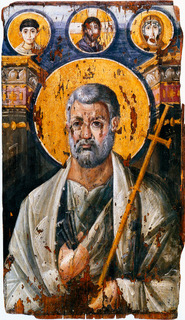
St Peter portrayed as a Roman consul
Twenty Second Sunday in Ordinary Time
The following words of Jesus spoken to Peter, found in this Sunday's gospel, have made me think hard this week: 'He turned and said to Peter, "Get behind me, Satan! You are an obstacle to me. You are thinking not as God does, but as human beings do."(M t 16:23) The apparent harshness of it does not frighten me at all, I don't believe Jesus was actually referring to Peter as a Satan, but his words do place him in a context where the love demanded of a disciple of Jesus needs to demonstrate a commitment to, and an understanding of, the uniqueness of the Christ, and of his mission as has taught it to them.
Peter remonstrates with Jesus privately about his statement that he would suffer and die, and then be raised from the dead, those two aspects of the mission and ministry of the Christ essential to our understanding of salvation: the first that he has to descend with us all into suffering and the finality of death, the second that this will resolve itself in the power of God to raise us up in the resurrection as Jesus himself is raised from death by the power of the Most High. But this is what Peter and the others cannot grasp, for the moment that wider realisation is beyond them, the fact is their inner and outer gaze is fixed on a narrower horizon, one where the struggle for the triumph of good over evil takes place in a context of their own normal life and experiences. It is difficult to move beyond that, to absorb the wider picture and its implications - at least for the moment! I suspect many of us who are not caught up in indulgent conspiracy theories of the tabloids and crazy media stories are also like the disciples, occupied with the everyday joys and trials of life, not really noticing the work of the Spirit in our lives and wider world or the challenges of the Gospel laid before us, that is until with the help of others we are forced to think and to look beyond ourselves!
Jesus' apparent harshness to Peter can be understood not so much as a nasty rebuke or accusation but as a reminder of a reality of sin, evil and the consequences of our choices. Peter is not thinking or feeling well, his thoughts are at that point not in tune with Jesus. Let us think this through! The reality of Satan, the devil, call the powers of evil what one may, are certainly with us. Goodness, badness, virtue and vice are part of the Pandora's box of life, but there are also the choices we make too. We often refer to the heart as that inner place of dialogue and love but also of anger, passive aggression, silent reproach as well as desire. We all know that in physical terms our heart is not the real seat of every emotion and speck of knowledge, but in symbolic and poetic terms it is very much understood as such. Here in the heart of our own being the drama of good and evil is worked out, and with the voice of an informed conscience the self discerns what is good and bad, but also gives itself permission to choose.
This is I think what Jesus' means when he tells Peter to 'get behind me Satan', Peter has chosen wrongly, maybe because he has not listened fully to the teachings of Jesus, but also because he has opened himself up to something very negative an vision of Jesus as a world leader, a power broker, a political force for change, but not the true Messiah. So Jesus, who really loves him, does what love sometimes must do, help another change track, reprove them in order to show and help them on the right way.
I was brought up in an age when discipline was used often, as chastisement as well as to enable change. I was taken up short the other day when I heard on the radio that corporal punishment had not been banned in schools here in England until 1986, but it brought back to me personal memories of punishment at school and discipline at home. That strange half-just punishment of the ferula (the Jesuit equivalent of the cane) at Wimbledon College, where I was at school from 1964. It was a strange punishment because those who ordered it, did not give it, but left that to a Prefect of Discipline who administered it usually just before the end of break, in a specific room and who entered the number of ferulas ordered (and by whom), ones name, and the days date in the punishment record. My memories of that punitive whack on the hands, are muddled, painful-yes, and of a rush to get them both under the cold tap to alleviate the stinging before going to class! Did it work? Not sure, but it still gives rise to lots of funny tales-what it didn't do was cause me psychological harm! That way of punishment is all over now, but it came from a tradition of 'spare the rod and spoil the child' wisdom. Thank goodness that is largely gone because it reminds me of the wrong way to reproach.
Because we understand Jesus in wider terms we see that what Jesus is doing to Peter I not harsh, but honest, for it is altogether a gentler more humane way of making Peter face up to his choices and decisions. What he is suggesting so forcibly misses the point of Jesus' teaching and shows a capacity for self-deception, and so as a friend who loves him, Jesus is switching the points, challenging Peter to change track. I write this thoughts not to start a debate on punishment, but to make the point that we all at times are going to need some way of changing our track of perhaps facing the necessity of retributive justice when we do wrong to others, especially if we have let ourselves go, become heedlessly cruel and selfish, when we too have become part of satan's rule! But this justice has to be based firmly on the rock that is Christ, by seeking truth, rendering good for evil, not judging, yet bringing our errant sister and brother back with a gentle but firm hand as we ourselves would wish to be treated and understood .
Jesus is never nasty, nor cruel, nor vengeful, he is not into punishment like that I mentioned or people still espouse, but he does advocate a discipline of life, a conversion, what we call metanoia. This is the second part of our gospel today, when we move from the dialogue with `Peter to Jesus' call t of complete discipleship where we are to lose ones life in order to find it: 'Then Jesus said to his disciples, "Whoever wishes to come after me must deny himself,take up his cross, and follow me. For whoever wishes to save his life will lose it, but whoever loses his life for my sake will find it.*' (Mt 16: 24,25)
I am afraid there is no way out of that commitment, no matter who we are, where we are, what we do, this call of Christ is part of our baptismal vocation, but it is not about having nothing, it is far more being given what life hands to us-with Christ as part of it all! We surrender the capacity to let evil loose , be as selfish as we want, indulgent and heedless of our world, its living creatures and its peoples and instead take up the cross of servant love, sharing, bearing with each other, repairing the torn fabric of life, caring in love for what has been given to us, and to know that none of this is ours alone, but is shared. That is the lesson to the Kingdom come amongst us, what is expressed in our second reading in the words of Romans 12; 'by the mercies of God, to offer your bodies as a living sacrifice, holy and pleasing to God, your spiritual worship. Do not conform yourselves to this age but be transformed by the renewal of your mind, that you may discern what is the will of God, what is good and pleasing and perfect.' (Rom 12:1,2)
We pray that we may find those wise souls to help us discern, that the Spirit will help us in our weakness, but above all that like Peter we may take up the offer of Christ and follow Him to life!
Lectio Divina
From The Last Testament of Dom Christian de Cherge, modern martyr and monk.
If it should happen one day - and it could be today -
that I become a victim of the terrorism which now seems ready to engulf
all the foreigners living in Algeria,
I would like my community, my Church and my family
to remember that my life was GIVEN to God and to this country.
I ask them to accept the fact that the One Master of all life
was not a stranger to this brutal departure.
I would ask them to pray for me:
for how could I be found worthy of such an offering?
I ask them to associate this death with so many other equally violent ones
which are forgotten through indifference or anonymity.
My life has no more value than any other.
Nor any less value.
In any case, it has not the innocence of childhood.
I have lived long enough to know that I am an accomplice in the evil
which seems to prevail so terribly in the world,
even in the evil which might blindly strike me down.
I should like, when the time comes, to have a moment of spiritual clarity
which would allow me to beg forgiveness of God
and of my fellow human beings,
and at the same time forgive with all my heart the one who would strike me down.
The Way of the Cross
From a homily of Dom Bede Griffiths
Love reveals itself not in the demonstration of power, but in weakness, in urrendering oneself. Now this surrender was a total surrender of himself and it has exercised this tremendous power ever since. We discern in it the sign of a love which is an incomparably greater power than that which is manifest in all the signs and wonders that people admire. So we derive from our reading the first and fundamental theme that the power of God is revealed in Jesus as this power of love which is 'weakness' insofar as it doesn't fight against the enemies, doesn't try to destroy them. It accepts humiliation and defeat, yet conquers by love, conquers by suffering, conquers by self-surrender. It's a tremendous message, when you think about it.
 Facebook
 Twitter
 LinkedIn
 Print
Print Email
Email








 Facebook
 Twitter
 YouTube
 LinkedIn
 Pinterest