

Sunday Reflection with Canon Robin Gibbons - 2 October 2022
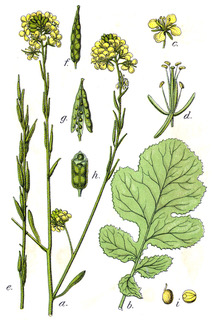
Brassica Nigra - Mustard Seed Image Wiki Wand
Twenty Seventh Sunday in Ordinary Time
It might seem that our world is totally beset with problems, the news does not help and institutions that once we placed our trust and hope in, the Church, Academia, our Politicians, the Judiciary and the Law, Medicine, these and so many other institutions and community structures have not risen up as beacons of truth and justice in the confusion about us, but instead reveal the awful truth that human beings are capable of much nastiness, malice, and self indulgence. Where that is allowed to flourish corruption and mendacity grows.
I do not wish to sound like the voice of doom, but perhaps our mess needs some response from each of us. Rather than simply shrugging our shoulders and hoping others will clear up the detritus Jesus calls us to act. This Sunday's Gospel from Luke (17:5-10) has got me really thinking about my own reactions to all these things and also my lack of response, it has also made me ask the question; 'just what do I think my faith is about?' To help work this through I have returned to looking at the Scriptures and the early centuries of the Church, because it seems to me we are in a place now not unlike it was then.
I have marked Church History papers for many years, and a frequent question given in exams is this: "Was Constantine a blessing for the Christian Church?" I have to admit I have a slight bias here, I was given Constantine as a patron when I made my final monastic oblation, and over time realise that his true character was not what we might imagine. Nevertheless, by granting toleration to Christianity and calling together the bishops in the Council of Nicaea, a route for Christianity was opened up which has been one of very mixed blessings, that of the institutionalisation of the Church where an emphasis on belief began to grow, and where earlier catechesis about following Christ were turned into into catechisms, we replaced the stress on faith in Jesus with tenets about him. Given we also trust in the abiding presence of Christ and the gifts of the Spirit, the supremacy of this ecclesial model is continually challenged for we are called back time and time again to real conversion of life, but it takes inner strength and courage to resist hiding behind structures instead of reforming them and ourselves!
Does this matter? Well if we take what Jesus is saying in Luke, very much so!
This passage presents 'faith' less in terms of our assent to certain Christological doctrines, but more in terms of our steadfast and faithful devotion to Christ. To be honest I see this development in my own life. Where once I thought there were certain things I had to believe in order to be considered a Catholic Christian, I now understand it far more as following the Way of Christ, in other words living out the Gospel in the circumstances of each day, and, most important this, looking beyond the immediate to the heart of the matter.
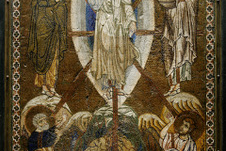
Suddenly I understand my own faith not so much as assent to creeds of formularies, but as a journey of transformation. The Gospel of the Transfiguration has certainly shaped my own understanding, that being in relationship, taking up ones cross, allowing the Divine to embrace us, is how we become like Christ, but we can only do this where we are now! And suddenly those words: 'even if you had faith the size of a mustard seed' gives me hope. No matter how small I may seem, nor how insignificant I might feel, my faith matters, it becomes part of the transformation of God through Christ in me.
If having "faith" - even faith the size of a mustard seed - means having one's whole life opened to the transformation of the Kingdom it also means we take on the vocation of servant as Christ did, becoming 'worthless slaves': those to whom nothing is owed (LK 17:10). We serve in the banquet of God's kingdom simply because of who we are, or more importantly, because of the One to whom we belong. But in doing that we help transform the world!
I take heart from these words of Hildegarde of Bingen: "Even in a world that's being shipwrecked, remain brave and strong." That is our task.
Lectio Divina
Hildegarde of Bingen
On our faith
"Don't let yourself forget that God's grace rewards not only those who never slip, but also those who bend and fall. So sing! The song of rejoicing softens hard hearts. It makes tears of godly sorrow flow from them. Singing summons the Holy Spirit. Happy praises offered in simplicity and love lead the faithful to complete harmony, without discord. Don't stop singing."
Therese of Lisieux
On not worrying in prayer
"I should be distressed that I drop off to sleep during my prayers and during my thanksgiving after Holy Communion. But I don't feel at all distressed. I know that children are just as dear to their parents whether they are sleep or awake and I know that doctors put their patients to sleep before they operate. So I just think that God "knows our frame; he remembers that we are dust."
Dietrich Bonhoeffer
On Faith
"I discovered later, and I'm still discovering right up to this moment, that is it only by living completely in this world that one learns to have faith. By this-worldliness I mean living unreservedly in life's duties, problems, successes and failures. In so doing we throw ourselves completely into the arms of God, taking seriously, not our own sufferings, but those of God in the world. That, I think, is faith."
St John Paul II
On Faith
All the just of the earth, including those who do not know Christ and his Church, who, under the influence of grace, seek God with a sincere heart (cf. Lumen gentium, n. 16), are thus called to build the kingdom of God by working with the Lord, who is its first and decisive builder. Therefore, we must entrust ourselves to his hands, to his Word, to his guidance, like inexperienced children who find security only in the Father: "Whoever does not accept the kingdom of God like a child", Jesus said, "shall not enter it" (Lk 18: 17). From a homily Oct 2004
 Facebook
 Twitter
 LinkedIn
 Print
Print Email
Email














 Facebook
 Twitter
 YouTube
 LinkedIn
 Pinterest