


Today's Gospel in Art: Among pagans it is the kings who lord it over them
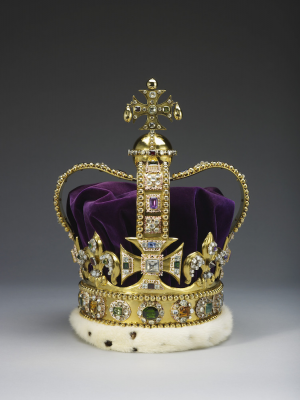
St Edward's Crown, Made for Charles II, by Crown Jeweller, Sir Robert Viner 1661 © Royal Collection Trust
Source: Christian Art
Gospel of 29th December 2021 - Luke 22:24-30
A dispute arose between the disciples about which should be reckoned the greatest, but Jesus said to them:
'Among pagans it is the kings who lord it over them, and those who have authority over them are given the title Benefactor. This must not happen with you. No; the greatest among you must behave as if he were the youngest, the leader as if he were the one who serves. For who is the greater: the one at table or the one who serves? The one at table, surely? Yet here am I among you as one who serves!
'You are the men who have stood by me faithfully in my trials; and now I confer a kingdom on you, just as my Father conferred one on me: you will eat and drink at my table in my kingdom, and you will sit on thrones to judge the twelve tribes of Israel.'
Reflection on the Royal Crown
Today we are looking at St Edward's Crown. This is the crown used at the moment of coronation of the new monarch. This gold crown, set with diamonds and rubies, was made for the Coronation of Charles II in 1661. It was a replacement for the medieval crown which had been melted down in 1649 by the Parliamentarians, and which was thought to date back to the 11th-century royal saint, Edward the Confessor (St Edward), the last Anglo-Saxon king of England. Even though the 17th-century crown follows the original in having four cross-bands and four fleurs-de-lis, it was not a reproduction of the medieval design but a new design that Sir Robert Viner, the crown jeweller at the time, came up with. Until the early 20th century the stones adorning the crown were hired for the occasion of the coronation and then returned. It was only in 1911, for the Coronation of George V, that the Crown was permanently set with its semi-precious stones. It was also used for the 1953 coronation of Queen Elizabeth.
In our reading today Jesus is making clear that kingship in the world's terms is very different from the kingship in Heaven. In the world, kingship and authority are used to exercise power over others. We get told what to do and we follow. The kingdom of heaven is entirely different. There, leadership is not telling others what to do, but true leadership is doing the work yourself, working alongside others. True greatness is living for others rather than living for ourselves.
Jesus isn't against ruling as such, but the way in which it is done is crucial. We are used to think about kingship as a top-down authority, where the king or queen has authority to direct everyone under him or her. Jesus turns this on its head and says that true authority comes from the bottom and works its way up. The one who is greater is the one who humbles himself or herself at the service of others. Authority is not established by virtue of office, but by virtue of service!
LINKS
Today's story - https://christian.art/en/daily-gospel-reading/1037
Christian Art - www.christian.art/
 Facebook
 Twitter
 LinkedIn
 Print
Print Email
Email















 Facebook
 Twitter
 YouTube
 LinkedIn
 Pinterest