


Profile: Port chaplain
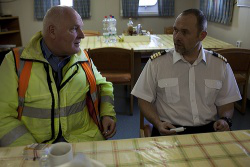
Chaplain Paul Glock with Chief Officer
Paul Glock, the Apostleship of the Sea chaplain to Tilbury in Essex, London’s closest port, has learned to expect the unexpected. Even suicide.
“The body of the seafarer had been taken off the vessel in Tilbury and flown home. But the crew was still in a state of shock. The seafarer was one of their family and the incident had happened in the family home, the ship,” he explains.
“The difficulty is that as a port chaplain you have a very limited and fixed window in which to operate. It is important to give as much time as possible to listening to where each one of the crew is.
“Each seafarer will handle the tragedy in their own way and so you must be able to listen and deal with many different facets and manifestations of their own individual grieving process.
“You have to make yourself available, pray with them, if that is what they want, and maybe bless them. You have to ensure that each has the opportunity to speak with their loved ones at home and ensuring that whoever wants to be heard, is heard.”
He adds that one of the most important areas of support is to ensure that the chaplain in the next port of call is alerted so that he can continue to support the crew as they come to terms with what has happened.
Paul joined Apostleship of the Sea in 2010 following a career in marketing. Like many port chaplains today, he is a permanent deacon. He says his years as a prison chaplain were excellent preparation for this challenging and unusual ministry.
Tilbury is one of the busiest in the country, handling everything from container ships to cruise ships. Paul is also responsible for visiting the ships that dock at the berths and wharves along the River Thames between Canvey Island and the Thames Barrier.
Most seafarers he meets when he goes on baord are from countries in the developing world, such as India and the Philippines. They go to sea in order to support their families, who are often living in poverty.
He usually visits around 20 ships a week. His ministry is to offer seafarers with both practical and spiritual help. This might include providing warm clothes; transport to local shops; phone cards; or rosaries and spiritual reading.
Many seafarers are Catholic and some ask for Mass to be celebrated on board, but this can be difficult, as many ships nowadays are in port for only a brief period. If Mass is celebrated on board, it is normally because the captain requests it.
“What is import is to try and provide the resources for the seafarers to be able to pray and witness when they are at sea. There is always the request for traditionally prayer aids such as rosaries, bibles, prayer cards, prayer books and crucifixes,” he says.
Paul has learned how being away at sea for, sometimes, months can put a strain on relationships with those back home.
“I once met a cadet who was advised on Facebook that his relationship with his girlfriend had ended. He was beside himself that the love of his life had gone and he was thousands of miles from his family.
“And the break-up had taken place in such a clinical and cold way. So what I tried to do was to give him as much access as I could get for him with his family back at home.”
For more information on the AoS visit www.apostleshipofthesea.org.uk
 Facebook
 Twitter
 LinkedIn
 Print
Print Email
Email















 Facebook
 Twitter
 YouTube
 LinkedIn
 Pinterest