


Gospel in Art: Saint Leo the Great, Pope, Doctor
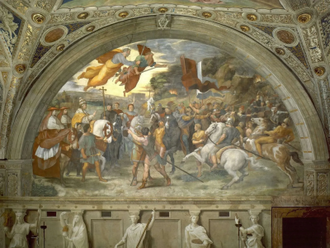
The Meeting of Leo the Great and Attila, by Raphael 1513-1514 © Apostolic Palace, Vatican Museums, Vatican City
Source: Christian Art
Gospel of 10 November 2026
Matthew 16:13-19
At that time: When Jesus came into the district of Caesarea Philippi, he asked his disciples, 'Who do people say that the Son of Man is?' And they said, 'Some say John the Baptist, others say Elijah, and others Jeremiah or one of the prophets.' He said to them, 'But who do you say that I am?' Simon Peter replied, 'You are the Christ, the Son of the living God.' And Jesus answered him, 'Blessed are you, Simon Bar-Jonah! For flesh and blood has not revealed this to you, but my Father who is in heaven. And I tell you, you are Peter, and on this rock I will build my Church, and the gates of hell shall not prevail against it. I will give you the keys of the kingdom of heaven, and whatever you bind on earth shall be bound in heaven, and whatever you loose on earth shall be loosed in heaven.'
Reflection on the Vatican Fresco
This year, as we celebrate the Feast of Saint Leo the Great today, and for the second time since Pope Leo XIV was elected, it is a timely day to revisit who the first Pope Leo was. Pope Leo I (c.400-461), served as Bishop of Rome from 440 until his death and was the first Pope to be styled "the Great" (Pope Gregory I "the Great" (590-604) would follow). His leadership came during a period of great upheaval. The Western Roman Empire was collapsing, theology was under attack, and barbarian invasions threatened Christendom. Leo distinguished himself as a great and wise defender of the faith in very difficult political circumstances.
In his famous letter, the 'Tome of Leo', Pope Leo explains that Jesus is fully God and fully human, and that neither nature diminishes the other. Becoming human did not mean that he stopped being God; being God did not mean that his humanity was somehow a disguise. He truly experienced hunger, tiredness, grief and pain. The same Jesus who wept at Lazarus's tomb also raised Lazarus from the dead. These are not two different persons taking turns: it is the ONE Christ, acting through both his human and divine natures. Leo's letter helped shape the Council of Chalcedon's teaching in 451 that these two natures remain united in one person, without being confused or separated: Jesus is 100% human and 100% divine (not 50% human, 50% divine).
Why does this matter to us? Because the humanity of Jesus assures us that God has truly entered our condition. Jesus knows suffering from within, having lived it himself. And his divinity assures us that, in meeting him, we really encounter God and his saving love.
One of the most enduring images of Leo's papacy is captured in our fresco by Raphael titled The Meeting of Leo the Great and Attila, painted in 1514 in the Apostolic Palace's Stanza di Eliodoro, Vatican City. The fresco depicts the legendary encounter in 452 AD when Leo met Attila the Hun outside Rome and persuaded him to turn back his invasion - an event that reinforced the role of the Pope not just as spiritual leader but also as protector of the city of Rome. In Raphael's scene, Leo rides confidently, flanked by cardinals, while Saints Peter and Paul appear in the sky, bearing swords in miraculous defence of the Church. The composition masterfully blends temporal and spiritual power.
Raphael was only 30 when he painted this. Raphael, born Raffaello Sanzio in Urbino in 1483, was one of the great masters of the Italian Renaissance. Trained first by his father and then by Perugino, Raphael quickly gained fame in Florence for his luminous Madonnas and balanced compositions. His reputation soon reached Pope Julius II, who invited him to Rome around 1508 to decorate the papal apartments in the Vatican Palace. There, Raphael created his most celebrated works - the Stanze di Raffaello - including The School of Athens, The Disputa, and today's fresco The Meeting of Leo the Great and Attila. These frescoes established him as the leading painter of the papal court and one of the defining artists of the High Renaissance. Tragically, Raphael died suddenly in 1520, on Good Friday, at just 37 years old, leaving behind a body of work remarkable for its sheer beauty.
LINKS
Christian Art: www.christian.art
Today's reading: https://christian.art/daily-gospel-reading/matthew-16-13-19-2026-2/
 Facebook
 Twitter
 LinkedIn
 Print
 Email






 Facebook
 Twitter
 YouTube
 LinkedIn
 Pinterest