


Gospel in Art: Give us some of your oil, for our lamps are going out
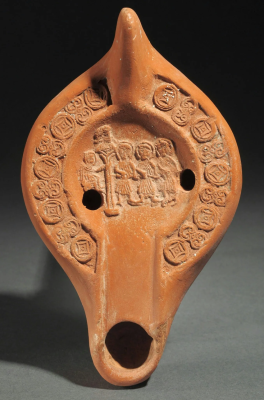
Late-Roman oil lamp, depicting Nebuchadnezzar, Shadrach, Meshach and Abednego, 4-5th C © Museum of the Bible, Washington DC
Source: Christian Art
Gospel of 8 November 2026
Matthew 25:1-13
At that time: Jesus told his disciples this parable, 'The kingdom of heaven will be like ten virgins who took their lamps and went to meet the bridegroom. Five of them were foolish, and five were wise. For when the foolish took their lamps, they took no oil with them, but the wise took flasks of oil with their lamps. As the bridegroom was delayed, they all became drowsy and slept. But at midnight there was a cry, "Here is the bridegroom! Come out to meet him." Then all those virgins rose and trimmed their lamps. And the foolish said to the wise, "Give us some of your oil, for our lamps are going out." But the wise answered, saying, "Since there will not be enough for us and for you, go rather to the dealers and buy for yourselves." And while they were going to buy, the bridegroom came, and those who were ready went in with him to the marriage feast, and the door was shut. Afterwards the other virgins came also, saying, "Lord, lord, open to us." But he answered, "Truly, I say to you, I do not know you." Watch therefore, for you know neither the day nor the hour.'
Reflection on the oil lamp
We tend to expect the bride to be a little late for her wedding. But in today's Gospel, it is the bridegroom who keeps everyone waiting! We cannot be entirely sure of the precise way that the wedding ceremony took in the time of Jesus. It seems that it was customary for the groom to first go to the house of the bride early evening (often already dark outside) and then to take his bride, in procession, back to his own house for a celebratory meal. Although we cannot reconstruct every detail of these customs with certainty, the young women in the parable have an important role: to lead the procession with their lamps and then to welcome the bridegroom in his own house for when the procession arrives. They needed a lot of oil to keep their lamps lit for the entire proceedings. Their lamps would have brought both practical light and a festive glow to the darkness. We can imagine the excitement as those flames approached, announcing that the celebration was about to begin. But a flame needs fuel, and five of the women have brought no reserve of oil. They are ready for a wedding that runs to schedule; but they are unprepared for the long wait.
The bridegroom represents Christ, whose coming his followers await. It is a beautiful image to pause over: Jesus describes our meeting with him through the joy and closeness of a wedding. He comes to draw us into communion with himself. Yet the delay matters. Faith involves periods when God seems distant, prayers appear unanswered, and our early enthusiasm begins to fade. Interestingly, all ten women fall asleep with the long wait. The difference between them is the preparation they have made. Jesus knows that we grow tired. His question is whether we are tending the relationship that will sustain us through the waiting.
Jesus does not give us a precise definition of the oil, but we can see in it the steady nourishment of a life turned towards God: prayer, kindness, forgiveness and the quiet habit of doing what is right. These keep the flame alive when feelings alone can no longer sustain it. Others can encourage us, but they cannot live that relationship on our behalf. The closed door in our reading gives the story its urgency: we cannot keep postponing our response to God. Today is an opportunity to pray, to make peace, to offer the kindness and fling open the door!
Our little clay oil lamp was made in North Africa in the 4th century. It is small and can be held in the palm of a hand. Although it dates from several centuries after Jesus, it belongs to the same long tradition of oil lamps used throughout the ancient Mediterranean. It also carries a biblical story: its decoration depicts the enthroned King Nebuchadnezzar, a bust of the king raised on a column, and the three young men, Shadrach, Meshach and Abednego, who refused to worship his golden image. An everyday household object thus becomes a reminder of faithfulness under pressure. We can imagine how lighting such a lamp might have brought that story into the ordinary routines of a home. Yes, art was already used to tell the story of Salvation.
These lamps worked very simply. Oil, commonly olive oil, was poured through a filling hole into the hollow body (the two holes at the top). A wick made from plant fibres rested in the oil, with one end protruding through an opening at the nozzle. The wick absorbed the oil and fed it steadily to the flame. Keeping the light burning meant replenishing the fuel and tending the wick. These lamps were small, portable, ideal for processions, and thus ran out of oil quickly. However carefully made or beautifully decorated a lamp might be, it cannot fulfil its purpose without fuel. Our faith, too, needs nourishment if it is to bring the light of Christ into the lives around us.
LINKS
Christian Art: www.christian.art
Today's reading: https://christian.art/daily-gospel-reading/matthew-25-1-13-2026/
 Facebook
 Twitter
 LinkedIn
 Print
 Email















 Facebook
 Twitter
 YouTube
 LinkedIn
 Pinterest