


Vatican at UN Statement on 'Peaceful Uses of Outer Space'
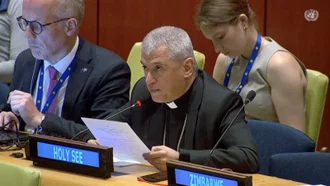
Source: Permanent Observer Mission of the Holy See to the United Nations
On 28 October 2026, in New York, His Excellency Archbishop Christophe Z EL Kassis, Permanent Observer of the Holy See to the United Nations, delivered a statement under Agenda Item 46, "International cooperation in the peaceful uses of outer space," in the Fourth Committee of the 81st Session of the United Nations General Assembly.
Archbishop El Kassis emphasized that outer space is a common good entrusted to the responsibility of the entire human family and that its exploration and use must benefit all peoples without creating new inequalities or exclusions. Recalling the principles of the 1967 Outer Space Treaty, he highlighted the potential of space-based technologies to address global challenges, including climate change, food insecurity, water scarcity and natural disasters. In this regard, he called for greater international cooperation, particularly through capacity-building and the sharing of scientific knowledge, to ensure that developing countries can fully benefit from technological advances.
Furthermore, he expressed concern over the growing challenges posed by orbital congestion, space debris and expanding commercial activities, stressing the need for a coordinated international response and responsible stewardship of the space environment to safeguard its peaceful and sustainable use for future generations.
Finally, Archbishop El Kassis underscored the essential role of the Committee on the Peaceful Uses of Outer Space (COPUOS) in fostering dialogue and international cooperation. He encouraged States to strengthen multilateral cooperation and mutual trust to preserve outer space as a realm of peace, stability and cooperation for the benefit of present and future generations.
The text of the statement follows:
Statement by HE Archbishop Christophe Z El Kassis, Permanent Observer of the Holy See to the United Nations at the Fourth Committee under Agenda item 46: International cooperation in the peaceful uses of outer space of the 81st Session of the United Nations General Assembly
New York, 28 October 2026
Mr Chair,
Outer space is a common good entrusted to the responsibility of the entire human family. Its exploration and use hold extraordinary promise for scientific advancement and integral human development. However, it is essential that such progress benefits all peoples, without creating new inequalities or exclusions.
As set out in the 1967 Outer Space Treaty, the exploration and utilization of outer space shall be carried out for the benefit and in the interests of all countries, regardless of their degree of development. Space-based technologies represent a valuable means of addressing the pressing challenges facing our planet, including climate change, food insecurity, water scarcity and natural disasters.
Therefore, there is a need for greater international cooperation, particularly in terms of capacity-building and sharing of scientific knowledge, so that developing countries can benefit fully from these advances.
Furthermore, the expansion of space activities demands greater care for the space environment. Increasing orbital congestion and space debris, coupled with growing commercial activities, present challenges that require a coordinated international response.
A responsible stewardship of outer space, with the objective of ensuring that scientific and technological progress does not compromise its peaceful and sustainable use by future generations, is imperative.
Mr Chair,
The role of the Committee on the Peaceful Uses of Outer Space (COPUOS) in fostering dialogue and international cooperation is paramount. As space activities continue to expand, it is essential that multilateral cooperation and mutual trust are strengthened to ensure that these activities are conducted responsibly and peacefully. The Holy See therefore encourages States to pursue their common efforts to preserve outer space as a realm of peace, stability, and cooperation, for the benefit of present and future generations.
Thank you, Mr Chair.
 Facebook
 Twitter
 LinkedIn
 Print
 Email



















 Facebook
 Twitter
 YouTube
 LinkedIn
 Pinterest