


Gospel in Art: Blessed is that servant whom his master will find
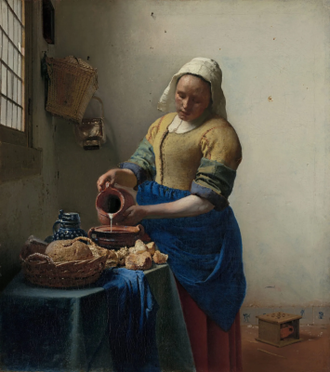
The Milkmaid, by Johannes Vermeer, 1660 © Rijksmuseum, Amsterdam
Source: Christian Art
Gospel of 21 October 2026
Luke 12:39-48
At that time: Jesus said to his disciples, Know this, that if the master of the house had known at what hour the thief was coming, he would not have left his house to be broken into. You also must be ready, for the Son of Man is coming at an hour you do not expect.'
Peter said, 'Lord, are you telling this parable for us or for all?' And the Lord said, 'Who then is the faithful and wise manager, whom his master will set over his household, to give them their portion of food at the proper time? Blessed is that servant whom his master will find so doing when he comes. Truly, I say to you, he will set him over all his possessions. But if that servant says to himself, "My master is delayed in coming", and begins to beat the male and female servants, and to eat and drink and get drunk, the master of that servant will come on a day when he does not expect him and at an hour he does not know, and will cut him in pieces and put him with the unfaithful. And that servant who knew his master's will but did not get ready or act according to his will, will receive a severe beating. But the one who did not know, and did what deserved a beating, will receive a light beating. Everyone to whom much was given, of him much will be required, and from him to whom they entrusted much, they will demand the more.'
Reflection on the painting
When we hear the word "Beatitudes", we tend to think of Jesus' familiar blessings in the Sermon on the Mount. But there are other beatitudes scattered throughout the Gospels. We find one in today's reading: "Blessed is that servant whom his master will find at work." What is this servant doing to deserve such praise? He is looking after the household, making sure that everyone receives their food at the proper time. His faithfulness is expressed through the ordinary, necessary work of caring for others.
The language of masters and slaves understandably makes us uncomfortable today. For us in the twenty-first century, that responsibility takes many forms. We may be caring for children or an elderly parent, managing colleagues, teaching pupils or simply keeping an eye on a neighbour. Each brings opportunities to be dependable, fair and kind, especially when nobody is watching or likely to thank us. In a world that gives so much attention to being seen, Jesus places value on quietly doing what needs to be done. If he arrived in the middle of our ordinary day, would he find us making life a little better for someone else?
A painting depicting this quiet service is our canvas by Johannes Vermeer. In his Milkmaid, painted around 1660, a woman quietly gets on with preparing food. She seems quite unaware of us. There is nobody beside her offering thanks, yet she gives the task her full attention. It is the sort of work that keeps a household going and is easily taken for granted. Everyday life had appeared in art before, but seventeenth-century Dutch painters gave it a remarkable new prominence. Kitchens, courtyards and people doing ordinary jobs became subjects worth painting in their own right. There is something quietly revolutionary about the attention Vermeer gives this woman: her daily work is worthy of our time and admiration. For our reflection today, she offers a lovely image of faithful service that seeks no applause.
And there is so much else to enjoy in this little painting! Despite its title, she is a kitchen maid rather than someone milking cows. So in a way, to me, the title of the painting has always felt a little wrong perhaps. With her sleeves rolled up, she carefully tips an earthenware jug, sending a thin stream of milk into the vessel below. The bread on the table suggests she may be making bread pudding - a good use for yesterday's leftovers! Light enters from the left, catching her yellow blouse, blue apron and the crusts of bread, which Vermeer makes sparkle with tiny dots of paint. Down on the floor sits a wooden foot warmer, with blue-and-white Delft tiles lining the wall behind it. Vermeer originally included a rack of jugs and a large basket, then painted them out to simplify the scene. Everything draws us back to concentrating on the milkmaid.
A little more recent history to end with: The Milkmaid went to New York for the 1939 World's Fair and ended up staying much longer than planned. War broke out during the fair, and the subsequent German occupation of the Netherlands prevented her return. She spent the war years safely in America, appearing in Detroit and at New York's Metropolitan Museum before returning home after the liberation.
LINKS
Christian Art: www.christian.art
Today's Reading: https://christian.art/daily-gospel-reading/luke-12-39-48-2026/
 Facebook
 Twitter
 LinkedIn
 Print
 Email
















 Facebook
 Twitter
 YouTube
 LinkedIn
 Pinterest