


Gospel in Art: One's life does not consist in the abundance of one's possessions
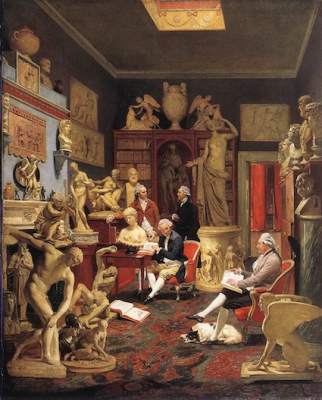
Charles Townley and Friends in His Library at Park Street, Westminster by Johann Zoffany, 1782 © Towneley Hall Art Gallery & Museum
Source: Christian Art
Gospel of 19 October 2026
Luke 12:13-21
At that time: Someone in the crowd said to Jesus, 'Teacher, tell my brother to divide the inheritance with me.' But he said to him, 'Man, who made me a judge or arbitrator over you?' And he said to them, 'Take care, and be on your guard against all covetousness, for one's life does not consist in the abundance of one's possessions.' And he told them a parable, saying, 'The land of a rich man produced plentifully, and he thought to himself, "What shall I do, for I have nowhere to store my crops?" And he said, "I will do this: I will tear down my barns and build larger ones, and there I will store all my grain and my goods. And I will say to my soul, 'Soul, you have ample goods laid up for many years; relax, eat, drink, be merry.' " But God said to him, "Fool! This night your soul is required of you, and the things you have prepared, whose will they be?" So is the one who lays up treasure for himself, and is not rich towards God.'
Reflection on the painting
Many of us find it difficult to part with things. Cupboards fill, shelves grow crowded, and objects kept "just in case" quietly take over our homes. Collecting shares something of this impulse to gather and preserve, but it can also be a wonderful pursuit. To cherish paintings, sculpture, books or ceramics is to appreciate some of the most remarkable things human hands have made. A collection can nurture curiosity, safeguard beauty and bring delight to others. Yet, like every earthly pleasure, it needs to be approached with discernment. There is always the possibility that our enjoyment of what we have will give way to a restless desire for more.
The rich man in today's Gospel reveals where that desire can lead. Faced with a plentiful harvest, he thinks only of enlarging his storage. The abundance around him never prompts him to consider the needs of others. His barns will be full, but his world has become terribly small: everything revolves around himself. Jesus challenges us to examine our own relationship with possessions. Can we enjoy them gratefully, share them generously and let them go when necessary? Or have we begun to rely on them for a security they cannot provide?
Johann Zoffany's Charles Townley and Friends in His Library at Park Street, Westminster, painted in 1782, offers a fascinating setting for these questions. Townley sits on the right in a red velvet armchair, accompanied by three friends and surrounded by classical sculpture. Zoffany gathers into this single room works that were actually displayed throughout the house, creating an imagined concentration of the collector's treasures. The painting celebrates the fascination with Greek and Roman antiquity that animated eighteenth-century collecting... or even hoarding, as the interior looks rather cluttered.
We need not see Townley as another version of the rich man in the parable. The presence of his friends suggests that a collection can become a source of conversation, learning and shared pleasure. Yet the sheer abundance of objects invites reflection: how do we make room for people among the things we treasure? People should always matter more than possessions. So the question maybe, if you like collecting things, is not simply about what or how much we have collected,.... but what our collecting has made of us...
LINKS
Christian Art: www.christian.art
Today's Reading: https://christian.art/daily-gospel-reading/luke-12-13-21-2026/
 Facebook
 Twitter
 LinkedIn
 Print
 Email














 Facebook
 Twitter
 YouTube
 LinkedIn
 Pinterest