


Gospel in Art: Saint Ignatius of Antioch, Bishop, Martyr
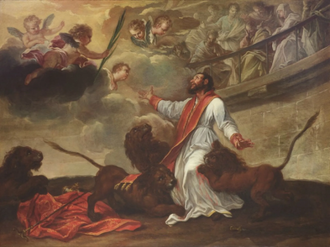
Martyrdom of St Ignatius of Antioch, by Pier Leone Ghezzi, 1750 © Galleria Nazionale d'Arte Antica, Palazzo Barberini and Palazzo Corsini Rome
Source: Christian Art
Gospel of 17 October 2026
John 12:24-26
At that time: Jesus said to his disciples, 'Truly, truly, I say to you, unless a grain of wheat falls into the earth and dies, it remains alone; but if it dies, it bears much fruit. Whoever loves his life loses it, and whoever hates his life in this world will keep it for eternal life. If anyone serves me, he must follow me; and where I am, there will my servant be also. If anyone serves me, the Father will honour him.'
Reflection on the painting
Today we celebrate the early Church Father, Bishop, and martyr Saint Ignatius of Antioch. Born in Syria in the middle of the 1st century, Ignatius is said to have been personally instructed (along with another future martyr, Saint Polycarp) by the Apostle John. When Ignatius became the Bishop of Antioch around the year 70, he assumed leadership of a local church that was, according to tradition, first led by Saint Peter before his move to Rome. Located in present-day Turkey, Antioch was one of the main cities of the Roman Empire. It was also the place where the believers in Jesus' teachings and His resurrection were first called 'Christians'.
Ignatius' letters passionately talk about the importance of Church unity, the dangers of heresy, and the importance of the Eucharist as the 'medicine of immortality'. His writings contain the first surviving written description of the Church as "Catholic," from the Greek word indicating both universality and fullness. About his impending martyrdom he wrote: "Now I begin to be a disciple. Let fire and the cross; let the crowds of wild beasts; let tearings, breakings, and dislocations of bones; let cutting off of members; let shatterings of the whole body; and let all the dreadful torments of the devil come upon me: only let me attain to Jesus Christ."
St Ignatius of Antioch bore witness to Christ publicly for the last time in Rome's Flavian Amphitheater, where is was mauled to death by lions. We see this moment depicted in our painting by Pier Leone Ghezzi. Our saint kneels among the lions, his arms open and his eyes raised towards heaven. Above him, an angel extends the palm of martyrdom, the sign of victory through faithfulness to Christ. Even as the beasts attack him, Ignatius reaches towards the heavenly life awaiting him. Notice how the amphitheatre seems already to open onto heaven. Clouds and angels enter the arena, bringing the promise of eternity into the very place of suffering. The spectators look down upon his death; Ignatius looks up towards his welcome.
Saint Ignatius gives us the words with which to understand this painting: "I am the wheat of God," he writes, longing to become "the pure bread of Christ." His language is deeply Eucharistic: he desires his whole life to become an offering, united with Jesus. The lions may tear his body, but they cannot tear him away from Christ.
LINKS
Christian Art: www.christian.art
Today's Reading: https://christian.art/daily-gospel-reading/john-12-24-26-2026-2/
 Facebook
 Twitter
 LinkedIn
 Print
Print Email
Email








 Facebook
 Twitter
 YouTube
 LinkedIn
 Pinterest