

Gospel in Art: Saint Teresa of Avila, Virgin, Doctor
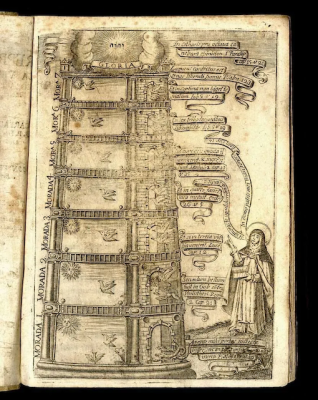
Page from Representaciones de la Verdad Vestida, of the Interior Castle, Engraved by Fray Juan de Roxas, publisher Antonio Goncalez de Reyes, Madrid, 1679 © Bridwell Library Special Collections, SMU, Dallas, Texas.
Source: Christian Art
Gospel of 15 October 2026
John 15:1-8
At that time: Jesus said to his disciples, 'I am the true vine, and my Father is the vine dresser. Every branch in me that does not bear fruit he takes away, and every branch that does bear fruit he prunes, that it may bear more fruit. Already you are clean because of the word that I have spoken to you. Abide in me, and I in you. As the branch cannot bear fruit by itself, unless it abides in the vine, neither can you, unless you abide in me. I am the vine; you are the branches. Whoever abides in me and I in him, he it is that bears much fruit, for apart from me you can do nothing. If anyone does not abide in me he is thrown away like a branch, and withers; and the branches are gathered, thrown into the fire, and burned. If you abide in me, and my words abide in you, ask whatever you wish, and it will be done for you. By this my Father is glorified, that you bear much fruit and so prove to be my disciples.'
Reflection on the engraved book page
Today we celebrate the life of Saint Teresa of Ávila (1515-1582), one of the great giants of the Church. To understand her place in history, it helps to remember the world she was born into: just two decades after Columbus opened the Western Hemisphere to Europe, and only two years before Martin Luther set in motion the Protestant Reformation. She lived through a century of upheaval and renewal, including the Council of Trent, which concluded less than twenty years before her death. Against this turbulent backdrop, Teresa stood out as a spiritual beacon whose influence has stretched far beyond her own time.
In a world largely shaped by men, Teresa charted her own course. She defied her father's opposition to enter the Carmelite Order and became a woman of extraordinary contrasts: wise yet practical, intellectual yet grounded, mystical yet full of energy for reform. She was a contemplative who also rolled up her sleeves to renew her Order. Her writings, especially The Way of Perfection and The Interior Castle, remain treasures of Christian spirituality. In 1970 she was declared a Doctor of the Church-the first woman to receive that title-though in truth she had already long been recognised as a teacher guiding hearts and minds of the faithful.
Saint Teresa's Interior Castle (written in 1577) is perhaps her greatest spiritual masterpiece. In it, she describes the soul as a magnificent crystal castle, within which are seven mansions or dwelling places. Each mansion represents a stage in the soul's journey toward God, beginning with the outer rooms of conversion and prayer, moving gradually inward through purification, detachment, and deeper intimacy, until reaching the innermost chamber where the soul enjoys mystical union with Christ. Teresa emphasises that the path is not reserved for mystics alone: every Christian is called to enter this "castle within," through prayer, humility, and perseverance. At its heart, the Interior Castle is an invitation to discover that God is not distant but already dwelling at the centre of our being, waiting for us to approach Him more and more each day.
Our engraving is from Representaciones de la Verdad Vestida by Fray Juan de Roxas (1679). Teresa's vision of the Interior Castle is depicted in symbolic form. We see the castle rising upward in seven tiers, each level representing one of the "mansions" of the soul. The façades slope gently, suggesting both ascent and the narrowing more focussed path toward God. At the base, Saint Teresa herself appears with a book in hand, teaching and guiding the viewer through the journey. The soul is represented as a dove, entering through the door of the castle and moving steadily toward the radiant divine Sun at its centre - the image of God dwelling within. Outside the walls, wild creatures and vermin symbolize the vices and temptations that harass the soul from outside but cannot penetrate the castle itself. The inscriptions placed by each doorway indicate the virtues required to pass from one dwelling to the next. It is an image at once theological and practical: the whole of the spiritual life shown as a pilgrimage inward, guided by Teresa's teaching, from the outer walls of conversion to the innermost union with God.
LINKS
Christian Art: www.christian.art
Today's Reading: https://christian.art/daily-gospel-reading/john-15-1-8-2026-3/
 Facebook
 Twitter
 LinkedIn
 Print
Print Email
Email











 Facebook
 Twitter
 YouTube
 LinkedIn
 Pinterest