

Gospel in Art: Saint Callistus, Pope, Martyr
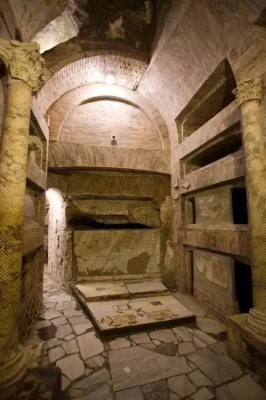
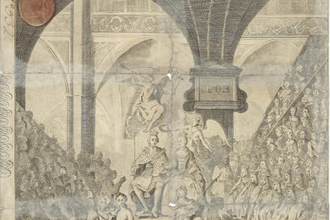
The Crypt of the Popes ('The Little Vatican'), Built and used mainly between 150-308AD © Christian Art
Source: Christian Art
Gospel of 14 October 2026
Luke 11:42-46
At that time: Jesus said, 'But woe to you Pharisees! For you tithe mint and rue and every herb, and neglect justice and the love of God. These you ought to have done, without neglecting the others. Woe to you Pharisees! For you love the best seat in the synagogues and greetings in the market-places. Woe to you! For you are like unmarked graves, and people walk over them without knowing it.'
One of the lawyers answered him, 'Teacher, in saying these things you insult us also.' And he said, 'Woe to you lawyers also! For you load people with burdens hard to bear, and you yourselves do not touch the burdens with one of your fingers.'
Reflection on the Catacombs
Pope Saint Callistus I whose papacy was from 218 - 222 AD, was a man whose life shows the astonishing reversals God can bring about. Born a slave in Rome in the late second century, he was condemned at one point to hard labour in the mines of Sardinia. Yet he found his way out of slavery and discovered a thriving Christian community he became very engaged with. He was ordained a deacon by Pope Zephyrinus. In 218 he was chosen as Bishop of Rome. From being shackled in the mines, he was raised to shepherd the flock of Christ ... a reminder that the Lord often calls those whom the world overlooks, to do amazing things.
As pope, Callistus became known for his emphasis on God's mercy. He allowed sinners who had committed very grave faults and sins, even to the point of apostatising (for early Christians, apostatising meant publicly renouncing their faith in Christ - for example, by offering worship to the Roman emperor or the Roman gods), to be reconciled with the Church, a stance that caused controversy at the time but revealed the very heart of the Gospel. He believed that the Church was not a club for saints, but a community of sinners trying to improve their ways. He thus also started to admit into the Church converts from sects or schisms who had distanced themselves from Christians. Forgiveness alone could welcome them back into the Church. He fought with success the heretics, and established the practice of absolution of all sins, including adultery and murder. He is thus a key figure in the establishment of the Sacrament of Confession. During a wave of persecution in 222, he was arrested and martyred, thrown into a well.
His names resonates probably most with the Catacombs of Saint Callistus, along the Appian Way in Rome. These catacombs are among the most important early Christian burial places. They date back to the mid-2nd century and became the official cemetery of the Church of Rome. When Callistus was a deacon under Pope Zephyrinus, he was placed in charge of this vast underground complex, which could hold tens of thousands of tombs. Because of his management and later his role as pope, the catacombs took his name. They became the burial site of many early popes. In fact, the famous "Crypt of the Popes" is located there, where nine popes and several martyrs were interred. While the catacombs predate Callistus, his association with them was so strong that they remain linked to his name.
"The Crypt of the Popes', illustrated here, is often called the "little Vatican" of the underground. It served as the official burial chamber for nine 3rd-century popes (Popes Pontian (230-235), Anterus (235-236), Fabian (236-250), Lucius I (253-254), Stephen I (254-257), Sixtus II(257-258), Dionysius (259-268), Felix I (269-274), and Eutychian (275-283) and several martyrs during the times of persecution. Simple inscriptions, carved in Greek, still mark the resting places of these early successors of Peter. Though the tombs are now empty, the space remains profoundly moving when one visits. During my four year studies in Rome, I went there quite regularly as it was such an awe-inspiring place. The Crypt of the Popes is a reminder that the Church was built not on worldly power, but on the quiet witness of men who gave their lives to shepherd Christ's flock, even unto death. Standing in that dim, narrow chamber, one senses both the fragility of those early centuries and the unshakeable faith of the early Christians that carried the Church through our her early history.
Pope Callistus I was not buried in the Crypt of the Popes in the Catacombs of Saint Callistus, even though the complex is named after him. According to tradition, after his martyrdom in 222 (he was thrown into a well during a local riot in Trastevere), Callistus was buried in the cemetery of Calepodius on the Via Aurelia.
LINKS
Christian Art: www.christian.art
Today's Reading: https://christian.art/daily-gospel-reading/luke-11-42-46-2026/
 Facebook
 Twitter
 LinkedIn
 Print
Print Email
Email











 Facebook
 Twitter
 YouTube
 LinkedIn
 Pinterest