


Gospel in Art: Feast of Saint Edward the Confessor, King
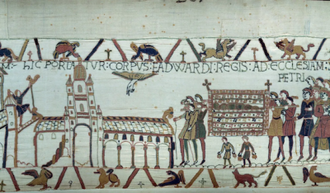
The Bayeux Tapestry. Scene section of the funeral of King Edward the Confessor of England, his body is taken to Westminster Abbey © Wikimedia
Source: Christian Art
Gospel of 13 October 2026
Matthew 5:1-12a
At that time: Seeing the crowds, Jesus went up on the mountain, and when he sat down, his disciples came to him. And he opened his mouth and taught them, saying: 'Blessed are the poor in spirit, for theirs is the kingdom of heaven. Blessed are those who mourn, for they shall be comforted. Blessed are the meek, for they shall inherit the earth. Blessed are those who hunger and thirst for righteousness, for they shall be satisfied. Blessed are the merciful, for they shall receive mercy. Blessed are the pure in heart, for they shall see God. Blessed are the peacemakers, for they shall be called sons of God. Blessed are those who are persecuted for righteousness' sake, for theirs is the kingdom of heaven. Blessed are you when others revile you and persecute you and utter all kinds of evil against you falsely on my account. Rejoice and be glad, for your reward is great in heaven.'
Reflection on the Bayeux Tapestry
Today we celebrate the Feast of Saint Edward the Confessor, one of the great saints of England and a saint whose story is inseparable from Westminster. Born around 1003, Edward became King of England in 1042 and reigned for more than twenty years. Yet history remembers him not principally for battles or conquests, but for his faith! The title 'Confessor' does not mean that he was a priest who heard confessions. In the early Church, a "confessor" was someone who openly professed, or confessed, the Christian faith by the witness of his life. Edward did exactly that.
One of the most beautiful stories told about Edward concerns a poor man who approached him asking for alms. Edward had no money with him, and so, he took a precious ring from his finger and gave it to the beggar. Some time later, two English pilgrims travelling in the Holy Land met an old man who revealed himself to them as Saint John the Evangelist. He gave them the same ring and asked them to return it to Edward, telling them that it was he who had appeared to the king disguised as a poor man. Whether we read the story as history or as the beautiful language of medieval devotion, its message is beautiful: what we place into the hands of the poor, we place into the hands of Christ!
Edward is particularly associated with Westminster Abbey, the great church he rebuilt beside his royal palace. It was consecrated shortly before his death in January 1066, and Edward was buried there. His shrine remains at the heart of the Abbey today.
There is a wonderful opportunity to come face to face with Edward at the moment, because Saint Edward the Confessor actually appears in the Bayeux Tapestry, now on display at the British Museum. The exhibition has captured the public imagination: the first release of tickets sold out within hours, making it the Museum's fastest-selling exhibition ever. It is perhaps not surprising. For the first time in almost a thousand years, this extraordinary 70-metre-long embroidery has returned to England, telling in thread the dramatic story of the events surrounding 1066.
And Edward is there right at the beginning of the story and the tapestry. The very first scene shows the elderly king seated on his throne, speaking with Harold Godwinson. That is significant because Edward's death without an heir would set in motion the struggle for the English crown that eventually culminated in the Battle of Hastings. Later in the tapestry we encounter Edward again, after Harold's return from Normandy, and then in a particularly moving sequence surrounding his death. We see the newly built Westminster Abbey, with the hand of God appearing above it; Edward's body is carried towards the church for burial, while a workman is still shown on its roof, completing the building. Then we see Edward on his deathbed, with his wife Edith grieving at his feet and Harold beside him. Edward died on 5 January 1066, only days after his Abbey had been consecrated.
It is rather beautiful that nearly a thousand years later, crowds are once again stopping to look at these little embroidered figures of Saint Edward. Kings, kingdoms and dynasties come and go,... yet the quiet witness of a holy life always endure...
LINKS
Christian Art: www.christian.art
Today's Reading: https://christian.art/daily-gospel-reading/matthew-5-1-12a-2026-2/
 Facebook
 Twitter
 LinkedIn
 Print
Print Email
Email












 Facebook
 Twitter
 YouTube
 LinkedIn
 Pinterest