

Gospel in Art: Blessed the breasts at which you nursed
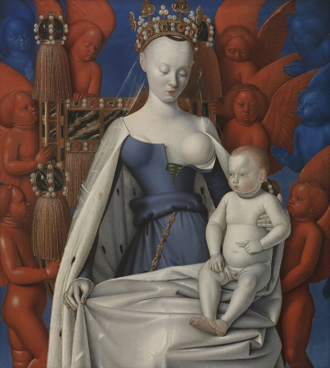
Mary and Child Surrounded by Seraphim and Cherubim by Jean Fouquet,1452-1458 © Royal Museum of Fine Arts, Antwerp
Source: Christian Art
Gospel of 10 October 2026
Luke 11:27-28
At that time: As Jesus was speaking, a woman in the crowd raised her voice and said to him, 'Blessed is the womb that bore you, and the breasts at which you nursed!' But he said, 'Blessed rather are those who hear the word of God and keep it!'
Reflection on the painting
Today's Gospel is remarkably short, yet remarkably powerful. Within it two women come into focus. The first remains anonymous. She is somewhere in the crowd listening to Jesus and is so moved by him that she suddenly cries out in praise of his mother: 'Blessed is the womb that bore you, and the breasts at which you nursed!' In other words, her admiration for Jesus leads naturally to admiration for Mary. In a similar way, we honour Mary precisely because of Jesus: because she is the mother of Christ, the one through whom God entered our human story in such an intimate and extraordinary way.
But Jesus takes the woman's words and gently leads them somewhere deeper. He gives us another beatitude: "Blessed rather are those who hear the word of God and keep it." He is not diminishing his mother; quite the opposite. He is pointing towards the deepest reason for her blessedness. Mary did not simply carry Jesus physically within her. She first made room for God within her heart. She was prepared, so that when the Annunciation came, the angel Gabriel's words could immediately take root: "Let it be to me according to your word." From that moment onwards, her whole life was shaped by that yes.
The words of the woman in today's Gospel 'Blessed is the womb that bore you, and the breasts at which you nursed' find a literal echo in today's painting. Jean Fouquet shows Mary with one breast exposed, following an ancient tradition known as the Virgo Lactans, the Nursing Virgin. Such images became particularly popular during the later Middle Ages, although their roots go back much further, including Byzantine images of the Galaktotrophousa, the "Milk-Giver". Medieval devotion increasingly emphasised the humanity of Christ: this was truly a child who needed to be held, fed and cared for by his mother. Yes Jesus was the Son of God, but he was fully human, growing us like any of us, totally dependent on needing to be fed by our mothers. Mary's milk therefore became another powerful sign of the Incarnation.
Fouquet, however, turns this familiar subject into something even more extraordinary. Painted around 1452, this was originally the right wing of the famous Melun Diptych. Mary sits enthroned as Queen of Heaven, crowned with pearls and precious stones and wrapped in ermine. Her extremely high forehead, tiny waist and pale skin reflect the ideals of beauty at the French court. But note Fouquet's severely restricted palette. Almost everything is reduced to red, blue and an almost supernatural white... colours of the French nation. Rather than creating a natural earthly space, Fouquet gives us something almost dreamlike and otherworldly.
LINKS
Christian Art: www.christian.art
Today's Reading: https://christian.art/daily-gospel-reading/luke-11-27-28-2026/
 Facebook
 Twitter
 LinkedIn
 Print
Print Email
Email












 Facebook
 Twitter
 YouTube
 LinkedIn
 Pinterest