

Recomposed by Max Richter: Vivaldi - The Four Seasons in historic Portsmouth
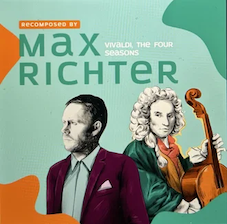
Vivaldi's beloved Four Seasons is a hugely popular and familiar work - dare one suggest possibly over-familiar? The baroque masterpiece, as recomposed by Max Richter in an avant garde and minimalist vein over ten years ago now, jolts us into a re-acquaintance with Vivaldi's music.
Mystery Ensemble's playing of the Richter re-imagining in Portsmouth's Anglican Cathedral last Friday was a delightful experience. Led by the excellent Reggie Clews as first violin and soloist, the other string players and pianist played with energy, sensitivity and verve with some truly moving moments.
The conductorless ensemble, quite possibly under-rehearsed, occasionally erred in time-keeping and there were a few off notes but, led by Clews, they honoured the exacting spirit of the music which transformed Vivaldi's vigorous rococo and baroque ideas into new thrills and sequenced delights. On several occasions, the strings had their bows poised suspended in the air as a sequence came to an abrupt end, leaving a haunting quality of restless potential and something ever more about to be.
A few gripes however. I understand that Mystery Ensemble (promoted and produced by Red Events) are a fully commercial outfit and will seek to keep costs down. Nevertheless, with no programme on hand, a small printed list of players with at least the playlist would have been highly welcome: credit where credit's due - even for a (doubtless regularly rotating) Mystery Ensemble.
And producers need to markedly improve production standards. Tickets were not cheap and only those in the front view could see the ensemble who were on the same ground level as the generally ground-level seats (there was a raised seating area pretty far back which could hardly have afforded much of a better view). Surely, the producers and cathedral between them could have come up with a playing platform.
Add to this some bizarre lighting fluctuations prior to the entrance of the musicians and a barely audible recorded instruction to turn off mobile phones (sadly not honoured by too many selfish and entitled smartphone filmers and photographers) and the production values were frankly substandard. Far better to have a stage manager or other member of the production team come out and make a polite, firm and audible request.
For all this, the moving and lovely music prevailed. And in a beautiful, atmospheric setting, between the strong pillars of the cathedral nave. Vivaldi, the prolific 'Red Priest' who taught orphaned and abandoned girls in Venice's Ospedale della Pietà to become highly accomplished players, would, one feels, have approved the venue.
The original part of Portsmouth Cathedral was a church dedicated to St Thomas Becket just ten years after his assassination in Canterbury Cathedral. The church only became a cathedral 99 years ago, a year after Portsmouth, 'the flagship of maritime England', became a city in 1926. (This is the city's centenary.) It was added to and extended over the following centuries with the final extension completed in the early 90s.
The cathedral has witnessed events of national and international scale and importance.
The remains of a medieval Doom painting are on one wall with Christ sitting in judgement over the good and bad as the last trump sounds. A representative and anonymous 'member of the ship's company' is buried on behalf of all those who perished on board Henry VIII's flagship the Mary Rose which is now on superb display in the nearby historic dockyard - itself once the greatest industrial complex in the world. A stained-glass window sees Richard the Lionheart giving the star and crescent seal of the city on his return from the Crusades.
Driftwood sculptures include Becket with a sword slicing through his mitre. There is a 'floating' candle-holder orb for Peace, and a memorial to George Villiers, the flamboyant and unpopular Duke of Buckingham, who was assassinated in the nearby Greyhound Inn by John Felton. A design in the organ pipes evokes the cheeky smile of a chimpanzee.
A visiting Bishop of Chichester was murdered in 1450 during the Wars of the Roses and the parishioners were excommunicated until they were made to perform a humiliating public penance 58 years later. According to local lore, nearby Penny Street is said to attest to this event with 'penny' deriving from 'penitentia'.
Over the road from there is Domus Dei, the House of God, where the Portuguese Princess Catherine of Braganza, future wife of Charles II, was welcomed to England. She popularized tea-drinking and included Bombay in her dowry which provided the secure deep-water base the East India Company used to build its territorial power in India.
Horatio Nelson lodged up the street and was rowed out to the Victory on his way to the Battle of Trafalgar, his dead body returning to the country in a cask of brandy. Also up the High Street is the John Pounds memorial Unitarian church. Pounds was an educator of poor children and an inspirer of the 'ragged schools' movement. Injured in the nearby dockyard, he became a cobbler and would feed, educate and clothe the children in his tiny workshop which is reconstructed next to the church.
Portsmouth is a twin cathedral city. The Catholic Church is dedicated to St John the Evangelist and there is a fine statue of the apostle bearing an anchor by the great doors. Three priests were rescued from a basement of Bishop's House when it was badly bombed in the Second World War. Just over the road from there is St Agatha's Church, built in the style of a Roman basilica. Here the Anglo-Catholic Fr Dolling took the Gospel to those living in the slums of Portsea. Sadly, the Lady Chapel was destroyed when it looked like a major road was going to be built where it stood, but mercifully the rest of the beautiful building remains. It houses beautiful sgraffito wall-paintings by Hayward Sumner. St Agatha's is now home to the Ordinariate of Our Lady of Walsingham.
There is a huge amount of history and romance in Portsmouth and why not come and visit during its centenary year as a city. Dickens was born here, Kipling languished with an overbearing evangelical aunt in Southsea, and Conan Doyle played in goal for Portsmouth AFC, a predecessor to the professional 'Pompey' Football Club, also finding the time to be a doctor and do some writing.
And for lovers of Vivaldi, his own original Four Seasons, along with Vaughan Williams's Lark Ascending, and other works, will be played by London Concertante, once more in St Thomas's Cathedral, Old Portsmouth, on Friday 13th November.
LINK
 Facebook
 Twitter
 LinkedIn
 Print
Print Email
Email














 Facebook
 Twitter
 YouTube
 LinkedIn
 Pinterest