


Gospel in Art: An argument arose among the disciples: who is the greatest
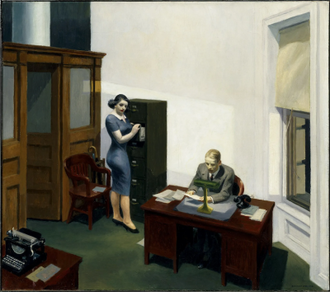
Office at Night by Edward Hopper, 1940 © Walker Art Gallery, Gift of the TB Walker Foundation, Gilbert M Walker Fund, 1948, Minneapolis
Source: Vatican Media
Gospel of 28 September 2026
Luke 9:46-50
At that time: An argument arose among the disciples as to which of them was the greatest. But Jesus, knowing the reasoning of their hearts, took a child and put him by his side and said to them, 'Whoever receives this child in my name receives me, and whoever receives me receives him who sent me. For he who is least among all of you is the one who is great.'
John answered, 'Master, we saw someone casting out demons in your name, and we tried to stop him, because he does not follow with us.' But Jesus said to him, 'Do not stop him, for the one who is not against you is for you.'
Reflection on the painting
The temptation to compare ourselves with others is particularly strong in the workplace. We notice who is doing well, who gets praised, who is promoted, whose ideas are listened to, who gets the bigger salary. Without quite intending it, we can begin to measure our own worth against the success of the person sitting beside us. Someone else's gifts can start to feel like a threat to our own. A healthy desire to do well can quietly turn into rivalry, jealousy or even resentment.
Something similar is happening among the disciples in today's Gospel. They begin arguing about which of them is the greatest. It is a surprisingly human moment. Even those closest to working with Jesus were not immune from ambition and competition. Yet Jesus refuses to enter into their little 'league table battle' if I can call it that. Instead, he places a child beside him, someone who in that society had very little status or influence, and tells the disciples to welcome such a person in his name.
Jesus turns their idea of success upside down. Greatness is not about getting ahead of everyone else, but about noticing those who might otherwise be overlooked. Whatever our profession, perhaps the better question is not, 'How am I doing compared with everyone else?' but, 'How am I treating the people around me?' The colleague who succeeds is not our rival, and the person with the least status in the workplace is no less worthy of our attention. Jesus invites us to step away from the constant measuring and comparing, and instead to recognise the same dignity in everyone we encounter and work with.
Edward Hopper's Office at Night, painted in 1940, gives us a wonderfully appropriate image. We peer into a brightly lit office after dark, where two people are still at work: a man absorbed at his desk and a woman standing beside an open filing cabinet. Hopper found the idea for this painting during journeys on New York's elevated railway, catching fleeting glimpses through the windows of offices as his train passed by. He later explained that he wanted above all to capture the feeling of an isolated, lonely office high above the city.
What strikes me is that these two people share the same small room, yet probably inhabit completely different worlds. There is an office hierarchy at work: the man occupies the main desk, while the woman appears to be his secretary or assistant. Whilst there are most likely office hierarchies at work, yet Hopper does not tell us who matters more. He deliberately resisted giving the painting a clear story. Both people are equally important in our painting. take one of them away, and the painting would be less strong. Perhaps that makes it particularly fitting for today's Gospel. We spend so much of our working lives conscious of position: who has the larger office, the greater responsibility, the better title, the greater recognition. Hopper strips all of that away. Seen from outside, through a window in the darkness, they are simply two human beings sharing a room and a working day. Both equally important.
LINKS
Christian Art: www.christian.art
Today's image: https://christian.art/daily-gospel-reading/luke-9-46-50-2026/
 Facebook
 Twitter
 LinkedIn
 Print
Print Email
Email












 Facebook
 Twitter
 YouTube
 LinkedIn
 Pinterest