


Gospel in Art: A man had two sons
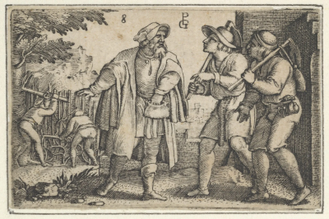
The Parable of the Father and His Two Sons in the Vineyard, Engraving by Georg Pencz, 1534-35 © Metropolitan Museum of Art, New York
Source: Christian Art
Gospel of 27 September 2026
Matthew 21:28-32
At that time: Jesus said to the chief priests and the elders of the people, 'What do you think? A man had two sons. And he went to the first and said, "Son, go and work in the vineyard today." And he answered, "I will not", but afterwards he changed his mind and went. And he went to the other son and said the same. And he answered, "I go, sir", but did not go. Which of the two did the will of his father?' They said, 'The first.' Jesus said to them, 'Truly, I say to you, the tax collectors and the prostitutes go into the kingdom of God before you. For John came to you in the way of righteousness, and you did not believe him, but the tax collectors and the prostitutes believed him. And even when you saw it, you did not afterwards change your minds and believe him.'
Reflection on the engraving
There is a great deal of humility in being willing to change our mind. We sometimes imagine that strength means sticking to what we have said, whatever happens. We do not want to appear inconsistent or admit that our first reaction may have been wrong. Yet there are moments when changing our mind is not a sign of weakness at all, but of wisdom.
So there is something of each of the two sons in us in today's reading. At times we are like the second son: quick to say 'yes', perhaps with the best of intentions, but slow to turn that promise into action. At other times we are like the first: our instinctive response is 'no', but something happens within us and we reconsider. Jesus seems to suggest that what matters is not simply the first word that leaves our lips, but where we eventually allow our heart to go. Words come quick, but our heart can be a bit slower. God leaves room for second thoughts, for changed minds and new beginnings.
We can also find ourselves on the receiving end of someone else changing their mind. Perhaps they once refused us, disagreed with us, or took a position that disappointed us, and then later thought differently. When that happens, we should resist the temptation to remind them too quickly of what they once said. If we hope that others will give us room to change, we must offer them the same courtesy.
Today's engraving by the German Renaissance artist Georg Pencz takes us directly into Jesus' parable. Made in 1534-35 as part of his series The Story of Christ, it is remarkably small, measuring less than six centimetres across. Yet Pencz manages to tell the whole story within this tiny space. We see the father addressing his two sons, while behind them the vineyard stretches into the distance: the place where words must eventually become deeds. That vineyard is important. Jesus is not particularly interested in which son gave the better first answer; he is interested in who eventually went to work. Pencz visually expresses that there is always space between our first response (on the right of the engraving) and what we finally choose to do (on the left).
LINKS
Christian Art: www.christian.art
Today's image: https://christian.art/daily-gospel-reading/matthew-21-28-32-2026/
 Facebook
 Twitter
 LinkedIn
 Print
Print Email
Email











 Facebook
 Twitter
 YouTube
 LinkedIn
 Pinterest