


Gospel in Art: Peter answered: 'you are the Christ of God.'
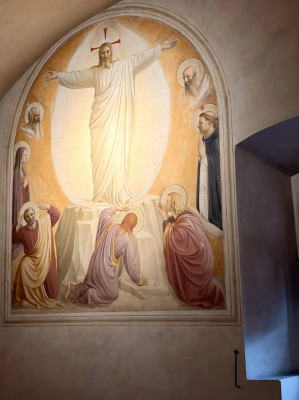
The Transfiguration (Cell 6), San Marco, Florence fresco by Fra Angelico © Christian Art
Source: Christian Art
Gospel of 25 September 2026
Luke 9:18-22
It happened that as Jesus was praying alone, the disciples were with him. And he asked them, 'Who do the crowds say that I am?' And they answered, 'John the Baptist. But others say, Elijah, and others, that one of the prophets of old has risen.' Then he said to them, 'But who do you say that I am?' And Peter answered, 'The Christ of God.' And he strictly charged and commanded them to tell this to no one, saying, 'The Son of Man must suffer many things and be rejected by the elders and chief priests and scribes, and be killed, and on the third day be raised.'
Reflection on the fresco
'How well do people really know me?' That is, in a sense, the question Jesus puts to his disciples in today's Gospel. It is a question any of us could ask. Most people know only something of us: what they have seen, what they have heard, the impression we have made. In fact sometimes we live our lives to only show one side of us in order to make a good impression. So most people probably don't know us all that well.
It was the same with Jesus. Those who encountered him recognised that there was something extraordinary about him, but they could not quite grasp who he was. Some thought he was Elijah, others John the Baptist, or one of the prophets. They were not entirely wrong, but they had only glimpsed part of the truth.
So Jesus turns to those who have travelled with him, and shared his daily life: his disciples. They should know who he is by now!? 'But who do you say that I am?' Jesus asks. Peter answers, 'The Christ of God.' He has lived sooooo close to Jesus and yet even Peter has much still to discover. Jesus immediately reveals something they could never have expected: the Messiah will suffer, be rejected and put to death. Peter knows the title of 'Christ', but he does not yet understand everything that the title contains. Perhaps that is true of every person we love: there are depths within them that even years of friendship cannot completely uncover. How much more, then, is this true of Christ. We can spend a lifetime coming to know him and still discover that there is always more. Therein lies something beautiful at the heart of our faith: we can spend a lifetime coming to know Jesus, and still find there is always more of him to discover.
Fra Angelico's Transfiguration beautifully takes us a little further into the question at the heart of today's Gospel: 'Who do you say that I am?' Peter has already answered, 'The Christ of God', but it is at the Transfiguration, just a few verses later in Luke's Gospel, that the penny really begins to drop. On the mountain, the Jesus whom Peter, James and John thought they knew suddenly appears before them in dazzling glory. For a brief moment, the veil is lifted. They are allowed to glimpse that there is infinitely more to this man they have been walking beside than they had ever imagined.
Fra Angelico painted this Transfiguration between 1440-42 directly onto the wall of Cell 6 in the Dominican convent of San Marco in Florence. It formed part of an extraordinary programme of more than forty frescoes created by Fra Angelico throughout the newly rebuilt convent. The friars' cells upstairs were deliberately austere: small rooms, whitewashed walls, a window, and very little else. Yet each cell was given a fresco of its own, usually a scene from the life or Passion of Christ. These were not decorations in the modern sense. They were companions! Companions to prayer. A Dominican friar would wake, study, pray and sleep with this single sacred image continually before his eyes.
There is something profoundly beautiful about Cell 6 in particular. Fra Angelico strips the Transfiguration of almost everything unnecessary. There is hardly a landscape; Christ simply rises before us in brilliant white, surrounded by a great radiance, while Peter, James and John crouch below, overwhelmed by what they see. Moses and Elijah appear almost mysteriously as disembodied heads, while the Virgin Mary and Saint Dominic stand at the edges in prayer. Christ's arms are stretched wide, already hinting at the Cross that awaits him. Imagine the friar who lived here returning to this image day after day, perhaps for years. He was never expected to 'finish' looking at it, as though its mystery could ever be exhausted. For just as the fresco would continue to reveal itself through a lifetime of contemplation, so too does Christ: however long we look, however deeply we pray, there is always more of him to discover.
LINKS
Christian Art: www.christian.art
Today's image: https://christian.art/daily-gospel-reading/luke-9-18-22-2026/
 Facebook
 Twitter
 LinkedIn
 Print
Print Email
Email











 Facebook
 Twitter
 YouTube
 LinkedIn
 Pinterest