

Sunday Reflection with Canon Robin Gibbons: 27th September 2026
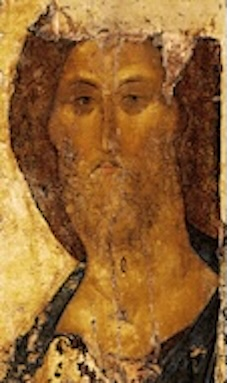
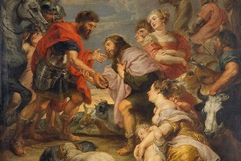
Rublev's Saviour
Twenty-sixth Sunday in Ordinary Time
Lectionary: 136
I felt a sense of deep joy when I watched the live broadcast of Vespers in Notre Dame Cathedral in Paris on Friday evening, presided over by Pope Leo XIV. There is the same presence of a human being who has lived life with us, similar to that of Pope Francis. The self same understanding a a very French Catholic spirituality of Christ's mother, the one we love and know as Notre Dame, Our Good Lady, whose Magnificat was sung to that wonderful 'magnificat du ton royale' attributed to King Louis XIII who consecrated France to the Blessed Virgin Mary. And perhaps more poignant in a cultural sense as the Magnificat Paul Claudel heard at the moment of his conversion in the Cathedral before the statue of Notre Dame on Christmas Day 1886, nearly 140 years ago.
Those words of Mary's song from St Luke's Gospel mean so much to so many of us. They are an evocation of joy in the Lord, an understanding that Christ's good will triumph victorious over all that strives to defeat us, and of a hope formed deep within our hearts, souls, and minds of the ultimate exaltation of the lost and the least as Christ in the little ones of life.
This is echoed by our second reading this Sunday from Philippians 2, that powerful hymn of Christ's kenosis, his emptying out of divinity to become as one with us in our humanity. The hymn identifies us with the Magnificat in that it points us into the way and journey of the humble Christ, and this is something that the gospels call us to embrace:
'Have in you the same attitude
that is also in Christ Jesus,
Who, though he was in the form of God,
did not regard equality with God
something to be grasped.
Rather, he emptied himself,
taking the form of a slave,
coming in human likeness;
and found human in appearance,
he humbled himself,
becoming obedient to the point of death,
even death on a cross". (Philippians 2:5-8)
We mustn't be discouraged by this calling to true honest humility, for as the Gospel points out, even if we oft times drag our heels, maybe even refuse to live out our faith at times, we are in good company. God's choice of good companions are fortunately often different to what we might expect, and these include the lost, least, tax collectors, sinners and prostitutes. This gives me hope in my own struggle and fills me with a warmer heart that knows forgiveness. Yes, these friends of God remind us that the gentle unfairness of the Lord is about God as a loving friend who says to us all:'But if the wicked turn from the wickedness they did and do what is right and just, they save their lives.'( Ezekiel 18:27)
Going back to the Pope's words at Vespers, I find they resonated with me because as one whose childhood was formed in the years just before the Council, and whose training for ordination was in that time of first openness to the Conciliar teachings, I have always believed and held to the truth that Vatican II was a Council of the Holy Spirit. And I, like so many, are tired of those whose constant mantra is to denigrate that Council and demand the Church turn back the clock, as if it could. That was certainly not what I heard from Pope Leo. Instead his affirmation that we go back again into the conciliar documents is an encouragement to those like myself who have tried to live by their insights and rejoiced that the holy scriptures as well as sacraments, good theology and living tradition form the basis of our faith. This exhortation of the Pope is only the call of Jesus to constant metanoia, the daily renewal of the Gospel in our lives!
Our vocation is as Pope Leo said, is to be welcoming to all: 'The strength of a living Church lies in welcoming those on the peripheries who already have a place in her heart; welcoming those who are far away but in reality are already near; welcoming the stranger, in whom Christ is already knocking at the door'. (Leo XIV Sermon Notre Dame Vespers Sept 25 2026)
Lectio
Leo XIV homily at Vespers, Notre Dame Paris, Sept 25 2026
Be conscious heirs of the Church Fathers and saints who, over the centuries, have handed down to us the profound meaning and beauty of the liturgy, always giving an example of great humility before the Mystery that is celebrated. The Second Vatican Council, whose richness owes much to France, gathered up and deepened this heritage in an eminent way, recognising the liturgy's central role in the life of the Church (cf. Sacrosanctum Concilium, 10)
… the liturgy remains a reflection of life. Eucharistic joy takes root and spreads wherever harmony is restored, wherever dignity is renewed, wherever authority becomes service, and wherever freedom is able to flourish again. This is the greatest gift we can share. Therefore, place communion with the successor of Peter and with the Church before your personal preferences, so as to foster the unity of God's people. Thus, together, we will bear prophetic witness to the possibility of a reconciled world.
Paul Claudels Conversion
Christmas Day 1886
The Virgin at Noon
By Paul Claudel
'It is noon. I see the church is open. I must go in.
Mother of our Lord, I have not come to pray.
I have nothing to offer and nothing to ask.
I am here only, my Lady, to look at you.
To look at you, to weep for happiness, to know this
That I am your son and that you are there.
Nothing other than for one moment during which everything stops. Noon!
To be with you, Mary, in this place where you are.
To say nothing, to look at your face.
To let my heart sing in its own language.
To say nothing, but simply to sing because my heart is too full.
Because you are beautiful, because you are immaculate,
The woman in the Grace
The creature in its first honour and in its final blossoming,
As it came out of God in the morning of its original splendor.
Ineffably intact because you are the Mother of Jesus Christ,
Who is the truth in your arms, and the only hope and the only fruit.
Because you are the woman, the Eden of the old forgotten tenderness,
Whose gazes finds the heart suddenly and brings forth the accumulated tears.
Because you have saved me, because you have saved France.
Because she also, like me, for you was that thing you thought about.
Because at that moment when everything cracked, that's when you stepped in you.
Because you saved France once again.
Because it is noon, because we are here in this day today.
Because you are there for always, simply because you are Mary, simply because you exist,
Mother of Jesus Christ, be thanked!
 Facebook
 Twitter
 LinkedIn
 Print
Print Email
Email







 Facebook
 Twitter
 YouTube
 LinkedIn
 Pinterest