


Children's Commissioner warns of "shocking failure" to protect refugee children
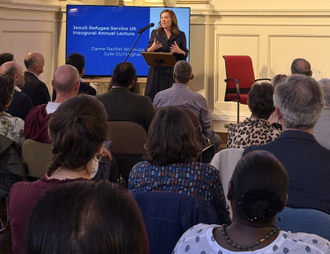
Source: Jesuit Refugee Services
The Children's Commissioner for England, Dame Rachel de Souza, has issued a powerful call for the protection of refugee and asylum-seeking children, warning that children wrongly treated as adults and placed in detention or adult accommodation represent a "shocking failure" of the asylum system.
Delivering the Inaugural Jesuit Refugee Service UK Annual Lecture today, Dame Rachel challenged both policymakers and the wider public to resist the increasingly polarised rhetoric surrounding migration and to recognise the human reality at the heart of the debate.
Drawing parallels between anti-migrant unrest in London more than 500 years ago and hostility towards migrants today, she warned that many of the arguments used against newcomers have changed remarkably little.
Dame Rachel said: "It is easy, from a distance, to talk about asylum seekers as strangers. It is much harder, and much more important, to remember that we are talking about children."
Drawing on her statutory powers as Children's Commissioner, Dame Rachel described what she has witnessed in migrant processing facilities and asylum accommodation, including children who have experienced violence, exploitation and trafficking on their journeys to the UK.
She was particularly critical of the treatment of young people whose ages are disputed by the authorities.
Citing the latest six months of data available to her, she said that 1,897 people had been assessed as adults, with 442 of those decisions subsequently overturned and hundreds more still pending, meaning that at least 23 per cent of the decisions had been found to be wrong.
The consequences of such mistakes could be severe, she warned, with children wrongly placed in immigration detention or adult accommodation, potentially sharing rooms with adult strangers.
"Either childhood means something or it does not. Either we owe special consideration to children or we do not. Either we should protect children, or we should not."
She added: "I do not believe there is such a thing as 'basically an adult', or 'nearly an adult' or 'old enough where it's less of an issue'. A child is a child."
Dame Rachel also called for greater scrutiny of government policy affecting refugee and migrant children, warning that meaningful policymaking was impossible without reliable information about the number of children who would be affected.
She argued that honesty must underpin both policy and public debate on migration. Supporting refugees, she said, does not require ignoring difficult questions about integration and social cohesion. Instead, society must resist misleading arguments and extreme rhetoric on all sides.
"We cannot live by lies. We have a duty to what is good, and what is true."
She continued: "Supporting refugees means acknowledging the problems but also the benefits. It means acknowledging the need for integration, for social harmony, and then making the case for the material base needed for this to happen."
Her appeal was also profoundly personal. Dame Rachel revealed that her own mother had been a refugee child, taken in by nuns in Bavaria in 1945 before later moving to England to reunite with family.
"They understood the need to protect her. They saw a little girl and they loved her."
Reflecting on what the treatment of refugee children says about Britain as a society, Dame Rachel warned:
"I believe firmly that the nation that fails to value childhood fails to value anything at all. It fails to value itself. It fails to value its own future."
She concluded the inaugural JRS UK Annual Lecture by returning to the historic idea of "The Stranger's Case", the celebrated appeal attributed to William Shakespeare and spoken through the character of St Thomas More, which asks audiences to consider how they themselves would wish to be treated if forced from their homeland and dependent upon the welcome of strangers.
Addressing those working alongside refugees, and particularly those supporting refugee children, Dame Rachel concluded:
"Let us always live in truth. Truth about the children we help. Truth about what they need. Truth about who they are. And truth about the moral requirement to support them."
"Let us never forget the stranger's case."
Read the full text of the speech given by Children's Commissioner for England Dame Rachel de Souza for the Jesuit Refugee Service UK inaugural annual lecture:
We live at a time in European history where it feels like our public discussion on refugees simply becomes more
depressing with every year.
So, I want to begin by recanting a period of England's history.
You may just see some parallels.
This story takes place in London, 509 years ago, in 1517.
England has absorbed more migrants than usual.
Some people have taken up against this, and so on roughly April 17th, 1517, a wealthy broker named John Lincoln meets with a populist street preacher - a 'Dr Bell' - near St Paul's Cross, then a popular place for street preaching and entertainment.
Lincoln dislikes migrants.
Bell preaches what sells.
And so Lincoln places into Bell's hands a bag of coin and tells him that he must preach today about the need to expel these migrants, these strangers in our lands.
Bell is only too happy to do so.
That day's preaching is different.
There is the gospel, we assume, but huge portions of Bell's oratory are devoted to firebrand denunciations of migrants.
Immigrants are "stealing jobs from English workers" and "eat[ing] the bread from poor fatherless children".
Those are quotes, by the way, from five hundred years ago.
Bell ups the ante; after all, what is to be done about this?
He ends with a call - and again, I quote: "A call to all Englishmen to cherish and defend themselves, and to hurt and grieve aliens for the common weal".
For two weeks hence, there are sporadic attacks on migrants throughout London.
Over the following two weeks, rumours abound in taverns, which I suppose are the social media of the day, that "on
May Day next the city would rebel and slay all aliens".
It's now 30th April, and John Mundy, a local alderman, is travelling through Cheapside on his way home.
A gang of young men are gathered after curfew, yelling about migrants.
He orders them to return home, and when they refuse, he tries to arrest one. The men set upon the alderman, who
is forced to flee.
The city is now whipped up.
This culminates on a warm May Day, where revellers find themselves swept up into an anti-migrant riot.
Within a few hours, approximately a thousand young male apprentices have congregated in Cheapside.
The mob grabs several prisoners who were locked up for attacking foreigners and proceeds to the areas where foreigners lived.
The migrants barricade themselves into their homes, sitting terrified, hoping it will pass.
Now I want to pause here.
We will return to this story later.
But I want to reflect on the fact that it has been five hundred years since that happened.
And yet could that not have been taken from a newspaper last week?
How far would we have to travel to hear the opinion that migrants were coming here in droves to take all of our money, to 'eat the bread of poor fatherless children'?
Is it unreasonable to say that scene of violence could have been in Epping, or Garston, or any number of locations across England?
So little has changed.
As Children's Commissioner, I have a statutory duty to protect and promote the rights of children in England.
No matter how they get here.
No matter what their asylum status is.
That has guided everything I have done in five years in this role, and it guides what I want to say to you now.
To execute this grave responsibility - which it has been the honour of my life to do - I have three powers under statute.
I can enter any premises where a child is educated or cared for.
I can demand any data held by a public body on children.
And when I write to public bodies, they must offer me a full response.
Those first two in particular have been invaluable to me in talking about refugee children, because I can demand the data the state would rather not divulge, and I can enter the premises the state would rather others not see.
And I have seen things.
In spreadsheets of data, in documents of case reports, and with my own eyes in migrant processing facilities, I have seen things in this role that will stay with me forever.
Just this month, I have seen proposals brought forward by the Home Office in the Immigration and Asylum Bill which seek to weaken children's access to their Article 8 rights to family life.
Under these proposals, children could be returned to a country in which they have never set foot, don't speak the language, far from the friends and school they know here. All under the guise of 'keeping migrants out'.
I have seen children with diphtheria taken not to hospital but to a shipping container, in which they were placed by guards.
Guards who smiled at me as they did so, very proud of the accommodation they had been able to find.
I have sat with children in hotels used to house asylum seekers, both those travelling with their families and those travelling alone.
I have met a young boy weeping for his mother, because he believes militants have killed her.
I have met a girl who was separated from her parents on the journey here, travelling instead with an older man she called her boyfriend.
Of course, he was not her boyfriend.
He was a man who had very likely trafficked her.
I asked the Home Office, under a certain Home Secretary, for information, and they attempted to deny me access - do you know, that is the only time my powers under law have been challenged - by a Home Secretary that did not wish for anyone to see that information.
This challenge failed.
I got the data.
That information showed children raped and beaten on their journey out of war zones.
Children who had their organs harvested.
I have fought, and will keep fighting, for action to stop children being placed in unsafe hotels, where some have then gone missing altogether.
I tell you this not to shock you, though I understand it will.
I tell you this because it is easy, from a distance, to talk about asylum seekers as strangers.
It is much harder, and much more important, to remember that we are talking about children.
And - forgive me - but this is personal for me.
I know what it means to protect children.
Not just because I am Children's Commissioner.
But because in 1945, a tiny refugee girl was taken in by nuns in Bavaria.
They became her parents.
They understood the need to protect her.
They saw a little girl and they loved her.
Some years later, that refugee girl would grow up, leave that convent in Bavaria, and move to England to reunite with family.
To Scunthorpe.
That refugee girl is my mother.
That, I think, brings me to the point I want to make during my time with you this evening.
The stories of migration live with us.
And the politics of migration are not going away.
The need to receive vulnerable children, and care for them, is not going away either.
So how should we proceed?
3It will not be easy.
But I know one thing.
We cannot live by lies.
We have a duty to what is good, and what is true.
We must have room for doubt.
We must live in life's full complexity.
There is an ability that I think many Catholics have; the ability to hold two things in our minds at once, to wrestle with their agreement and their divergence, to know one thing and yet to know the world is not always just so.
This is so needed in the modern world.
I was in Rome recently, speaking to those working for the Jesuit Refugee Service.
And I heard about what we must do.
We must speak openly and with clarity about the problems we see in front of us.
We see it now.
But we must not live by lies.
We must not give in to those who wish to peddle falsehoods, on one side or the other.
We live in an age where people seem to feel comfortable in the extremes.
This must be fought.
Supporting refugees means acknowledging the problems but also the benefits.
It means acknowledging the need for integration, for social harmony, and then making the case for the material base needed for this to happen.
I know we can do this.
We must not comfort ourselves with fairytales, reducing refugees to one-dimensional vectors of morality, and nor
should we allow those for whom the easy option is talk of disaster to take up the conversation.
No.
We must do the hard yards of living in, and with, the truth.
Much of this is about how the media, and our public discourse, speaks about refugees.
But there are issues at the level of policy too, let me assure you.
Sometimes, not even the state wishes to live in truth.
Let me give you an example.
There were three proposals put to public consultation earlier this year. Each one affects children I have a duty towards.
There was a simple problem sitting underneath all three of these proposals.
Nobody could tell me how many children will be affected.
4The proposal didn't even try.
And so I used my data powers on the Home Office, and the number I got in return seems to be something of a guess.
How can we expect to have sensible, working policy that pertains to these children if we cannot even reliably count
them?
Why do we allow ourselves to live in ignorance?
Here is another example - one I intend to fight.
I want to tell you about what the British state is currently doing to children who come here seeking asylum.
As the nature of migration changes, we need to keep children at the front of our minds and decisions, so the system works for them.
That was hotels initially.
Now through one in one out policy, the numbers of age disputed children has rocketed and the system is catching up.
One of the ways that officials attempt to root out those who they suspect of lying about their age is something called an age assessment.
This involves an interview process, often very soon after a long and traumatic journey, alongside any available evidence.
In the latest six months of data, 1,897 people were age assessed as adults.
These decisions were then overturned a total of 442 times, with hundreds more decisions pending.
So at least 23 percent of decisions are later overturned. This is an extraordinarily high rate of inadequate decision making.
The consequences are appalling.
Children, rightly, are given special protections.
All of these wrongly assessed children will have either been detained or placed in adult accommodation.
It must get better. And it must be swifter.
I recently visited Heathrow immigration removal centre to speak to some of those young people who say they have
been wrongly assessed as being adults.
I spoke to one young person - a boy - there. He was waiting for an age assessment.
He told me his story. How he had come to the UK. It was one that is both harrowing and familiar. Of travelling across
continents. Without a family, without friends, being denied food, unable to wash - even once in Europe.
But yet, he said of Heathrow detention, that it was: "The safest place I've been."
That, "if they opened the doors and said you can go, I would stay. I have nowhere to go."
That spoke not to the fact he was in the right place for him. But to what had gone before.
For anyone with a safeguarding role, or anyone who has even considered safeguarding before, know this: adult
accommodation for this population is almost always shared.
5In plain English, this means these children, who in some cases have been through hell, will have been told to sleep in the same room as adult strangers they do not know, and about whom the state knows little.
I have seen the accommodation.
It is not pleasant.
I shudder to think about those wrongly assessed children, forced to sleep alongside strange adults.
There are further knock-on effects.
We, rightly, have different asylum claim routes for children.
We run the risk of denying children access to these routes - incorrectly assessing them, throwing them in with adults, and then when we correct our mistake, declaring too much time has passed, they are now 18, and can no longer access those routes which they are legally entitled to.
These routes may close by the time they are correctly age assessed given that many of these children are 17.
This is a binary issue.
Either childhood means something or it does not.
Either we owe special consideration to children or we do not.
Either we should protect children, or we should not.
I am of the view that it does mean something.
That we do owe special care to children.
That we must protect them.
And so every single one of these children placed in adult accommodation or detention is a shocking failure.
It isn't okay because they are older children.
I do not believe there is such a thing as 'basically an adult', or 'nearly an adult' or 'old enough where it's less of an
issue' - a child is a child.
This - this fundamental reality of childhood - is the thing we must protect.
Every time we allow a 17 year old to be classified as an adult, we cheapen the category of 'child'.
Every time we allow the state to misidentify an age, we cheapen the category of 'child'.
Saint Pope John Paul II said, during a homily in Perth, that 'As the family goes, so goes the nation and so goes the whole world in which we live'
He was, of course, right, and so too is this maxim applicable to childhood.
I believe firmly that the nation that fails to value childhood fails to value anything at all.
It fails to value itself. It fails to value its own future.
As childhood goes, so goes the nation, and the whole world in which we live.
For if we cannot protect children, who can we protect?
6I know not all of us in the room are Catholic, but I want to reflect a moment on the idea that sin is not merely bad because it can hurt the other, but also because of the impact on the soul of the sinner themselves.
Forgive me one more aphorism here.
If, as the saying goes, you cannot cross a river without getting wet, are we really to believe that a nation can
mistreat, mislabel, and mislay children without losing something fundamental about itself?
What does that say about our society?
What does that say about our national character?
What does that say about our souls?
To dwell on that for a moment, I want to come back to that story I opened with.
To remind you - it is 1517, and a riot has broken out in London.
As the riots move to harass foreigners, the Under-Sheriff of London, a talented former MP and civil servant, and future Lord Chancellor, political philosopher, and martyr - St Thomas More - is sent out to quell the riots.
We don't know exactly what he said.
But a playwright put a version of his speech to the rioters down to parchment.
We don't know who for certain, but there is academic consensus on one figure: William Shakespeare.
It is on this that I would like to end.
More opens by telling the rioters that what they are doing is against the law.
Against the King's wishes.
He tells them that their morality is broken, that their view that their strength simply allows them to do as they want
means that:
"Not one of you should live an agèd man,
For other ruffians, as their fancies wrought,
With self same hand, self reasons, and self right,
Would shark on you, and men like ravenous fishes
Would feed on one another."
He ends, though, with an appeal that it is hard for us, in wealthy, comparatively safe countries to remember.
But it is one we must never forget, for it is at our lowest moments, of war, of famine, of disease, that this eternal lesson is needed.
More asks the rioters what would happen if the King turned against them.
If they were banished.
His question is simple: what if this was you?
And so he asks the crowd just that:
"Whither would you go?
What country, by the nature of your error,
Should give you harbour? Go you to France or Flanders,
To any German province, to Spain or Portugal,
Nay, anywhere that not adheres to England,
Why, you must needs be strangers: would you be pleased
To find a nation of such barbarous temper,
That, breaking out in hideous violence,
Would not afford you an abode on earth,
Whet their detested knives against your throats,
Spurn you like dogs, and like as if that God
Owed not nor made not you, nor that the elements
Were not all appropriate to your comforts,
But chartered unto them, what would you think
To be thus used?
This is the strangers' case;
And this your mountainish inhumanity."
I told you at the start of this speech that little has changed.
This is true for the negative part of our work, certainly.
But it is also true for the moral underpinning of what we do.
More's speech that I have read offers the fundamental case for concern for migrants.
It is known today as The Stranger's Case.
For all of you in the audience working with refugees - and especially for those wonderful people helping refugee children - let us always live in truth.
Truth about the children we help.
Truth about what they need.
Truth about who they are.
And truth about the moral requirement to support them.
Let us never forget the stranger's case.
May we never accept our mountainish inhumanity.
 Facebook
 Twitter
 LinkedIn
 Print
Print Email
Email












 Facebook
 Twitter
 YouTube
 LinkedIn
 Pinterest