

Francis Davis reviews new works on social ethics and political theology by Clemens Sedmak and Chris Shanahan
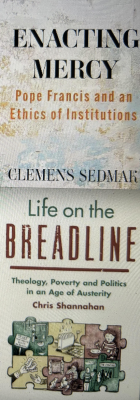
In the world of social ethics and political theology it is not often that two inspiring, thoughtful and fresh new books with wide relevance come along at the same time: Clemens Sedmak's superb new work: Enacting Mercy: Pope Francis and an Ethics of Institutions (Orbis) and Chris Shanahan's Life on the Breadline: Theology, Poverty and Politics in an Age of Austerity (SCM Press) are though two such seminal contributions recently published.
For those who do not know them, Sedmak is probably the English-speaking world's most important applied social ethicist in the Catholic tradition - even while originating from Austria and holding three doctorates from mainland European universities. He is now both a Professor at the University of Notre Dame in the USA and an advisor to the Holy See. Shanahan, a Methodist, is an 'organic intellectual in the true sense of the word being both embedded in the struggles of very poor urban communities in the UK while teaching at Manchester and Coventry universities after doctoral and post-doctoral studies in Birmingham.
Institutions are the places where so many of our ideas, habits and hopes for civic renewal are built and shaped. Those who stand alone on 'belief' can often miss this empirical reality for in some cases, as Mary Douglas once observed, 'institutions can come to think'. Consequently, from the refusal to sign an unjust restraining order in a psychiatric hospital through a trustee decision to sell a Diocesan parcel of land for a data centre to how we make sense of the constitutions and purposes of Religious Orders and nations, workplaces and firms a dynamic of more than individual choice is in ethical play and this needs attention.
Sedmak takes us on a journey to critically reflect on similar matters beginning with the 'weight' and 'vulnerability' of institutions. He considers the role of institutionalisation in Christianity not least through Rules such as St Benedict's and touches on the need to develop a 'culture of mercy' in how all institutions are led, lived in and avoid self - referential myopia. Rooted in significant inter -disciplinary reading Sedmak's additional grasp of the extent of Pope Francis's written and spoken words re-presents the late Pontiff so that Jose Bergoglio becomes not only a guide in such matters but is emerges into into a new light.
Read alongside Sedmak's Enacting Catholic Social Tradition: The Deep Practice of Human Dignity (2022) and Enacting Integral Human Development (2023) the reader gets a glimpse of the author's prolific brilliance while also being presented with a portfolio of concrete routes to consider the power and significance of institutions in moral development , social questions, and action.
It is no criticism of either Sedmak or Shanahan to say that Life on the Breadline has an added urgency because of the pastoral practice and very close observation very specifically in contexts of urban poverty from from which it flows. Shanahan has written before about his work with Citizens UK and community organising is acknowledged here too. His real target though is the individualisation, social atomisation and unedifying brute force of poverty that neo-liberal ascendancy has brought across recent decades.
Understandably there is moral indignation in the face of such inequalities and a zeal to resist its force. To understand what has gone wrong Shanahan draws on geography, sociology, practical community building and theologies of severe trauma to name that which he disapproves. Critically he then weaves in new matrices of analysis and cultural critique to plan new approaches to what the Catholic Bishops of England once called the 'symbiotic pledge to care, advocacy and empowerment'.
This is no sectarian Leftism though but a capacious, empirically informed and rigorously argued paradigm of analysis and action with significance on its own terms but also in response to places in which some preachers speak of 'beauty, truth and goodness' free of all materiality. A drug dealers' bullet or sales efforts - nor the dormant land banking to drive up house building costs and so homelessness of a major supermarket store - cannot, after all, be prayed away.
Read back-to-back with Sedmak Shanahan's local wisdom blends with Sedmak's more normative instincts to offer a double act of benefit to Caritas leaders and Prelates, community organisers and health professionals as well as those of us interested in how our society might fare in the future. My one question would be why, amidst such deep wisdom, there is little use of political science as a resource in aid. Perhaps then these are two bridging texts to a fresh 'empirical political theology' that does just that.
Either way, that two such interesting, contrasting but mutually reinforcing books should come along together is fortuitous. That they should both convey the moral seriousness of the questions at hand and their author's moral seriousness too is doubly remarkable. ICN readers would do well to put these books on their reading lists for the Autumn and Christmas lists just after that. My students will certainly be reading them this coming semester.
Clemens Sedmak (2026) Enacting Mercy: Pope Francis and an Ethics of Institutions is published by ORBIS
Chris Shanahan (2025) Life on the Breadline: Theology, Poverty and Politics in an Age of Austerity is published by SCM Press.
Francis Davis is an award-winning social entrepreneur and Professor of Social Institutions and International Studies. In 2025 the UK Muslim Community Association gave him a national award for educational empowerment of Muslims by a non - Muslim.
 Facebook
 Twitter
 LinkedIn
 Print
Print Email
Email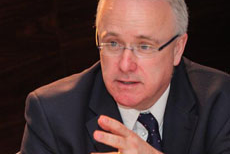







 Facebook
 Twitter
 YouTube
 LinkedIn
 Pinterest