


Gospel in Art: Saint Hildegard of Bingen, Virgin, Doctor
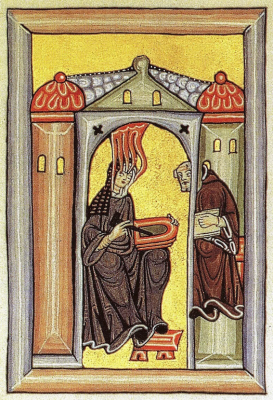
20c copy of 11c illumination showing St Hildegard receiving a vision and dictating to teacher Volmar. From Rupertsberg Codex of Liber Scivias.
Source: Christian Art
Gospel of 17 September 2026
Luke 7:36-50
At that time: One of the Pharisees asked Jesus to eat with him, and he went into the Pharisee's house and reclined at table. And behold, a woman of the city, who was a sinner, when she learned that he was reclining at table in the Pharisee's house brought an alabaster flask of ointment, and standing behind him at his feet, weeping, she began to wet his feet with her tears and wiped them with the hair of her head, and kissed his feet, and anointed them with the ointment.
Now when the Pharisee who had invited him saw this, he said to himself, 'If this man were a prophet, he would have known who and what sort of woman this is who is touching him, for she is a sinner.' And Jesus answering said to him, 'Simon, I have something to say to you.' And he answered, 'Say it, Teacher.'
'A certain moneylender had two debtors. One owed five hundred denarii, and the other fifty. When they could not pay, he cancelled the debt of both. Now which of them will love him more?' Simon answered, 'The one, I suppose, for whom he cancelled the larger debt.' And he said to him, 'You have judged rightly.' Then turning towards the woman he said to Simon, 'Do you see this woman? I entered your house; you gave me no water for my feet, but she has wet my feet with her tears and wiped them with her hair. You gave me no kiss, but from the time I came in she has not ceased to kiss my feet. You did not anoint my head with oil, but she has anointed my feet with ointment. Therefore I tell you, her sins, which are many, are forgiven - for she loved much. But he who is forgiven little, loves little.' And he said to her, 'Your sins are forgiven.' Then those who were at table with him began to say among themselves, 'Who is this, who even forgives sins?' And he said to the woman, 'Your faith has saved you; go in peace.'
Reflection on the medieval illumination
Saint Hildegard of Bingen (1098-1179), who we celebrate today, was one of the most extraordinary women of the Middle Ages. A Benedictine nun, abbess, mystic, writer and composer lived at a time when very few women had a public voice. Yet Hildegard corresponded with popes, bishops, emperors and kings, and was not afraid to challenge them when she believed they were failing in their Christian responsibilities. Nearly nine centuries later, in 2012, Pope Benedict XVI declared her a Doctor of the Church, recognising the depth and lasting importance of her theological teaching.
Hildegard was born in 1098 in the Rhineland region of Germany. From childhood she experienced unusual visions of light, although for many years she spoke of them only reluctantly. As a young girl she was entrusted to the care of a religious community, eventually becoming a Benedictine nun. Later she became abbess and founded a monastery at Rupertsberg, near Bingen. In 1141, when Hildegard was in her early forties, she experienced a particularly powerful vision in which she believed God commanded her to write down what she saw and heard. The result was her first great visionary work, Scivias-a shortened form of the Latin Sci vias Domini, meaning "Know the Ways of the Lord." Her visions were not intended as predictions of the future. They were simple about a way of contemplating Scripture and Creation.
Perhaps one of the most beautiful aspects of Hildegard's spirituality was her conviction that the whole of creation speaks of God. She saw the natural world not simply as something useful to us, but as something charged with divine meaning. Plants, animals, the human body, the stars, medicine, colour, light and sound all belonged to one creation and ultimately pointed towards its Creator. Alongside her theological writings she thus wrote about medicine and the natural world, and hundreds of her letters survive.
And then there was music. Music was central to Hildegard's spiritual life. She composed a remarkable collection of sacred songs for her community (antiphons, hymns, sequences and responsories) as well as the Ordo Virtutum, a sung sacred drama in which the Virtues struggle for the human soul. For Hildegard, music was much more than decoration added to worship. Human song was an echo of the harmony of heaven! Sin had damaged that harmony, but in singing God's praises humanity could begin to recover something of the beauty for which it had been created.
Our artwork today takes us directly into Hildegard's extraordinary interior world. It comes from the famous illuminated manuscript of her Scivias. We see Hildegard herself seated inside a small architectural space, almost like a room or monastic cell. Above her head descend tongues or streams of fire. They represent the divine light of the vision entering her mind. Yet Hildegard is not shown asleep or in a trance. Her eyes are open. She remains alert and attentive, receiving what she understands to be God's illumination while holding a writing tablet upon her knees. Beside her, in the adjoining space, sits Volmar, the monk who served as her secretary and spiritual adviser. Hildegard communicates what she has received, while Volmar helps commit it to writing. The image therefore captures a beautiful movement: God speaks; Hildegard receives; Hildegard communicates; another hand records.
There is another remarkable story behind the image itself. The lavish Rupertsberg Scivias manuscript was produced circa 1175, and contained thirty-five extraordinary miniatures illustrating her visions. Centuries later, between 1927 and 1933, Benedictine nuns at the Abbey of St Hildegard painstakingly created a facsimile of the manuscript on parchment, reproducing its writing and illuminations. Their work turned out to be providential. During the Second World War the medieval original was moved for safekeeping and subsequently disappeared; it has been considered lost since 1945. The careful copy made by those nuns therefore preserves for us the appearance of a masterpiece that might otherwise have vanished.
LINKS
Christian Art: www.christian.art
Today's image: https://christian.art/daily-gospel-reading/luke-7-36-50-2026/
 Facebook
 Twitter
 LinkedIn
 Print
Print Email
Email
















 Facebook
 Twitter
 YouTube
 LinkedIn
 Pinterest