


Gospel in Art: Saints Cornelius, Pope, and Cyprian, Bishop, Martyrs
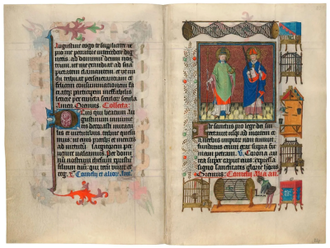
Saints Cornelius and Cyprian, from the Book of Hours of Catherine of Cleves, by the Master of Catherine of Cleves, circa 1440. Utrecht © The Morgan Library & Museum, New York
Source: Christian Art
Gospel of 16 September 2026
John 17:11b-19
At that time: Jesus lifted up his eyes to heaven, and praying said,
'Holy Father, keep them in your name, which you have given me, that they may be one, even as we are one.
While I was with them, I kept them in your name, which you have given me. I have guarded them, and not one of them has been lost except the son of destruction, that the Scripture might be fulfilled.
But now I am coming to you, and these things I speak in the world, that they may have my joy fulfilled in themselves.
I have given them your word, and the world has hated them because they are not of the world, just as I am not of the world. I do not ask that you take them out of the world, but that you keep them from the evil one. They are not of the world, just as I am not of the world.
Sanctify them in the truth; your word is truth. As you sent me into the world, so I have sent them into the world. And for their sake I consecrate myself, that they also may be consecrated in truth.'
Reflection on the Book of Hours
Saints Pope Cornelius and Bishop Cyprian are celebrated together on 16th September because of their close friendship and shared dedication to the early Christian Church during a time of intense persecution by the emperor Decius. Cornelius, born in Rome, served as Pope from 251 to 253 AD. His papacy was characterised by his compassionate stance towards Christians who had lapsed under persecution and had apostatised. Apostasy refers to the act of renouncing one's Christian faith, often under the threat of death or severe punishment, by publicly denying belief in Christ or participating in pagan rituals. Pope Cornelius was advocating that people who did this should be forgiven and welcomed back into the Church, rather than being given harsh punishments by fellow Christians.
Cyprian, the Bishop of Carthage (Roman North Africa; modern-day Tunisia), who had converted to Christianity aged 35, became a staunch supporter of Cornelius in this matter. The two maintained a strong correspondence, with Cyprian defending Cornelius against schismatic movements that sought to undermine his authority. Pope Cornelius and Bishop Cyprian remain profoundly relevant today because they championed forgiveness as a cornerstone of our Christian faith. In a world that is becoming increasingly unforgiving and, as a result, harsher and more difficult to navigate, their message is more important than ever. While calls for justice are often appropriate and necessary, we must never lose sight of the imperative to forgive, a principle that lies at the heart of our faith.
Our illustration comes from a double page of the Book of Hours of Catherine of Cleves, created around 1440 in Utrecht, the Netherlands. Here we see Saints Cornelius and Cyprian sharing the top right page illumination: Cornelius holds a horn (cornus in Latin-a visual pun on his name), while Cyprian bears the sword, the symbol of his martyrdom. The scene is framed by exquisite borders of birdcages rendered in silver and gold, perhaps a reference to Cornelius as patron saint of pets. The Hours of Catherine of Cleves is recognised as the greatest Dutch illuminated manuscript, containing 157 extraordinary miniatures by the anonymous artist known as the 'Master of Catherine of Cleves '. He is celebrated as the finest and most original illuminator of the medieval northern Netherlands, and this book is considered his masterpiece.
LINKS
Christian Art: www.christian.art
Today's image: https://christian.art/daily-gospel-reading/john-17-11b-19-2026-2/
 Facebook
 Twitter
 LinkedIn
 Print
Print Email
Email









 Facebook
 Twitter
 YouTube
 LinkedIn
 Pinterest