


Gospel in Art: Lord, how often will my brother sin against me, and I forgive him?
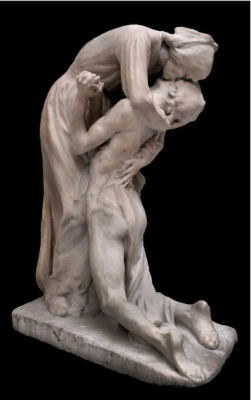
Le Pardon (Forgiveness), by Pieter Braecke, 1893-1895 © Musées Royaux des Beaux-Arts de Belgique, Brussels
Source: Christian Art
Gospel of 13 September 2026
Matthew 18:21-35
At that time: Peter came up and said to Jesus, 'Lord, how often will my brother sin against me, and I forgive him? As many as seven times?' Jesus said to him, 'I do not say to you seven times, but seventy times seven.
'Therefore the kingdom of heaven may be compared to a king who wished to settle accounts with his servants. When he began to settle, one was brought to him who owed him ten thousand talents. And since he could not pay, his master ordered him to be sold, with his wife and children and all that he had, and payment to be made.
So the servant fell on his knees, imploring him, "Have patience with me, and I will pay you everything." And out of pity for him, the master of that servant released him and forgave him the debt. But when that same servant went out, he found one of his fellow servants who owed him a hundred denarii, and seizing him, he began to choke him, saying, "Pay what you owe."
So his fellow servant fell down and pleaded with him, "Have patience with me, and I will pay you." He refused and went and put him in prison until he should pay the debt. When his fellow servants saw what had taken place they were greatly distressed, and they went and reported to their master all that had taken place.
Then his master summoned him and said to him, "You wicked servant! I forgave you all that debt because you pleaded with me. And should not you have had mercy on your fellow servant, as I had mercy on you?" And in anger his master delivered him to the jailers, until he should pay all his debt. So also my heavenly Father will do to every one of you, if you do not forgive your brother from your heart.'
Reflection on the marble sculpture
Someone once said that forgiveness seems like a very good idea until you have someone to forgive. There is a great deal of truth in that. We can listen to the words of Jesus and readily agree with them. His teaching sounds beautiful, wise and right... until life suddenly puts that teaching to the test. If someone causes an accident that changes your life, do you forgive? If a doctor makes a serious mistake during a procedure, do you simply forgive? If someone betrays you deeply, destroys your reputation, or even takes the life of someone you love, can you forgive then? Suddenly the words of Jesus are no longer comfortable ideals. They become painfully real.
That is often the challenge of the Gospel. What Jesus asks of us does not change, but our circumstances do. A teaching that seems straightforward today can become extraordinarily difficult tomorrow. And that is precisely what we encounter in today's Gospel: the call to forgive. But what does that actually mean? Are we really expected to forgive everyone and everything? Does forgiveness mean pretending that nothing happened? Does it mean there should be no justice or consequences? Does forgiving also mean forgetting? These are not easy questions.
Peter tries to make sense of the teaching of forgiveness. He asks Jesus, 'Lord, how often must I forgive my brother if he wrongs me? As often as seven times?' In the biblical world, seven symbolised fullness and completeness. Peter therefore thinks he is being remarkably generous. Seven times is surely enough. Yet Jesus replies, 'Not seven, I tell you, but seventy-seven times.' In other words, stop counting! Forgiveness cannot simply be reduced to a quota that, once exhausted, gives us permission to hold on to resentment.
That theme of forgiveness is captured with great tenderness in our sculpture today, Le Pardon (Forgiveness) carved in white marble by the Belgian sculptor Pieter Braecke between 1893 and 1895. We see a mother and her son at the moment when words seem almost unnecessary. The son has come close to her, his body suggesting remorse and vulnerability, while the mother bends towards him and receives him back. We do not know what he has done. Braecke deliberately leaves the story untold, allowing us to imagine the hurt that has passed between them. What matters is the gesture we see now: reconciliation. The marble may be cold and hard, but the scene itself is wonderfully warm and tender. Perhaps that is something of what forgiveness does.... turn coldness to warmth...
LINKS
Christian Art: www.christian.art
Today's image: https://christian.art/daily-gospel-reading/matthew-18-21-35-2026-2/
 Facebook
 Twitter
 LinkedIn
 Print
Print Email
Email














 Facebook
 Twitter
 YouTube
 LinkedIn
 Pinterest