


Gospel in Art: Feast of the Exaltation of the Holy Cross
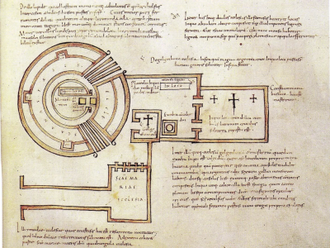
Church of the Holy Sepulchre oldest known plan from Adomanàn's De locis santis, 7th century. Copy in Zurich manuscript © Vienna, Österreichische Nationalbibliothek
Source: Christian Art
Gospel of 14 September 2026
John 3:13-17
At that time: Jesus said to Nicodemus,
'No one has ascended into heaven except he who descended from heaven, the Son of Man.
And as Moses lifted up the serpent in the wilderness, so must the Son of Man be lifted up, that whoever believes in him may have eternal life.
For God so loved the world, that he gave his only begotten Son, that whoever believes in him should not perish but have eternal life.
For God did not send his Son into the world to condemn the world, but in order that the world might be saved through him.'
Reflection on the Ancient Manuscript
Today we celebrate the Exaltation of the Holy Cross, when the Church places before us the great paradox at the heart of Christianity: an instrument of death became the instrument of our salvation. Crucifixion was designed by the Romans to humiliate, torture and publicly destroy a human being. Yet because Christ embraced the Cross, it has become for Christians the enduring symbol of our faith.
Today's feast is also traditionally associated with the discovery of the True Cross by Saint Helena, mother of the Emperor Constantine. In 326 AD, Helena travelled to Jerusalem and ordered excavations around the site believed to be Calvary and Christ's tomb. Tradition tells us that three crosses were discovered there. Various stories later developed about how the Cross of Christ was identified. One held that the titulus, the inscription naming Jesus of Nazareth as King of the Jews, remained associated with it. Another tells how the three crosses were brought into contact with a dead or gravely ill person, who was miraculously restored to life when touched by the True Cross. We know that by the middle of the fourth century relics of the true Cross believed started to get venerated.
Under Constantine, a magnificent complex of buildings was constructed over the places associated with Christ's death and resurrection: the Church of the Holy Sepulchre. Calvary and the tomb of Christ were brought together within this great Christian sanctuary, which was dedicated in September 335AD. The annual celebrations surrounding that dedication became closely connected with the veneration of the Cross, giving rise to the feast we celebrate today on 14 September. Over the centuries the church suffered enormously: it was damaged during the Persian invasion of Jerusalem in 614 and much of it was destroyed under the Fatimid caliph al-Hakim in 1009. It was rebuilt and altered many times, but the sacred geography remained the same: the place of the Cross and the place of the Resurrection standing extraordinarily close to one another.
Our artwork today takes us back into that history. At first glance, it may seem rather modest: not a painting of the Crucifixion, nor a glittering reliquary containing a fragment of the Cross, but a simple floor plan. Yet it is an extraordinary document. It comes from a ninth-century manuscript copy of De Locis Sanctis (On the Holy Places), written by Saint Adomnán, abbot of the monastery of Iona from 679 until 704. Adomnán himself never travelled to Jerusalem. Instead, his account drew especially upon the testimony of Arculf, a Frankish pilgrim who had travelled through the Holy Land around the year 670 and later described in detail what he had seen. From Arculf's memories, supplemented by other sources, Adomnán created a three-book description of Jerusalem, Bethlehem and other sacred places.
The little drawing we are looking at today is particularly precious because it preserves what is regarded as the oldest surviving floor plan of the Church of the Holy Sepulchre. The version before us survives in a ninth-century manuscript. Its circles, lines and carefully arranged spaces may look almost childlike to modern eyes accustomed to precise architectural plans. Yet this was not intended to be a modern architect's blueprint. It is something closer to a map of memory and faith: an attempt to communicate to Christians living thousands of miles away the physical shape of the place where the central events of their Christian faith had happened.
And perhaps that makes this simple drawing particularly appropriate for today's feast. Christianity is rooted not only in ideas, but in places, bodies and actual events. Jesus carried a real, true Cross through the streets of a real city. He was crucified on a particular piece of ground and laid in a particular tomb nearby. Adomnán's little plan tries to locate those places on parchment: here was Calvary; here was the tomb; here generations of pilgrims came to kneel and pray. Nearly thirteen centuries after this manuscript was copied, pilgrims still enter the Church of the Holy Sepulchre and move between those same two places. The distance between Calvary and the tomb is remarkably small. And therein lies perhaps the most beautiful message of today's feast: the Cross and the Resurrection are never very far apart.
LINKS
Christian Art: www.christian.art
Today's image: https://christian.art/daily-gospel-reading/john-3-13-17-2026/
 Facebook
 Twitter
 LinkedIn
 Print
Print Email
Email









 Facebook
 Twitter
 YouTube
 LinkedIn
 Pinterest